



Uncertainties remain despite $200 billion agreement on investment in the U.S.
Oct 02, 2026, 09:46 am


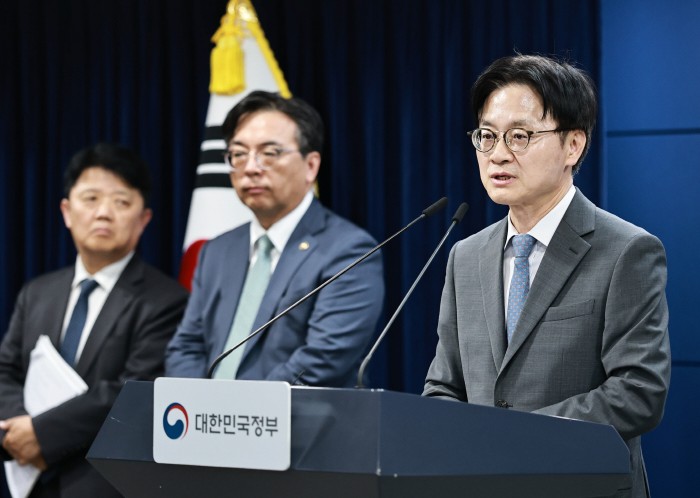 |
| Minister of Trade, Industry and Resources Kim Jung-kwan explains project details during a press background briefing on U.S. investment at the Government Complex Seoul on the 22nd of last month. / Yonhap |
While South Korea and the U.S. agreed on specific details of investment projects in the U.S. through a "Joint Fact Sheet" on the 1st, a mountain of challenges remains for the South Korean government to turn this into tangible outcomes. Beyond controversies surrounding the Alaska LNG project, numerous working-level and political hurdles lie ahead, including establishing a stable recovery mechanism for principal and interest, securing long-term power purchase agreements (PPAs) for the flagship Texas gas-fired power plant, and acquiring an equity stake in Westinghouse in the nuclear power sector.
From the South Korean government's perspective, the foremost challenge is ensuring the stable recoupment of principal and interest on the 200 billion dollar investment in the U.S. Kim Jung-kwan, Minister of Trade, Industry and Resources, also noted, "Our primary focus was how to secure the return of principal and interest."
The government incorporated a "risk-pooling" mechanism grounded in an umbrella investment structure within the fact sheet. Under this setup, revenue sharing between South Korea and the U.S. remains split 50-50 until the principal and interest of the total investment are recouped, allowing returns from other ventures to backstop recoveries even if profitability drops in a specific project.
However, because long-term investment risks—such as exchange rates, project delays, and U.S. policy shifts—cannot be entirely eliminated, securing safety valves such as payment guarantees and cross-border repatriation mechanisms for actual returns remains vital.
In particular, securing profitability for the flagship project, the Encinal combined-cycle gas turbine plant in Texas, stands as the immediate litmus test. While designed at a total capacity of 6.3 GW to meet electricity demand from artificial intelligence (AI) data centers, the execution of long-term power purchase agreements (PPAs)—the core linchpin guaranteeing stable cash flow—remains undecided.
Minister Kim stated, "From our perspective, securing higher electricity prices delivers stronger profitability, which requires negotiation. Rather than rushing, we will negotiate with off-takers that present the most favorable terms among multiple potential buyers." The government projects that it can recover principal and interest through more than 43 billion dollars in revenue over the next 20 years.
Hur Yoon, professor at the Sogang University Graduate School of International Studies, suggested, "Rather than solely weighing return rates 20 years down the line, we also need approaches that link U.S. investments to other pressing agenda items currently under negotiation with the U.S. to lock in immediate tangible gains."
Furthermore, "Project Power" (nuclear energy), which currently exists only as an outline, faces the challenge of nailing down concrete commercial terms. The initiative envisions investing a total of 120 billion dollars into eight large commercial nuclear reactors in the U.S., with site selection and the acquisition of an equity stake in Westinghouse Electric Company (WEC) still pending. Howard Lutnick, U.S. Secretary of Commerce, mentioned Tennessee, South Carolina, and Ohio as candidate locations.
Minister Kim remarked, "The underlying bedrock must be exceptionally solid, and access to water is essential. We will thoroughly evaluate how such factors influence commercial feasibility to identify the best sites."
In particular, the government is negotiating to secure a 5% to 10% equity stake in WEC to facilitate the deployment of the South Korean APR1400 reactor model in the U.S. and drive joint expansion into global nuclear markets. In addition to equity ownership ratios, the parties must align on voting rights, intellectual property (IP), and terms for amending existing Settlement Agreements (SA). As plans move forward to make an advance payment of 10 billion dollars by year-end, coordinating commercial rationality reviews with domestic legal procedures also remains a pressing task.
Kim Jeong-kyu
Kim So-young
Most Read
-
1
Alteogen secures European patent for Keytruda SC,..

-
2
Trump shares map on social media labeling Strait o..

-
3
Celltrion seeks rheumatoid arthritis indication ex..

-
4
Kia Sportage outperforms Mazda CX-5 in German auto..

-
5
Chinese e-commerce giants AliExpress, Temu and She..

-
6
China expels No. 2 military official Zhang Youxia..

-
7
Trump rejects Iran's offer to open Strait of Hormu..

PEOPLE







-
Address : In-Young Bldg., 34, Uisadang-daero 1-gil, Yeongdeungpo-gu, Seoul
Copyright by ASIATODAY CO., LTD. All rights resereved