



[Exclusive] Police do not separately track misconduct by former internal affairs officers
Oct 01, 2026, 10:26 am


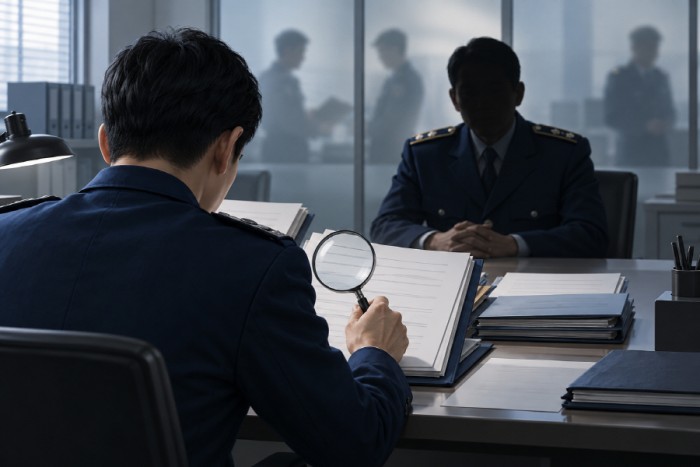 |
| This image was generated by AI. |
Senior officers with backgrounds in internal affairs—the division responsible for investigating officer misconduct—were reported for workplace bullying against subordinates, but the outcomes varied widely from dismissal without action to administrative warnings. The police do not maintain statistics to compare whether such cases were handled under the same standards as those involving regular personnel. Nor were there established criteria to transfer cases to other departments based on a subject's prior service in internal affairs.
According to data obtained from the National Police Agency on the 1st by the office of Representative Park Sang-woong of the National Assembly's Public Administration and Security Committee, three cases involving senior officers with internal affairs backgrounds reported as perpetrators of workplace bullying were handled over the five-year period from 2022 to this year. In all three cases, complaints were withdrawn or victims expressed that they did not seek punishment, yet whether an internal probe was launched and the resulting dispositions differed in each instance.
In 2025, Senior Superintendent A was reported for loudly reprimanding staff over work. The police closed the case without initiating an internal probe, citing reconciliation between the parties and the withdrawal of the complaint. In 2024, Senior Superintendent B was investigated by internal affairs following a report that an employee attempted suicide due to workplace bullying, but the case was closed without action after the victim stated they did not desire punishment. In 2023, Superintendent C was reported for unfair work orders and abusive language. Although the report was later withdrawn, the officer received an administrative warning for leadership and managerial accountability.
The police do not maintain separate statistical data distinguishing between officers with internal affairs backgrounds and regular personnel regarding probe initiation rates, disciplinary demands, dismissal rates, or processing times. Consequently, the system makes it difficult to verify after the fact whether dispositions involving officers with internal affairs experience statistically differ from similar cases involving ordinary police officers.
Officers with internal affairs backgrounds could also be investigated by former colleagues. The police assign investigative departments based on jurisdiction and have no established criteria to reassign cases to other teams or higher authorities solely due to past internal affairs service. Instead, investigators are excluded or replaced under the disqualification, challenge, and recusal provisions of the Police Inspection Regulations.
During the same period, there were 13 disqualifications and challenges, 9 recusals, and 12 case reassignments to other teams or higher authorities. These figures do not exclusively represent cases involving former internal affairs officers. Because reassignments are not routinely tracked statistically, the data was compiled manually by reviewing official documents upon request from the lawmaker's office. To curb personal collusion, the police have established criteria excluding heads of hearing and inspection divisions at city and provincial police agencies from being assigned to their hometowns and are considering expanding this policy to inspectors and superintendents.
Lee Yoon-ho, a professor of police administration at Dongguk University, said, "It is difficult to rule out the possibility that judgments become lenient due to camaraderie," adding, "A mechanism is needed to allow external verification of the objectivity of internal inspections."
An official from the National Police Agency said, "We ensure the fairness of investigations through disqualification, challenge, and recusal regulations," adding, "Even if a report is withdrawn or a victim expresses no desire for punishment, appropriate measures such as requesting disciplinary action are taken if misconduct is confirmed during the investigation."
Seol So-young
Most Read
-
1
Alteogen secures European patent for Keytruda SC,..

-
2
Trump shares map on social media labeling Strait o..

-
3
Celltrion seeks rheumatoid arthritis indication ex..

-
4
Chinese e-commerce giants AliExpress, Temu and She..

-
5
China expels No. 2 military official Zhang Youxia..

-
6
Houthi rebels release video claiming downing of Sa..

-
7
Trump rejects Iran's offer to open Strait of Hormu..

PEOPLE







-
Address : In-Young Bldg., 34, Uisadang-daero 1-gil, Yeongdeungpo-gu, Seoul
Copyright by ASIATODAY CO., LTD. All rights resereved