



Survey on unification shows public indifference toward N. Korea hits record high at 70%
Sep 30, 2026, 05:18 pm


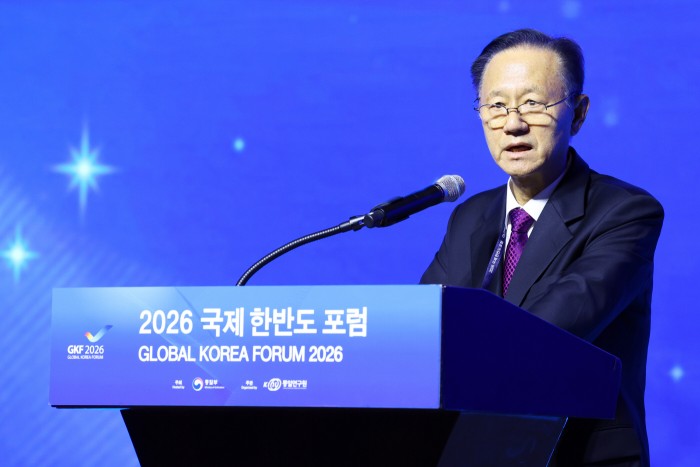 |
| Kwon Man-hak, president of the Korea Institute for National Unification, delivers welcoming remarks at the opening ceremony of the 2026 Global Forum for Peace and Prosperity on the Korean Peninsula held under the theme "A New Paradigm for Peaceful Coexistence on the Korean Peninsula Amid Great Transformation of International Order" at the Westin Josun Seoul in Jung-gu, Seoul, on the 27th. / Yonhap News |
Survey results released on the 30th showed that public indifference toward North Korea has reached an all-time high. Analysts interpret this trend not as a temporary phenomenon driven by ups and downs in inter-Korean relations, but rather as a structural detachment.
According to the findings of the KINU Unification Perception Survey 2026 released by the Korea Institute for National Unification on the 30th, respondents stating they have no interest in North Korea rose to 70.3% this year, climbing steadily after registering 50.8% in 2015. The institute analyzed that "given that responses to this question are largely unaffected by improvements or deteriorations in inter-Korean relations, it appears closer to a structural detachment rather than a temporary phenomenon."
The perception of North Korea as an independent state rather than part of a special inter-Korean relationship is becoming widespread. Among respondents, 71.6% answered that "North Korea is also an independent country".
Regarding North Korea's nuclear threats, the survey found that the public increasingly views them as routine risks rather than emergency crises. Interest in the North Korean nuclear issue fell from 45.6% in 2016 to 27.9%, while associated anxiety dropped from 58.5% to 44.3%. This is interpreted as fatigue over repeated nuclear threats alongside the normalization of such risks.
Amid persistent North Korean threats, public support for independent nuclear armament has remained steady. Sixty-eight percent of respondents favored domestic nuclear armament, while 59.6% supported the redeployment of U.S. nuclear weapons to the Korean Peninsula. Although the sense of crisis regarding North Korea's nuclear threat has declined, public demand for securing tangible deterrence remains robust. The Korea Institute for National Unification diagnosed that "while social interest and emotional reactions toward North Korea are waning, a realistic attitude is taking shape that simultaneously favors strong deterrent measures, such as independent nuclear armament, and conditional dialogue, while recognizing North Korea as a state in real terms."
The proportion of respondents viewing unification as necessary edged down slightly to 48.2%, compared to 49% last year. In addition, 66.9% responded that unification is unnecessary if the two Koreas can coexist peacefully. The Korea Institute for National Unification explained that this figure has risen steadily over the long term, regardless of changes in inter-Korean ties or political administrations.
Through its annual unification perception survey, the Korea Institute for National Unification examines public views on unification, North Korea, North Korea and unification policies, inter-Korean integration, security perspectives, and attitudes toward neighboring countries, identifying various factors influencing public perceptions. This survey was conducted through face-to-face interviews with 1,003 adult men and women aged 18 and older nationwide from April 2 to 24, with a margin of error of plus or minus 3.1 percentage points at a 95% confidence level.
Mok Yong-jae
Most Read
-
1
Alteogen secures European patent for Keytruda SC,..

-
2
Trump shares map on social media labeling Strait o..

-
3
Celltrion seeks rheumatoid arthritis indication ex..

-
4
Trump demands rates fall below 1% as Fed hikes for..

-
5
Chinese e-commerce giants AliExpress, Temu and She..

-
6
China expels No. 2 military official Zhang Youxia..

-
7
Houthi rebels release video claiming downing of Sa..

PEOPLE





HEADLINE NEWS
- UNC says N. Korea violated armistice agreement in DMZ landmine explosion
- U.S. 30-year Treasury yield hits 5.613% intraday, highest since 2002 as bon..
- Netanyahu faces political crisis ahead of election over allegations he igno..
- Chinese Foreign Minister Wang Yi demands retraction of Takaichi's remarks o..

-
Address : In-Young Bldg., 34, Uisadang-daero 1-gil, Yeongdeungpo-gu, Seoul
Copyright by ASIATODAY CO., LTD. All rights resereved