



Production, consumption, and investment fall in tandem in August
Sep 30, 2026, 09:49 am


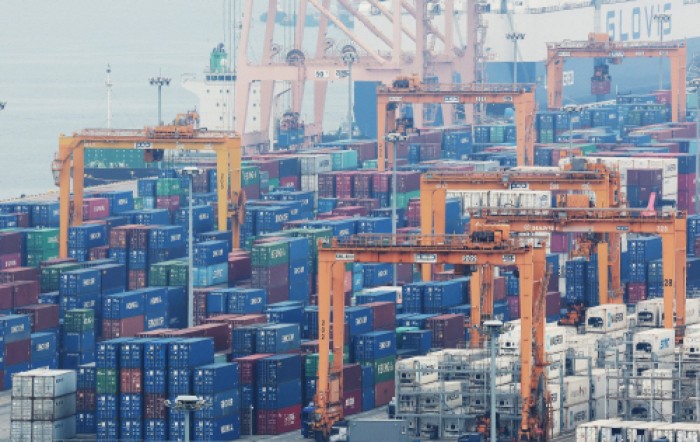 |
| Containers stacked at Pyeongtaek Port in Gyeonggi Province. / Yonhap |
=In the wake of sluggish automobile production and sales, production, consumption, and investment all fell last month, marking a "triple decline" for the first time in three months. The government explained that temporary factors, such as summer vacations at automakers and base effects from prior investments in ships and aircraft, converged to cause the adjustment.
According to the "August Industrial Activity Trends" released by Statistics Korea on the 30th, the index of all-industry production (seasonally adjusted, 2020=100) stood at 118.7 last month, down 1.3 percent from the previous month and falling for two consecutive months. The margin of decline was the largest since October of last year.
By sector, mining and manufacturing, which includes automobiles as well as rubber and plastics, declined by 4.8 percent from the previous month. Among these, automobiles, including newly produced auto parts and recreational passenger vehicles, fell by 24.8 percent, while rubber and plastics also dropped by 11 percent.
An official from the Ministry of Economy and Finance explained, "Automobile production fell due to summer vacations at finished-vehicle makers, and the production of rubber and plastics declined because of fewer operating days in downstream sectors like automobiles."
During the same period, service sector output increased by 0.5 percent on-month. While wholesale and retail trade dropped by 0.7 percent, information and communications and professional, scientific, and technical activities grew by 4.7 percent and 2.3 percent, respectively.
The retail sales index contracted by 1.8 percent from the previous month. Although sales of semi-durable goods, such as medical goods, rose by 0.4 percent, durable goods like passenger cars and non-durable goods like food and beverages fell by 4.5 percent and 1.6 percent, respectively. In particular, sales at retail establishments for passenger cars and fuel fell by 11.2 percent compared with the same month last year.
The finance ministry official explained, "Durable goods sales decreased due to reduced passenger car sales caused by production disruptions, as well as demand having been absorbed early by large-scale home appliance discount events held between June and early July."
Facility investment fell by 9.5 percent from the previous month, returning to a downward trend after two months. While machinery such as semiconductor manufacturing equipment grew by 1.6 percent, transportation equipment plunged by 32.8 percent due to lower investment in vessels and aircraft. The explanation noted that a high concentration of vessel and aircraft deliveries in the preceding month led to a base effect.
Construction completed, which reflects overall construction activity, climbed by 1.9 percent on-month last month. This came as construction work output rose by 4.5 percent, driven by concurrent increases in non-residential construction, such as semiconductor plants, and residential construction, such as apartments.
With production, consumption, and investment all declining, the cyclical component of the composite leading index, which forecasts future economic trends, fell by 0.1 point from the previous month. This marks a return to a downward slope for the first time in 10 months since October of last year.
However, the government maintains that the solid growth momentum of the economy continues. The finance ministry official stated, "In September, key industrial activity indicators are projected to rebound given the resolution of temporary factors, improving consumer sentiment, and favorable trends in flash indicators such as exports, capital goods imports, and machinery orders." The official added, "The upward trend in the cyclical component of the coincident index also remains intact."
Seo Byung-ju
Most Read
-
1
Alteogen secures European patent for Keytruda SC,..

-
2
Trump shares map on social media labeling Strait o..

-
3
Celltrion seeks rheumatoid arthritis indication ex..

-
4
Trump demands rates fall below 1% as Fed hikes for..

-
5
Chinese e-commerce giants AliExpress, Temu and She..

-
6
China expels No. 2 military official Zhang Youxia..

-
7
Houthi rebels release video claiming downing of Sa..

PEOPLE






HEADLINE NEWS
- UNC says N. Korea violated armistice agreement in DMZ landmine explosion
- U.S. 30-year Treasury yield hits 5.613% intraday, highest since 2002 as bon..
- Netanyahu faces political crisis ahead of election over allegations he igno..
- Chinese Foreign Minister Wang Yi demands retraction of Takaichi's remarks o..

-
Address : In-Young Bldg., 34, Uisadang-daero 1-gil, Yeongdeungpo-gu, Seoul
Copyright by ASIATODAY CO., LTD. All rights resereved