



Small businesses and self-employed struggle amid economic slump
Sep 30, 2026, 09:18 am


 |
The number of rehabilitation and bankruptcy filings submitted to courts by individuals and corporations surged sharply last year. Countless corporations, including small and medium-sized enterprises, were unable to endure prolonged economic sluggishness and slumping consumer spending, while individuals appear to have been pushed to the brink by soaring material and labor costs.
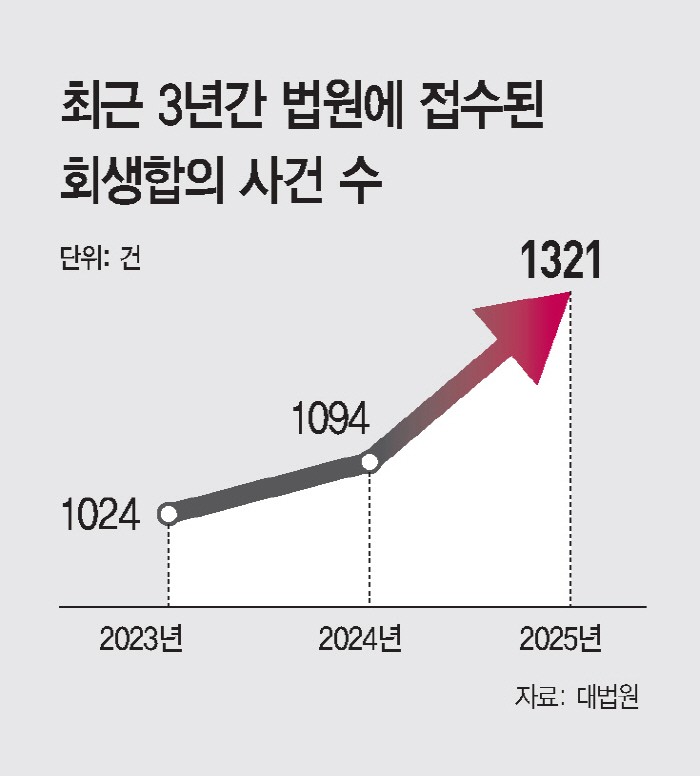
According to the 2026 Judicial Yearbook released by the Supreme Court on the 29th, the number of collegiate corporate rehabilitation cases filed last year reached 1,321, up 20.75 percent from 1,094 cases the previous year. Over the same period, corporate bankruptcy filings also rose 17.63 percent, climbing from 1,940 to 2,282 cases.
Individual rehabilitation filings increased 15.17 percent from 129,499 to 149,147 cases, while personal bankruptcy filings rose 2 percent from 40,104 to 40,909 cases. The sharp rise in rehabilitation and bankruptcy filings is attributed to the mounting debt repayment burden on individuals and businesses amid prolonged economic weakness, compounded by high interest rates and inflationary pressures.
The total number of litigation cases filed with courts in 2025 stood at 6,863,796, edging down 0.75 percent from 6,915,400 cases in the previous year. By case type, civil cases accounted for the largest share at 4,699,251 cases or 68.5 percent of the total, followed by criminal cases at 1,762,877 cases (25.7 percent) and family cases at 199,435 cases (2.9 percent).
Looking strictly at lawsuits on the merits, trends diverged between civil and criminal cases. Civil merits cases rose 0.53 percent from 879,799 to 884,494 cases, whereas criminal merits cases fell 1.4 percent from 347,292 to 342,426 cases.
Variations also emerged by court level. Civil merits filings in first-instance and second-instance courts rose 0.56 percent and 4.15 percent year on year, respectively. For criminal trial cases, first-instance filings fell 7.15 percent to 222,833 from 239,981 cases the previous year, yet second-instance filings actually grew 3.49 percent.
Civil filings submitted to the Supreme Court stood at 12,714 cases, down 15 percent from 14,958 cases the previous year. However, when excluding excessive, repetitive filings lodged by the same individuals, the actual decline was limited to 2.4 percent. In contrast, criminal trial cases reached 34,272 filings, surging 37.7 percent year on year.
The number of cases handled per judge edged down across the board, with the exception of the appellate courts. The Supreme Court's caseload per justice dropped from 4,579.3 to 4,084.1 cases, and district courts saw a 0.6 percent decrease from 499.9 to 496.7 cases. Conversely, high courts recorded an increase from 106.8 cases in 2024 to 115.7 cases last year.
Meanwhile, the National Court Administration took steps last year to overhaul various institutional frameworks to resolve trial delays and enhance judicial services. While establishing conditions for swift trials, such as improving the appraisal system, and pursuing institutional enhancements for thorough hearings, the agency overhauled registration, deposit, and family relation registration systems to protect citizens' property and family relationship data. Alongside these efforts, it also pursued the digital transformation of judicial services, building a criminal electronic litigation system and revamping the judicial information disclosure portal.
Son Seung-hyun
Most Read
-
1
Alteogen secures European patent for Keytruda SC,..

-
2
Trump shares map on social media labeling Strait o..

-
3
Celltrion seeks rheumatoid arthritis indication ex..

-
4
Trump demands rates fall below 1% as Fed hikes for..

-
5
Chinese e-commerce giants AliExpress, Temu and She..

-
6
China expels No. 2 military official Zhang Youxia..

-
7
Houthi rebels release video claiming downing of Sa..

PEOPLE






HEADLINE NEWS
- UNC says N. Korea violated armistice agreement in DMZ landmine explosion
- U.S. 30-year Treasury yield hits 5.613% intraday, highest since 2002 as bon..
- Netanyahu faces political crisis ahead of election over allegations he igno..
- Chinese Foreign Minister Wang Yi demands retraction of Takaichi's remarks o..

-
Address : In-Young Bldg., 34, Uisadang-daero 1-gil, Yeongdeungpo-gu, Seoul
Copyright by ASIATODAY CO., LTD. All rights resereved