



N. Korea again condemns U.S. to justify nuclear status
Sep 29, 2026, 05:13 pm


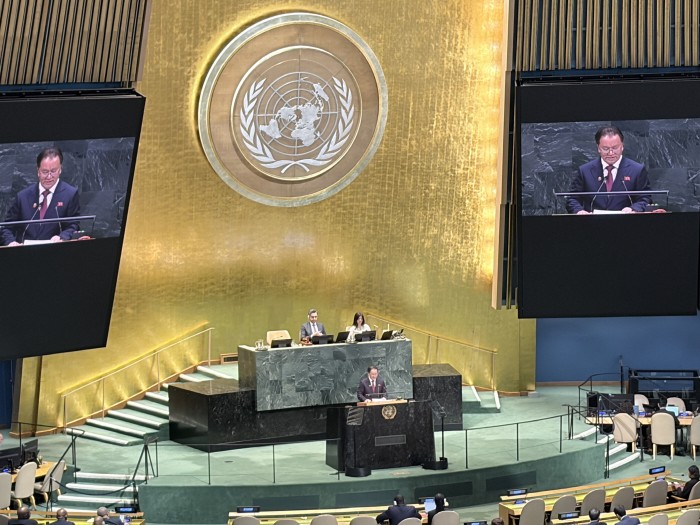 |
| Kim Son-gyong, North Korea's vice minister of foreign affairs, delivers a keynote speech at the 81st session of the United Nations General Assembly at UN Headquarters in New York, U.S., on the 28th local time. / Yonhap News |
North Korea condemned the U.S., claiming it has abandoned its disarmament obligations as a nuclear-weapon state and continues acts of nuclear proliferation. North Korea has recently reinforced the justification for its nuclear possession based on the logic that while it complies with nonproliferation responsibilities as a nuclear power, the U.S. is proliferating nuclear weapons to its allies. This is also interpreted as preliminary positioning aimed at steering potential dialogue with the U.S. toward nuclear disarmament negotiations.
According to the Korean Central News Agency on the 29th, North Korea's Ministry of Foreign Affairs released a memorandum on the 27th exposing what it called the truth and dangers of U.S. nuclear proliferation acts. Listing the history of U.S. nuclear development and arms reduction alongside Washington's extended deterrence policies for allies, the ministry claimed that the U.S., in violation of core provisions of the Treaty on the Non-Proliferation of Nuclear Weapons, openly transfers nuclear weapons technology to follower forces and deploys nuclear strike assets on a large scale across foreign territories under the pretext of a nuclear umbrella and extended deterrence.
The ministry stated that this clearly demonstrates the true nature of the U.S.-Japan-South Korea trilateral military cooperation framework evolving into a U.S.-led nuclear alliance, sharply condemning South Korea's move to introduce nuclear-powered submarines as an AUKUS-style act of nuclear proliferation. The ministry continued by stating that international nuclear order is in total collapse due to the buildup of U.S. nuclear forces and blatant nuclear proliferation, adding that as a responsible nuclear-weapon state, the DPRK's course of action will strictly reflect the grave reality in which the strengthening of U.S. nuclear capabilities and its nuclear proliferation schemes remain unchecked.
According to South Korea's Ministry of Unification, a memorandum is a format North Korea uses to disclose historical truth regarding specific issues, marking its reappearance about 16 months after issuing one criticizing the U.S. missile defense system in May last year. Speaking to reporters, a unification ministry official analyzed that the move is intended to take issue with the double standards of international nuclear regimes such as the NPT and the Comprehensive Nuclear-Test-Ban Treaty (CTBT), reinforce the justification for its nuclear possession, and highlight North Korea as a responsible nuclear state, while structurally synchronizing in timing with Vice Foreign Minister Kim Son-gyong's address at the UN General Assembly.
Recently, North Korea has been issuing pushback against the international community's discussions on North Korean denuclearization through statements, press remarks, and memoranda released under the names of Party General Affairs Department Director Kim Yo-jong, the foreign ministry, and the defense ministry.
From the 17th to the 19th, Director Kim released statements for three consecutive days pushing back against the IAEA's North Korean denuclearization discussions and U.S.-led joint military exercises, repeatedly insisting on the country's nuclear status. Foreign Minister Choe Son-hui reaffirmed nuclear possession on the 24th in connection with the South Korea-U.S.-Japan foreign ministers' meeting held on the sidelines of the UN General Assembly. On the same day, a foreign ministry spokesperson emphasized that the Friends of the CTBT Ministerial Meeting would not affect North Korea's nuclear status.
Experts analyzed that because North Korea's immediate and repetitive reactions target the U.S., Pyongyang is laying the groundwork to guide prospective U.S.-North Korea talks in a favorable direction.
Mok Yong-jae
Most Read
-
1
Trump shares map on social media labeling Strait o..

-
2
Trump demands rates fall below 1% as Fed hikes for..

-
3
Celltrion seeks rheumatoid arthritis indication ex..

-
4
Chinese e-commerce giants AliExpress, Temu and She..

-
5
Trump warns countries not helping U.S. must pay re..

-
6
China expels No. 2 military official Zhang Youxia..

-
7
Houthi rebels release video claiming downing of Sa..

PEOPLE






HEADLINE NEWS
- N. Korea declares nuclear status irreversible and condemns S. Korea, U.S., Japan at UN
- Japan tracks Ukraine fiber-optic drones, bolsters SDF electronic warfare
- Wave of undocumented Chinese caught in Argentina after Brazil's visa-free m..
- France's far-right National Rally forms first-ever parliamentary group in S..

-
Address : In-Young Bldg., 34, Uisadang-daero 1-gil, Yeongdeungpo-gu, Seoul
Copyright by ASIATODAY CO., LTD. All rights resereved