



U.S., China turn transactional while Japan stays hawkish on Beijing, complicating Seoul's diplomacy
Sep 29, 2026, 01:16 pm


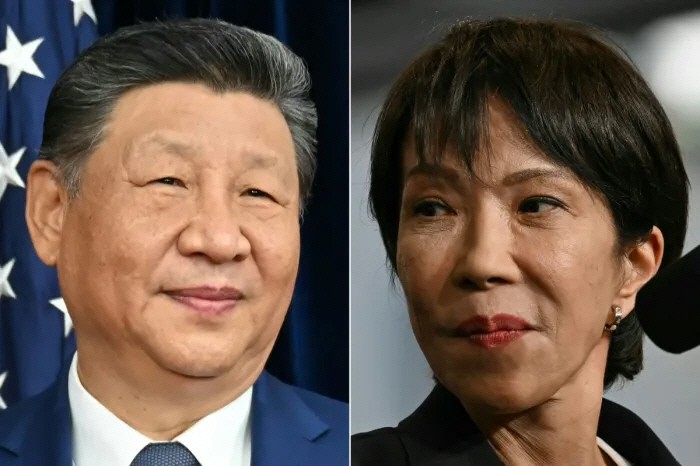 |
| Japanese Prime Minister Sanae Takaichi (right) and Chinese President Xi Jinping / Yonhap News |
The U.S. and China agreed during their summit on preferential tariff arrangements to apply to 30 billion dollars worth of goods each in trade and investment. The two sides also reaffirmed at the summit their constructive strategic stability relationship established in May. As the U.S. and Chinese leaders agreed to steer bilateral ties toward strategic stability, the hardline China policy of the Japanese administration under Prime Minister Sanae Takaichi has been put to a new test. While continuing strategic competition with China, the U.S. is moving toward striking deals in the economic sphere and managing conflict.
Japan, on the other hand, maintained its existing policy stance toward China on Taiwan and economic security issues, coordinating heavily with the U.S. on China matters before and after the U.S.-China summit. Diplomatic calculations for South Korea are also growing more complicated, as Seoul must sustain trilateral cooperation with the U.S. and Japan while simultaneously managing its relations with China.
U.S. President Donald Trump and Chinese President Xi Jinping held a summit in Washington on September 24 and agreed to build a constructive U.S.-China strategic stability relationship grounded in respect, fairness, and mutual benefit. In the economic realm, transaction-oriented agreements materialized. The U.S. and China agreed on preferential tariff measures for 30 billion dollars worth of non-sensitive goods on each side and decided to fully launch a consultative body on trade and investment. They also agreed to continue consultations on the supply of critical minerals, including rare earths.
A posture of managing relations was also evident in announcements from the Chinese side. According to China's Ministry of Foreign Affairs, President Xi stated that U.S.-China relations should be directed toward making cooperation the mainstream, managing competition within appropriate bounds, and controlling differences.
However, fundamental tensions between the U.S. and China over Taiwan have not been resolved. President Xi demanded that President Trump hold fast to opposing Taiwan independence. In effect, the U.S. and China have entered a phase of managed competition, expanding transactional cooperation in economics while holding their ground on security issues.Japan intensively coordinated on China matters with the U.S. around the time of the U.S.-China summit.
Prime Minister Takaichi held talks lasting about 35 minutes with President Trump in New York on the 22nd to discuss China issues. According to Japan's Ministry of Foreign Affairs, the two leaders exchanged views on China-related issues, including economic security, with the U.S.-China summit in mind, and agreed to continue close cooperation between the U.S. and Japan.
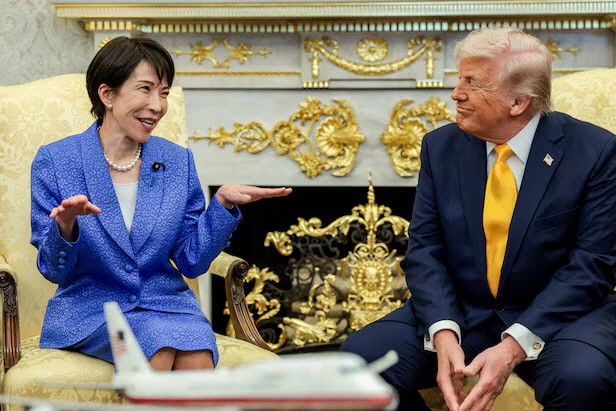 |
| Japanese Prime Minister Takaichi (left) and U.S. President Trump / Yonhap News |
The two leaders also agreed to strengthen cooperation in economic security sectors, including artificial intelligence (AI), semiconductors, and critical minerals. They reaffirmed their standing commitment to enhance the deterrence and response capabilities of the U.S.-Japan alliance to ensure peace and prosperity in the Indo-Pacific region. Coordination between the U.S. and Japan continued even after the conclusion of the U.S.-China summit.
President Trump held a telephone conversation lasting about 20 minutes with Prime Minister Takaichi on the 26th to explain the outcome of the U.S.-China summit in detail. The two leaders once again discussed China-related issues across economic and security spheres, including economic security, and agreed to cooperate closely.
This reveals a dual structure in which the U.S. strikes deals with China while separately coordinating its China policy with Japan. While the U.S. simultaneously requires both economic transactions with China and the management of strategic competition, Japan faces issues tied directly to its own security—such as the Taiwan Strait and the East China Sea—giving Tokyo relatively narrower room for maneuver in its China policy.
South Korea is also directly affected by these shifts in U.S.-China and Japan-China relations. President Lee Jae-myung held a summit with President Trump in New York on the 22nd, emphasizing that the U.S.-China summit scheduled for the following day was "critical to regional affairs, including Korea-China relations," and expressing hopes for a successful meeting. This publicly underscored that shifts in U.S.-China relations are directly linked to Korea-China relations and the security environment on the Korean Peninsula.
The South Korean government continues its policy direction of maintaining the South Korea-U.S. alliance and South Korea-U.S.-Japan cooperation while steadily managing relations with China. During the South Korea-Japan summit in May, President Lee stated that to achieve regional peace and stability, it is important not only to pursue bilateral and trilateral cooperation with the U.S. and Japan, but also for South Korea, China, and Japan to respect each other, cooperate, and seek common interests. Efforts to manage South Korea-China relations are proceeding in parallel.
Foreign Minister Cho Hyun held talks with Chinese Foreign Minister Wang Yi last month to discuss pending bilateral issues, including South Korea-China relations and Korean Peninsula affairs. Ultimately, diplomacy in Northeast Asia following this U.S.-China summit has become difficult to frame through a simple dichotomy of the U.S. versus China. While strategically competing with China, the U.S. is pursuing economic transactions and relational stability, whereas Japan is maintaining its existing China policy anchored to the U.S.-Japan alliance.
For South Korea, it must sustain cooperation with the U.S. and Japan while stably managing ties with China and preserving the framework of trilateral cooperation among South Korea, China, and Japan. As a phase unfolds where the U.S. and China compete while cutting deals as needed, South Korea's diplomacy toward China faces an even greater need for delicate coordination that pursues both South Korea-U.S.-Japan and South Korea-China-Japan cooperation in parallel.
Choi Young-jae
Most Read
-
1
Trump shares map on social media labeling Strait o..

-
2
Trump demands rates fall below 1% as Fed hikes for..

-
3
Celltrion seeks rheumatoid arthritis indication ex..

-
4
Chinese e-commerce giants AliExpress, Temu and She..

-
5
Trump warns countries not helping U.S. must pay re..

-
6
China expels No. 2 military official Zhang Youxia..

-
7
Houthi rebels release video claiming downing of Sa..

PEOPLE






HEADLINE NEWS
- N. Korea declares nuclear status irreversible and condemns S. Korea, U.S., Japan at UN
- Japan tracks Ukraine fiber-optic drones, bolsters SDF electronic warfare
- Wave of undocumented Chinese caught in Argentina after Brazil's visa-free m..
- France's far-right National Rally forms first-ever parliamentary group in S..

-
Address : In-Young Bldg., 34, Uisadang-daero 1-gil, Yeongdeungpo-gu, Seoul
Copyright by ASIATODAY CO., LTD. All rights resereved