



China to apply MFN tariff rates to 90% of products agreed for tariff cuts with U.S.
Sep 29, 2026, 10:10 am


China announced on the 28th that it has decided to apply most-favored-nation (MFN) tariff rates to approximately 90% of the products—valued at around 30 billion dollars (40.77 trillion won) each—agreed upon for tariff cuts with the U.S.
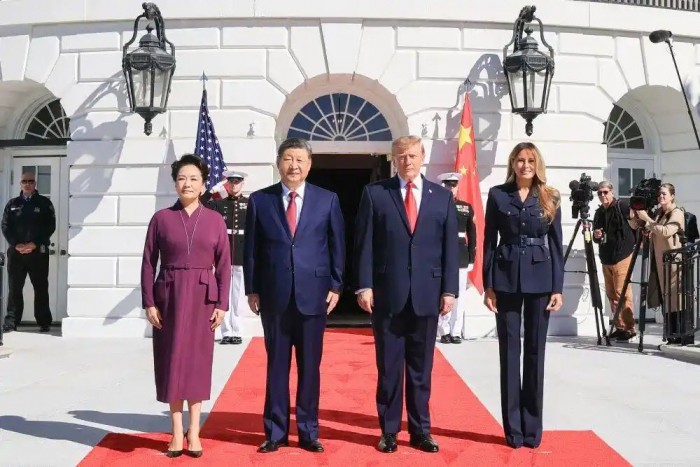 |
| U.S. President Donald Trump and Chinese General Secretary and State President Xi Jinping pose with their respective wives ahead of a tea gathering following their summit held at the White House in Washington, D.C. on the 24th local time. / Xinhua News Agency |
According to Beijing diplomatic sources versed in U.S.-China relations on the 28th, an official from the Department of American and Oceanian Affairs under China's Ministry of Commerce disclosed the details that day while outlining the outcomes of the 8th U.S.-China economic and trade negotiations held in New York and Washington from the 20th to the 23rd. Under the arrangement, both sides agreed to implement the tariff reduction measures simultaneously once internal legal procedures are finalized in each country. Concrete details regarding specific tariff cuts are expected to be unveiled at a later date.
Earlier, China's Ministry of Foreign Affairs announced the outcomes of the U.S.-China summit on the 26th, disclosing an agreement on mutual tariff cuts totaling 30 billion dollars. The Ministry of Commerce went further that day, outlining additional details concerning applied tariff rates and implementation procedures. As a result, China's import tariffs on U.S. coal are also slated for reduction. The ministry noted that this measure will bolster China's imports of U.S. coal in 2027 and 2028.
The Ministry of Commerce also reaffirmed the previously disclosed agreement to establish a bilateral communication channel addressing artificial intelligence (AI) incidents. Furthermore, in the financial sector, the ministry stated that it will review and approve applications from foreign financial institutions—including those from the U.S.—seeking to operate and establish branches in China in accordance with relevant laws and regulations.
The ministry added that it looks forward to the U.S. providing a fair, transparent, and stable policy environment for Chinese financial institutions as well. According to the ministry, both sides appear set to maintain communication on matters concerning increasing direct passenger flights between the U.S. and China.
Earlier, U.S. President Donald Trump hailed Chinese General Secretary and State President Xi Jinping's state visit to the U.S. as "very successful" on the 25th local time. President Xi echoed this sentiment, stating that mutually beneficial outcomes were achieved in the economic and trade arenas. Contrary to the rhetoric of the two strongmen, however, Beijing diplomatic sources downplayed the significance of the summit, assessing that no exceptional breakthroughs were reached. This suggests that, as initially expected, the meeting likely devolved into little more than a feast of words.
Hong Soon-do
Most Read
-
1
Trump shares map on social media labeling Strait o..

-
2
Trump demands rates fall below 1% as Fed hikes for..

-
3
Celltrion seeks rheumatoid arthritis indication ex..

-
4
Chinese e-commerce giants AliExpress, Temu and She..

-
5
Trump warns countries not helping U.S. must pay re..

-
6
China expels No. 2 military official Zhang Youxia..

-
7
Houthi rebels release video claiming downing of Sa..

PEOPLE






HEADLINE NEWS
- N. Korea declares nuclear status irreversible and condemns S. Korea, U.S., Japan at UN
- Japan tracks Ukraine fiber-optic drones, bolsters SDF electronic warfare
- Wave of undocumented Chinese caught in Argentina after Brazil's visa-free m..
- France's far-right National Rally forms first-ever parliamentary group in S..

-
Address : In-Young Bldg., 34, Uisadang-daero 1-gil, Yeongdeungpo-gu, Seoul
Copyright by ASIATODAY CO., LTD. All rights resereved