



N. Korea declares nuclear status irreversible and condemns S. Korea, U.S., Japan at UN
Sep 29, 2026, 10:44 am


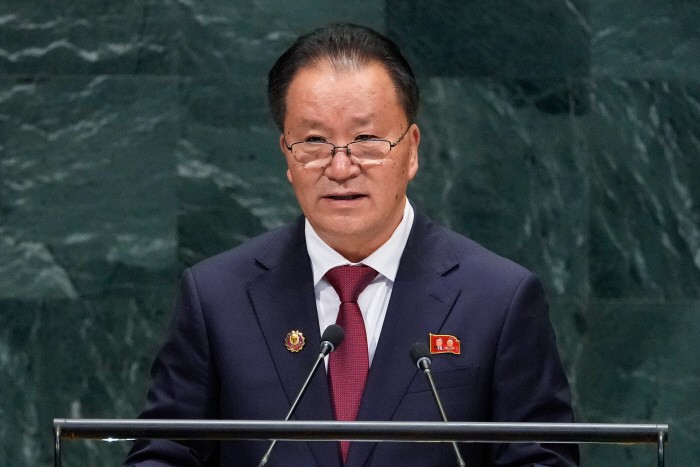 |
| Kim Son-gyong, North Korea's vice minister of foreign affairs, addresses the general debate of the 81st session of the United Nations General Assembly at UN Headquarters in New York, U.S., on the 28th local time. / AFP, Yonhap |
North Korea's nuclear status cannot be reversed, vice foreign minister says, calling nuclear deterrence absolute power
North Korea's Vice Minister of Foreign Affairs Kim Son-gyong stated during his speech at the general debate of the 81st session of the United Nations General Assembly held at UN Headquarters in New York, U.S., on the 28th local time that North Korea's status as a nuclear weapons state has become permanently fixed both physically and legally, and "cannot be reversed under any circumstances or by anything."
Defining North Korea's nuclear deterrence as an "absolute power and irresistible force," Vice Minister Kim criticized military cooperation among the U.S., South Korea, and Japan. He made no direct mention of dialogue between the U.S. and North Korea.
Kim said, "The nuclear deterrence possessed by the Democratic People's Republic of Korea is an absolute power and irresistible force to defend our sovereignty, security, and peace against external aggression and threats." Asserting that North Korea's status as a nuclear weapons state has been permanently fixed both physically and legally, he stressed, "I reaffirm the official position that it cannot be reversed under any circumstances or by anything."
Kim attributed the absence of physical conflict on the Korean Peninsula to North Korea's military strength. He argued, "It is because we possess a formidable war deterrence and thoroughly manage hostile forces' will to use military force." Maintaining that "the regional balance of power driven by our self-defensive capabilities firmly deters the possibility of armed conflict," Kim asserted that the "power of justice" serves as the fundamental guarantee of sovereign rights, national prestige, peace, and stability.
Kim noted that State Affairs Commission President Kim Jong-un had proclaimed that national sovereignty and security have been guaranteed by formidable strength and will remain unchanged going forward. He added that North Korea will strictly control and manage external threats with overwhelming power and "remain all the more faithful to its mission as a responsible nuclear weapons state."
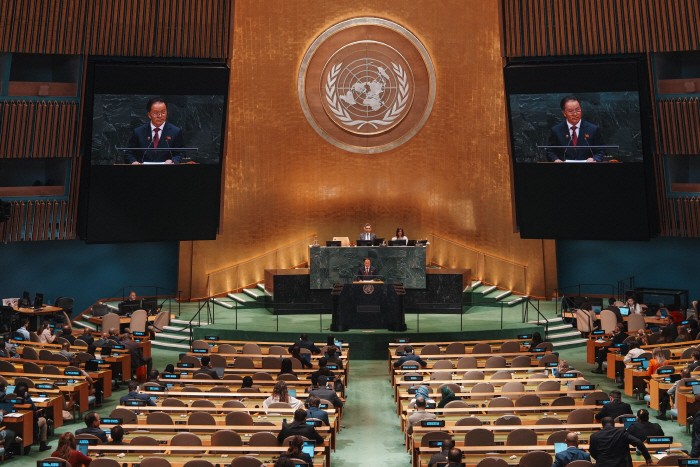 |
| Kim Son-gyong, North Korea's vice minister of foreign affairs, speaks at the general debate of the 81st session of the United Nations General Assembly at UN Headquarters in New York, U.S., on the 28th local time. / AFP, Yonhap |
North Korea condemns nuclear elements in South Korea-U.S.-Japan military structure and claims U.S. approved South Korea's nuclear submarine ambitions
Vice Minister Kim claimed that the Korean Peninsula and surrounding regions have been plunged into a level of instability and tension distinct from last year due to the hostile policy toward North Korea and acts of military confrontation by countries including the U.S. Kim criticized the U.S. for evolving the South Korea-U.S.-Japan combined military structure into a more aggressive military bloc embedded with "nuclear elements." He stated that the U.S. is "colluding with allies to revise and update nuclear war scenarios while continuously cultivating and mastering their execution capabilities."
Kim condemned the U.S. for staging a series of bilateral and multilateral military exercises simulating real combat this year, such as Freedom Shield and Freedom Edge. He asserted that the U.S. made no attempt to conceal its intent for military confrontation against North Korea.
Kim pointed out that the U.S. approved and is actively pushing forward South Korea's ambition to possess nuclear-powered submarines. Noting that the U.S. is redeploying advanced missiles and drones to the Korean Peninsula and surrounding areas, Kim criticized that "current military trends are rendering the already volatile regional security environment even more fragile."
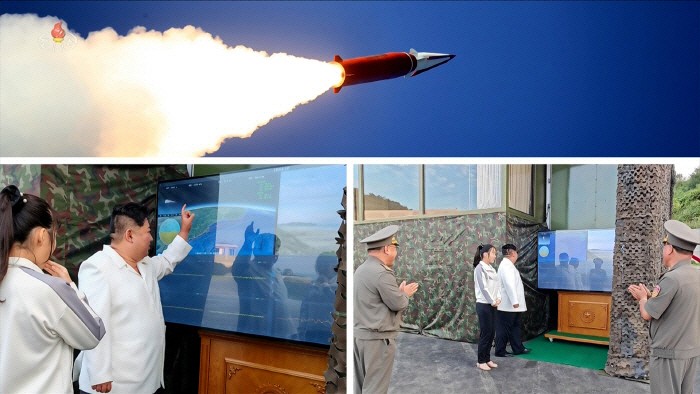 |
| North Korean leader Kim Jong-un inspects the Missile General Bureau's new weapon test alongside his daughter Ju-ae, Workers' Party of Korea Central Committee First Deputy Department Director Kim Jong-sik, and General Bureau Director Jang Chang-ha on September 20. / Korean Central Television footage, Yonhap |
North Korea criticizes Japan's rearmament, saying long-range strike weapons run counter to defeated nation's obligations
Vice Minister Kim defined Japan as a "war criminal state that inflicted indescribable pain and disaster on humanity in the last century." Kim claimed that Japan is "accelerating its rearmament at an unprecedented pace" under the pretext of volatile international circumstances through moves including regressive revisions to its pacifist constitution, abandoning the principle of exclusively defense-oriented policy, reorganizing military structures, and expanding armed forces.
Kim said Japan is fully dedicated to developing and possessing long-range strike weapons that put neighboring countries within range under the pretext of counterstrike capabilities. Kim criticized Japan, saying, "Japan's ambition completely runs counter to the obligations of a defeated nation," and constitutes a shameless disregard for the UN Charter as well as a grave challenge to world peace.
Five-year plan completed through self-reliance, with all set goals achieved, Kim says
Kim introduced that the Ninth Congress of the Workers' Party of Korea held in Pyongyang in February this year reviewed achievements over the past five years and presented new goals. Kim claimed that North Korea successfully completed its five-year plan for national economic development by maintaining the principle of self-reliance despite the pandemic, extreme weather, and geopolitical confrontation.
Kim stated, "No matter how the situation changes, we will thoroughly rely on our own strength to definitely achieve everything we have aimed for." Kim described this as "a confidence that every one of our people firmly shares."
Time to reform UN, Kim says, stressing multilateralism and multipolarity with no mention of U.S.-North Korea dialogue
Kim stated that the UN must not be used as an instrument for certain forces to carry out hegemonic strategies, adding, "Now the time has come to reform the UN." Regarding UN reform, Kim argued, "Rather than reform centered around specific countries, the will and interests of all member states must be equally and fairly represented." Kim emphasized that the era in which a single member state unilaterally imposed its will on the world and held sway over international politics "has come to an end forever."
Kim stated, "Multilateralism and multipolarity based on justice and fairness are an irresistible aspiration and trend of our times." Kim cited climate change as an issue requiring collective action from the international community and noted that emerging technologies, including artificial intelligence (AI), also carry the risk of being exploited for malicious purposes.
Kim noted that this year marks the 35th anniversary of North Korea's admission to the UN, stating that North Korea has remained faithful to the purposes and principles of the UN Charter. Kim did not directly mention dialogue between the U.S. and North Korea in this speech. During the address, North Korean mission staff, including North Korean Ambassador to the UN Kim Song, applauded, but there was no response from other foreign delegations, while a small number of staff from the South Korean, U.S., and Japanese missions remained in their seats.
Ha Man-ju
Most Read
-
1
Trump shares map on social media labeling Strait o..

-
2
Trump demands rates fall below 1% as Fed hikes for..

-
3
Celltrion seeks rheumatoid arthritis indication ex..

-
4
Chinese e-commerce giants AliExpress, Temu and She..

-
5
Trump warns countries not helping U.S. must pay re..

-
6
China expels No. 2 military official Zhang Youxia..

-
7
Houthi rebels release video claiming downing of Sa..

PEOPLE






HEADLINE NEWS
- N. Korea declares nuclear status irreversible and condemns S. Korea, U.S., Japan at UN
- Japan tracks Ukraine fiber-optic drones, bolsters SDF electronic warfare
- Wave of undocumented Chinese caught in Argentina after Brazil's visa-free m..
- France's far-right National Rally forms first-ever parliamentary group in S..

-
Address : In-Young Bldg., 34, Uisadang-daero 1-gil, Yeongdeungpo-gu, Seoul
Copyright by ASIATODAY CO., LTD. All rights resereved