



Crude oil flows through Strait of Hormuz recover to 60% level
Sep 29, 2026, 09:58 am


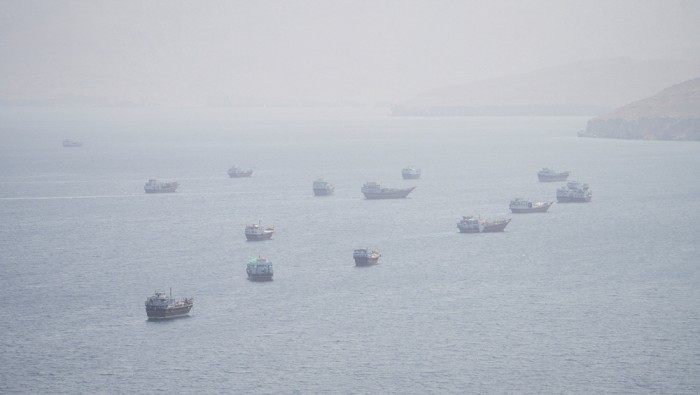 |
| Vessels in the Strait of Hormuz, as seen from Musandam, Oman, on the 2nd local time. / Reuters, Yonhap |
Crude oil transit volumes through the Strait of Hormuz, which had been virtually paralyzed by an Iranian blockade and threats from militant groups, have recovered to about 60% of pre-Middle East conflict levels. This rebound appears driven by a sharp rise in oil tankers covertly passing through the blockaded strait.
Even as the conflict continues, supplies of Middle Eastern crude are rebounding, a trend cited as a key factor preventing international oil prices from surging to all-time highs around 150 dollars per barrel.
The Nihon Keizai Shimbun (Nikkei) reported on the 28th that despite the blockade of the Strait of Hormuz—through which roughly 20% of the world's oil supply passes—and intensifying attacks by pro-Iranian militants on tankers in the alternative Red Sea route since July, crude prices have avoided extreme spikes. Analysts attribute this to a growing number of tankers transiting the strait with their Automatic Identification System (AIS) switched off.
Under International Maritime Organization (IMO) regulations, tankers operating on international routes are required in principle to transmit location signals via AIS to prevent collisions and enable vessel traffic authorities to manage navigation.
However, ships may turn off AIS as an emergency measure if security threats arise. Doing so makes it harder for Iranian forces to track vessel positions, thereby lowering the risks of drone strikes or seizures.
According to commodities data analytics firm Kpler, estimated crude oil transiting the Strait of Hormuz—including volumes carried by tankers with their AIS deactivated—averaged about 9.36 million barrels per day this month, up roughly 3.56 million barrels from the previous month.
This marks the highest level since the military clashes in late February, recovering to about 60% of the pre-conflict average of roughly 15 million barrels per day.
Yuui Torikata, principal market analyst at Kpler, explained, "The practice of turning off AIS to pass through the strait and subsequently transferring crude to Asia-bound tankers outside the Persian Gulf—known as ship-to-ship transfer—is supporting the supply of Middle Eastern crude."
International oil prices have remained relatively stable recently. West Texas Intermediate (WTI) futures traded in the 91 to 95 dollar per barrel range as of the 25th.
That sits about 20% below the post-conflict peak in the 119 dollar range. The gap is even wider compared to the record high of 147.27 dollars per barrel set in 2008, when speculative funds flooded the market.
Kim Hyun-min
Most Read
-
1
Trump shares map on social media labeling Strait o..

-
2
Trump demands rates fall below 1% as Fed hikes for..

-
3
Celltrion seeks rheumatoid arthritis indication ex..

-
4
Chinese e-commerce giants AliExpress, Temu and She..

-
5
Trump warns countries not helping U.S. must pay re..

-
6
China expels No. 2 military official Zhang Youxia..

-
7
Houthi rebels release video claiming downing of Sa..

PEOPLE






HEADLINE NEWS
- N. Korea declares nuclear status irreversible and condemns S. Korea, U.S., Japan at UN
- Japan tracks Ukraine fiber-optic drones, bolsters SDF electronic warfare
- Wave of undocumented Chinese caught in Argentina after Brazil's visa-free m..
- France's far-right National Rally forms first-ever parliamentary group in S..

-
Address : In-Young Bldg., 34, Uisadang-daero 1-gil, Yeongdeungpo-gu, Seoul
Copyright by ASIATODAY CO., LTD. All rights resereved