



U.S. slows EV rollout, prompting Hyundai and Kia to change EV strategies
Sep 29, 2026, 09:46 am


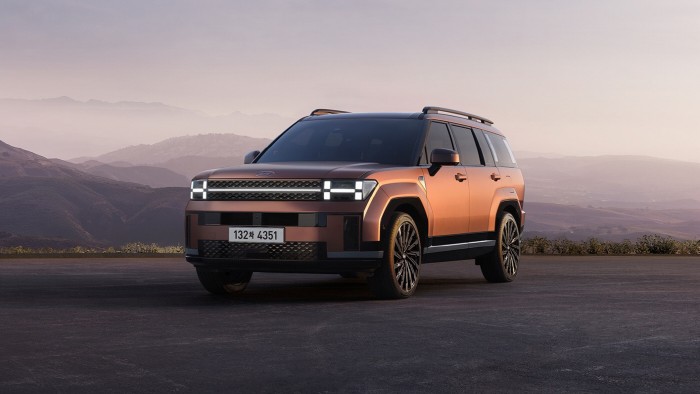 |
| Hyundai Santa Fe. / Hyundai Motor Company |
With U.S. President Donald Trump formalizing the end of the Biden administration's so-called "EV mandate," a new variable has emerged for Hyundai Motor and Kia's U.S. strategy. As the pace of transition toward electric vehicles is more likely to slow, Hyundai and Kia plan to address these policy shifts by flexibly managing their existing product portfolio spanning hybrid and internal combustion engine (ICE) models while expanding local production.
According to foreign media reports on the 28th, President Trump announced on Truth Social on the 26th local time that he "approved new fuel economy standards that eliminate the unreasonable EV mandate." He added that this move would squeeze out inflated vehicle manufacturing costs, lower vehicle prices, and allow buyers to save thousands of dollars per car.
The Trump administration had long defined tightening fuel economy and emissions regulations as an "EV mandate," arguing they effectively forced automakers to sell electric vehicles. The core of this latest measure will likely center on relaxing Corporate Average Fuel Economy (CAFE) standards. The U.S. Department of Transportation previously proposed lowering CAFE requirements for model year 2031 vehicles from about 50 miles per gallon to 34.5 miles per gallon. Easing fuel economy rules reduces automakers' pressure to boost average fuel economy by selling high-efficiency vehicles such as pure electric or hybrid models.
For Hyundai and Kia, this elevates the importance of a product strategy capable of recalibrating the proportions of ICE, hybrid, and electric models based on market demand, rather than aggressively pushing EV sales in the U.S. market. The first card they can play is hybrids. Hyundai and Kia have already been expanding hybrid sales rapidly in the U.S. Last year, their combined U.S. hybrid sales surpassed 330,000 units, surging 48.8% year over year.
Hybrids represent more than a regulatory compliance tool; they align closely with actual demand from U.S. consumers. In a U.S. market with strong preferences for recreational vehicles (RVs) like large SUVs and pickup trucks, hybrids offer higher fuel efficiency and longer driving ranges than conventional ICE vehicles while carrying less charging burden than battery-electric vehicles. Hyundai and Kia's RV-centric sales structure further underpins this approach. Since entering the U.S. in 1994, the two automakers' cumulative U.S. RV sales have reached 15,067,646 units, surpassing the 15 million mark. RVs have also accounted for more than 70% of their annual U.S. sales each year since 2022.
Between January and August this year, Hyundai and Kia sold 936,789 RVs in the U.S., representing roughly 68% of last year's total annual volume of 1,387,145 units. Hyundai SUVs such as the Santa Fe, Tucson, and Palisade, alongside Kia RVs including the Sportage, Sorento, and Telluride, serve as the backbone of their U.S. market presence. Establishing lineups that offer ICE, hybrid, and EV powertrains within identical segments provides another competitive edge. Even if EV demand grows more slowly than anticipated, deploying hybrid and ICE models across their established RV sales foundation allows them to navigate shifting demand.
Flexibility is also taking shape on the manufacturing front. In particular, Hyundai Motor Group Metaplant America (HMGMA), targeting an annual output of 500,000 units, incorporates a flexible mixed-model production system that can adjust the manufacturing balance between EVs and hybrids according to market needs. Even if U.S. electrification policies or consumer demand shift unexpectedly, adjusting production models flexibly will enable the plant to maintain high capacity utilization.
Expanding U.S. investments and accelerating the establishment of local production and supply chains follow the same logic. Amid frequent policy swings surrounding the U.S. auto sector—including tariffs, subsidies, and fuel economy rules—reinforcing a setup where vehicles sold in the U.S. are manufactured in the U.S. enhances resilience against external headwinds.
However, these policy shifts do not signal a retreat from Hyundai and Kia's broader electrification strategy. While moderating their rollout speed to match changing EV demand in the U.S. market, they intend to keep expanding their electrified lineups. Hyundai plans to roll out an extended-range electric vehicle (EREV) based on the Santa Fe early next year.
An industry official noted, "Pairing expanded hybrid sales and RV-centric product competitiveness with local manufacturing flexibility to navigate policy shifts will likely stand as the central task for their U.S. operations moving forward."
Kim Jeong-gyu
Most Read
-
1
Trump shares map on social media labeling Strait o..

-
2
Trump demands rates fall below 1% as Fed hikes for..

-
3
Celltrion seeks rheumatoid arthritis indication ex..

-
4
Chinese e-commerce giants AliExpress, Temu and She..

-
5
Trump warns countries not helping U.S. must pay re..

-
6
China expels No. 2 military official Zhang Youxia..

-
7
Houthi rebels release video claiming downing of Sa..

PEOPLE






HEADLINE NEWS
- N. Korea declares nuclear status irreversible and condemns S. Korea, U.S., Japan at UN
- Japan tracks Ukraine fiber-optic drones, bolsters SDF electronic warfare
- Wave of undocumented Chinese caught in Argentina after Brazil's visa-free m..
- France's far-right National Rally forms first-ever parliamentary group in S..

-
Address : In-Young Bldg., 34, Uisadang-daero 1-gil, Yeongdeungpo-gu, Seoul
Copyright by ASIATODAY CO., LTD. All rights resereved