



Harmful ingredients in cigarettes to be disclosed next month
Sep 29, 2026, 09:33 am


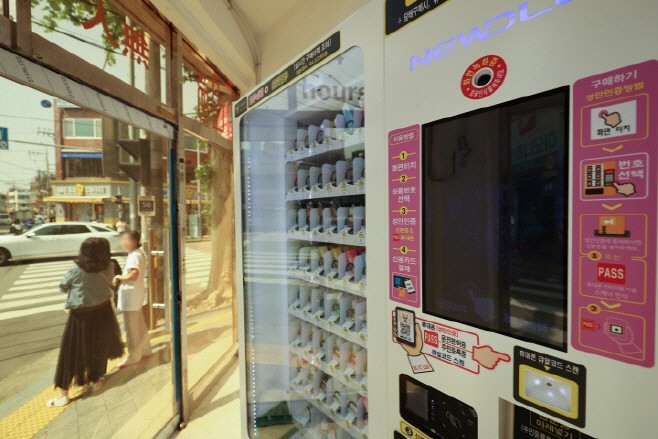 |
| Synthetic nicotine e-cigarette liquids are displayed in a vending machine installed at an unmanned vape shop. / Yonhap |
As the government plans to disclose the harmful ingredients in tobacco products next month, promotional posts selling nicotine-free e-liquid inhalation products have begun appearing with attached component analysis reports. Consequently, concerns are emerging in some quarters that the government's harmful ingredient findings could be exploited in advertisements promoting "less harmful tobacco."
According to the second-half policy plan released by the Ministry of Food and Drug Safety on the 28th, the ministry will disclose harmful ingredient analysis results for 465 tobacco products across 20 manufacturers this October. This marks the first time individual product test results are disclosed under the Act on the Management of Tobacco Harmfulness, which took effect in November last year.
The inspection targets 44 harmful substances found in emissions from conventional cigarettes and heated tobacco products, as well as 20 harmful ingredients in e-cigarettes. The figures 44 and 20 represent the designated number of ingredients required for testing by product category, rather than the count of substances actually detected.
However, the detected levels of individual ingredients do not account for overall health risks. The World Health Organization (WHO) explains that while certain toxic substances in heated tobacco products are detected at lower levels than in conventional cigarettes, other compounds are found at similar or higher concentrations. The WHO maintains that evidence remains insufficient to conclude that heated tobacco products are less harmful. This is why caution is required when low levels of one or two substances are circulated like a product's "safety score."
Yet moves to leverage these figures for sales purposes have already emerged. According to the Korea Center for Tobacco Control Research and Education (KCTCRE), cases have surfaced where sellers promoted nicotine-free liquid inhalation products online by attaching component analysis reports. This drives concern that if companies selectively cite certain items in their advertisements after the government releases official data, test results could be misinterpreted as a government safety endorsement.
Accordingly, observers point out that the government must present the scope and methods of testing along with the limitations of cross-product comparisons in plain language alongside the detected amounts. Authorities also need to establish guidelines before the public release on how to monitor advertisements that frame reductions in specific substances as an overall decrease in harm. Even if the figures themselves are accurate, omitting explanations could lead consumers to draw mistaken conclusions.
Inhalation products excluded from the disclosure also warrant scrutiny. Following the revision of the Tobacco Business Act in April, synthetic nicotine was brought under tobacco regulations, but nicotine analogues—substances distinct from nicotine—fall outside the legal definition of tobacco. When the government collected and tested 105 products marketed as "nicotine-free" with high online sales in June, nicotine was found in 13 items and 6-methylnicotine, a type of nicotine analogue, was detected in 12 products. These findings reflect targeted screening tests and do not represent the overall detection rate across all market products.
Lee Sung-kyu, head of the Korea Center for Tobacco Control Research and Education, noted, "Expanding the definition of tobacco marks an institutional advance 37 years in the making, but stockpiling synthetic nicotine inventories prior to enforcement and substituting them with nicotine analogues and nicotine-free products is delaying regulatory effectiveness." He added, "Alongside managing school protection zones, establishing a sophisticated regulatory framework that encompasses nicotine analogues as a whole is an urgent priority."
Lee Se-mi
Most Read
-
1
Trump shares map on social media labeling Strait o..

-
2
Trump demands rates fall below 1% as Fed hikes for..

-
3
Celltrion seeks rheumatoid arthritis indication ex..

-
4
Chinese e-commerce giants AliExpress, Temu and She..

-
5
Trump warns countries not helping U.S. must pay re..

-
6
China expels No. 2 military official Zhang Youxia..

-
7
Houthi rebels release video claiming downing of Sa..

PEOPLE






HEADLINE NEWS
- N. Korea declares nuclear status irreversible and condemns S. Korea, U.S., Japan at UN
- Japan tracks Ukraine fiber-optic drones, bolsters SDF electronic warfare
- Wave of undocumented Chinese caught in Argentina after Brazil's visa-free m..
- France's far-right National Rally forms first-ever parliamentary group in S..

-
Address : In-Young Bldg., 34, Uisadang-daero 1-gil, Yeongdeungpo-gu, Seoul
Copyright by ASIATODAY CO., LTD. All rights resereved