



North Korea stays silent on repatriation of POWs to South Korea
Sep 29, 2026, 09:21 am


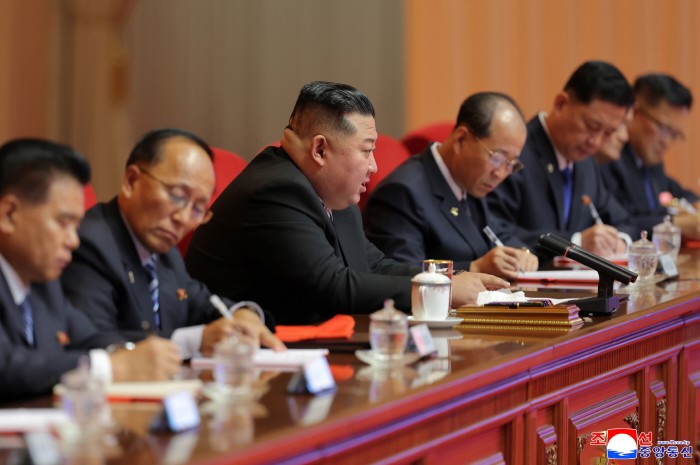 |
| North Korean leader Kim Jong-un delivered an address at the closing ceremony of the Third Workshop for Propaganda Officials of the Workers' Party of Korea on the 21st, the Korean Central News Agency reported on the 22nd. / Yonhap News |
Four days have passed since Ukrainian President Volodymyr Zelensky announced that Ukraine repatriated two North Korean prisoners of war to South Korea, yet North Korea has shown no reaction whatsoever. Observers suggest that Pyongyang likely calculates no domestic or external benefit in responding to the issue, making it highly probable that it will maintain silence going forward.
According to the Ministry of Unification on the 28th, North Korean domestic and external media outlets have yet to issue any comment since President Zelensky made the repatriation public on the 23rd (local time). Aside from statements issued on the 24th by Foreign Minister Choe Son-hui and a Foreign Ministry spokesperson reasserting North Korea’s nuclear-power status, Pyongyang has refrained from sending distinct external messages following Zelensky’s remarks.
Yoon Min-ho, spokesperson for the Ministry of Unification, stated at a press briefing held at the government complex that day, "No related movements [regarding the domestic repatriation of the North Korean POWs] have been detected thus far, and we will continue monitoring the situation." The remark is seen as a sign that the government is closely watching the potential fallout on inter-Korean relations and related areas.
Experts forecast that North Korea will consistently remain unresponsive to the transfer of its captured soldiers to the South. Their analysis indicates that if the public learns that surviving prisoners were not brought home alive, the regime’s responsibility would come to the fore, potentially weakening internal control over the system. In particular, given that North Korean authorities have glorified deployed soldiers who blew themselves up as "stars of the motherland" and hailed them as heroes, the mere existence of surviving captives could adversely affect troop morale and internal solidarity.
Cho Han-bum, senior research fellow at the Korea Institute for National Unification, projected, "The repatriation of two North Korean prisoners to South Korea is a fatal issue for North Korean authorities. Because the regime has continuously emphasized a heroic narrative around deployed soldiers, the likelihood of disclosing this matter domestically is extremely low."
Some observers also note that unless the repatriated soldiers engage in public appearances in the future, North Korea is unlikely to mount a diplomatic backlash over the issue.
Meanwhile, under the North Korean Defectors Protection and Settlement Support Act, the two North Korean POWs who arrived in the South will undergo temporary protection measures—including inquiries to determine protection eligibility and emergency medical treatment—administered by the National Intelligence Service before being transferred to Hanawon, a settlement support facility. After completing a designated period of social adaptation training, they are integrated into society. However, when cases require separate management due to acute sensitivity or high-profile defector status, individuals reportedly bypass Hanawon.
Regarding settlement support and protection decisions for the North Korean captives, Spokesperson Yoon explained, "The review will proceed in accordance with the North Korean Defectors Protection and Settlement Support Act and past precedents. Under standard legal procedures, if an individual is deemed capable of significantly affecting national security, the Director of the National Intelligence Service decides on protection; in other cases, the Minister of Unification makes the determination."
Mok Yong-jae
Most Read
-
1
Trump shares map on social media labeling Strait o..

-
2
Trump demands rates fall below 1% as Fed hikes for..

-
3
Celltrion seeks rheumatoid arthritis indication ex..

-
4
Chinese e-commerce giants AliExpress, Temu and She..

-
5
Trump warns countries not helping U.S. must pay re..

-
6
China expels No. 2 military official Zhang Youxia..

-
7
Houthi rebels release video claiming downing of Sa..

PEOPLE






-
Address : In-Young Bldg., 34, Uisadang-daero 1-gil, Yeongdeungpo-gu, Seoul
Copyright by ASIATODAY CO., LTD. All rights resereved