



Chinese shipyards challenge S. Korea in large LNG carriers
Sep 28, 2026, 10:05 am


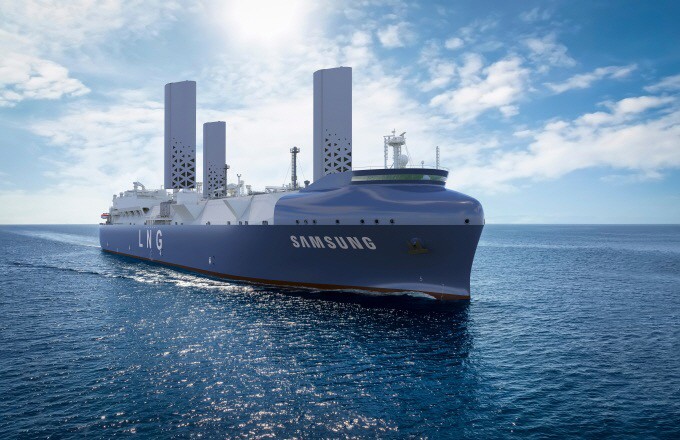 |
| An LNG carrier equipped with a wind-assisted propulsion system developed by Samsung Heavy Industries. / Samsung Heavy Industries |
Observers note that the South Korean shipbuilding industry must lead in quality competition through technological superiority to hold off China's pursuit. This comes as six Chinese shipbuilders, led by Hengli Heavy Industry, have jumped into liquefied natural gas (LNG) carrier production, challenging South Korea’s dominance in the high-value vessel market.
According to foreign media reports, including Chinese industry outlet eWorldShip on the 27th, six Chinese shipyards—Hengli, Jiangnan Shipyard, Hudong-Zhonghua Shipbuilding, Dalian Shipbuilding Industry, China Merchants Industry-affiliated yards, and Yangzijiang Shipbuilding—are known to be pursuing LNG carrier construction. Hengli, in particular, announced plans to build two LNG carriers through self-investment, aiming to demonstrate its construction capabilities before scaling up orders. As of now, no confirmed orders have been placed for the two LNG carriers Hengli announced it would build.
According to Reuters, when Hengli initially entered the shipbuilding business and struggled to secure shipowner orders, it first built very large crude carriers (VLCCs) on its own account. Last year, it secured orders for 115 vessels across various ship types, translating that experience into large LNG carriers.
Data from Clarkson Research shows that in the first half of this year, South Korea secured 7.97 million CGT (195 vessels), accounting for 19% of global order volume. Over the same period, China captured 31 million CGT (1,131 vessels), holding a 72% market share. While South Korea's order intake jumped 60% compared to the same period last year, the volume gap with China remained substantial. Although these figures do not directly reflect construction difficulty or ship-type competitiveness for LNG carriers, attention is focused on the growing number of Chinese shipyards challenging the specialty vessel sector.
An industry insider remarked, "China's pursuit expanding into LNG carriers and other specialty vessel segments that require high technological complexity warrants vigilance. It will present a considerable challenge to the South Korean shipbuilding industry."
In response to China's chase, South Korea's shipbuilding industry is narrowing its focus toward securing next-generation technologies. At this month's Gastech exhibition, HD Hyundai Heavy Industries announced Approval in Principle (AiP) from Lloyd's Register for its 185,000-cubic-meter hybrid electric propulsion LNG carrier design. Samsung Heavy Industries highlighted design technology for floating LNG (FLNG) facilities, while Hanwha affiliates showcased AiP for a 22,000-cubic-meter LNG bunkering vessel concept design. This demonstrates that South Korean shipbuilders are expanding their business footprint into LNG production and bunkering while improving the propulsion efficiency of existing carriers.
Ultimately, maintaining the competitiveness of South Korea's Big Three shipbuilders extends beyond unveiling new designs. They must apply technologies that boost propulsion efficiency and minimize cargo boil-off to actual ships, deliver them on schedule, and prove operational performance. Only when shipowners observe these results and return to South Korean yards will technology investments translate into proven track records capable of countering China's volume offensive. Another industry insider noted, "It remains uncertain whether Chinese shipbuilders' spec-built vessels will find buyers and reach delivery. In the meantime, the crucial factor will be whether the South Korean shipbuilding industry can connect next-generation technologies to contracts, deliveries, operational performance, and repeat orders."
Han Dae-ui
Most Read
-
1
Celltrion nears additional contract with major U.S..

-
2
U.S. weighs dropping MOAB, world's most powerful n..

-
3
"Aren't those foreigners on welfare?": M..

-
4
Houthis launch successive attacks on Saudi airport..

-
5
Saudi Arabia, Iran hold first diplomatic talks to..

-
6
Saudi airport in Riyadh struck again, leaving at l..

-
7
Five ASEAN countries welcome Myanmar coup leader

PEOPLE






HEADLINE NEWS
- Trump's approval rating hits low of 33% as public turns back over soaring inflation
- Trump says Hyundai announced 748.6-billion-won investment in Georgia
- China tightens grip on boosting domestic demand and expanding anti-graft dr..
- Food prices jump 35% over 10 years, fueling massive protests by 800,000 acr..

-
Address : In-Young Bldg., 34, Uisadang-daero 1-gil, Yeongdeungpo-gu, Seoul
Copyright by ASIATODAY CO., LTD. All rights resereved