



Police penetrate social media and random chat apps
Sep 28, 2026, 09:49 am


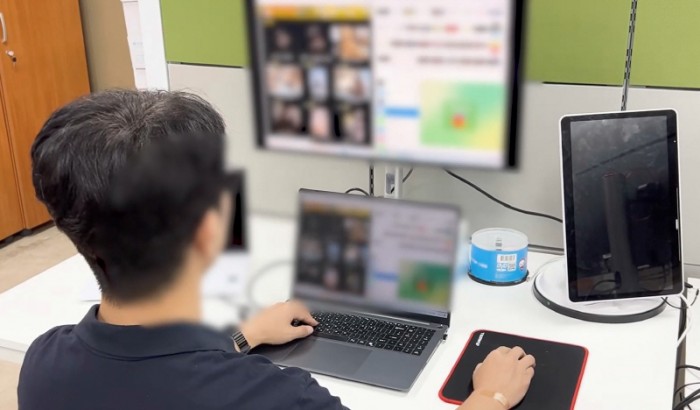 |
| Police officers conduct an undercover investigation. / Korean National Police Agency |
Police undercover investigations into digital sex crimes have expanded sharply this year. In particular, cases where officers went undercover as children or adolescents on social media and random chat platforms, apprehending suspects from the initial stages of grooming conversations aimed at sexual exploitation, have surged.
According to the National Investigation Headquarters of the Korean National Police Agency on the 27th, a total of 1,503 undercover investigations have been conducted from September 24, 2021—when the undercover investigation system was introduced—through August of this year. These operations resulted in the arrest of 2,873 individuals, with 164 taken into formal custody. From January to August this year alone, 598 undercover operations were carried out, marking a 234% increase of 419 cases compared to 179 cases in the same period last year.
Undercover investigations were instituted in 2021 following the "Nth Room" and "Baksa Room" cases. The scope was expanded to cover digital sex crimes targeting adults starting in June last year, and provisions penalizing attempted grooming conversations for the purpose of child and youth sexual exploitation took effect last October, enabling police to pose as minors and launch investigations from the very initial stages of illicit conduct.
By crime category, distribution offenses—including sale and dissemination—accounted for the largest share at 748 cases (49.8%). This was followed by conversations aimed at sexual exploitation with 562 cases (37.4%), production offenses with 143 cases (9.5%), and purchase, possession, or viewing with 46 cases (3.1%).
Apprehensions of suspects engaged in grooming conversations for sexual exploitation rose noticeably. From the launch of the system in 2021 through last year, 87 suspects had been caught via undercover probes in this category; this year alone, however, 338 suspects were apprehended, with six taken into custody. Police intend to intervene starting from the online grooming phase to cut off crimes before they escalate into the actual production of sexually exploitative material, statutory rape, or physical sexual assault.
In one notable case, the Ulsan Metropolitan Police Agency identified a suspect through an undercover operation and arrested him last month on charges of luring seven children and adolescents via social media between October 2021 and March this year, committing statutory rape 24 times, and producing sexually exploitative material on 78 occasions. In another case in April, officers approached a suspect producing and selling deepfake videos under the pretext of commissioning content, pinpointed his identity, and arrested him while he was hiding in a motel.
The Gyeonggi Nambu Provincial Police Agency also identified and arrested two operators last month through an undercover operation. Since May last year, the two had run 23 illegal websites, uploading more than 10,000 illicitly filmed videos and reaping 70 million won in advertising revenue.
Between January and August this year, police arrested 32 operator-level suspects across 66 websites that circulated sexually exploitative material, placing nine under formal arrest. Authorities are also tracking key participants, including administrators and developers, as well as distribution routes across 76 illegal websites currently under investigation.
Hong Seok-ki, head of the National Investigation Headquarters, stated, "Anonymity and closed networks can no longer serve as a shield for crime. Undercover officers are active in online crime scenes at this very moment."
Seol So-young
Most Read
-
1
Trump demands rates fall below 1% as Fed hikes for..

-
2
Celltrion seeks rheumatoid arthritis indication ex..

-
3
Chinese e-commerce giants AliExpress, Temu and She..

-
4
Trump warns countries not helping U.S. must pay re..

-
5
China expels No. 2 military official Zhang Youxia..

-
6
Houthi rebels release video claiming downing of Sa..

-
7
Trump rejects Iran's offer to open Strait of Hormu..

PEOPLE







-
Address : In-Young Bldg., 34, Uisadang-daero 1-gil, Yeongdeungpo-gu, Seoul
Copyright by ASIATODAY CO., LTD. All rights resereved