



8 in 10 South Koreans support low-risk handguns
Sep 23, 2026, 09:27 am


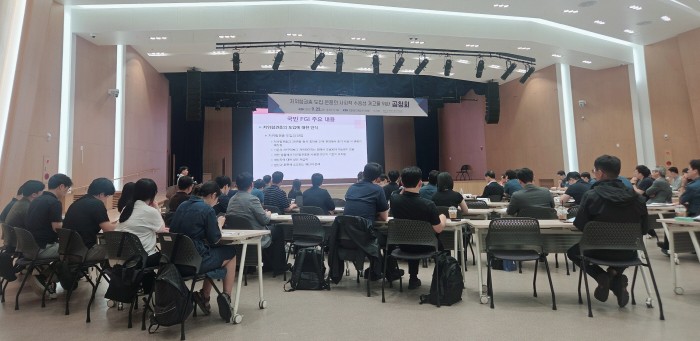 |
| Around 80 participants, including citizens, frontline police officers, and experts, exchange views during a public hearing on introducing less-lethal handguns, held at the National Police Agency in Seodaemun District, Seoul, on the 22nd. / Reporter Seol So-young |
A majority of the public and police officers support introducing less-lethal handguns, findings showed. However, concerns over low stopping power and weapon performance run high among officers who have conducted test firings, prompting calls for field validation and clear guidelines for use prior to full-scale deployment.
The National Police Agency held a public hearing on introducing less-lethal handguns on the 22nd at its headquarters in Seodaemun District, Seoul, attended by around 80 people, including citizens, frontline police officers, and experts.
A survey of 809 adults conducted by the Korean Institute of Criminology and Justice showed that 81.3% supported introducing less-lethal handguns. High proportions of respondents also agreed that the weapons would help subdue criminals (83.2%) and complement electronic stun devices (86.1%). Conversely, 62.4% expressed concern over weak stopping power, while 61.1% voiced worries about potential misuse or abuse.
Among 3,197 police officers assigned to firearms-related divisions, 73.5% favored the rollout. However, the approval rate stood at only 48.9% among the 331 officers who participated in test-firing sessions. This was 27.4 percentage points lower than the 76.3% approval rate recorded among officers without test-firing experience. Overall performance satisfaction among experienced shooters was also low at 41.7%.
Although less-lethal rounds pack roughly one-tenth the power of conventional .38 caliber live ammunition, they can penetrate the body by about 60 mm, meaning the risk of fatal or severe injuries cannot be ruled out. The research team assessed that the equipment legally qualifies as a weapon.
Concerns were also raised that deploying conventional revolvers alongside less-lethal handguns could heighten legal burdens for frontline officers. If an officer fires a standard handgun first, they could face scrutiny for failing to select a less dangerous option. Conversely, if an officer deploys a less-lethal handgun and fails to incapacitate a suspect, questions of accountability could arise regarding failure to sufficiently safeguard citizens and fellow officers.
Citizens cited establishing clear usage criteria and procedures as the primary prerequisite, while police officers pointed to delineating liability boundaries and revising protective standards. Experts noted that the label "less-lethal" could cause misconceptions that the equipment is entirely safe or non-lethal, suggesting that a name change should also be considered.
Experts advised addressing issues regarding weak stopping power, laser sights, and safety mechanisms, while establishing usage criteria alongside immunity and protection standards for officers before moving forward with phased pilot operations.
Seol So-young
Most Read
-
1
Trump demands rates fall below 1% as Fed hikes for..

-
2
Celltrion seeks rheumatoid arthritis indication ex..

-
3
Chinese e-commerce giants AliExpress, Temu and She..

-
4
Trump warns countries not helping U.S. must pay re..

-
5
Turkish Airlines named main club partner of Liverp..

-
6
China expels No. 2 military official Zhang Youxia..

-
7
Houthi rebels release video claiming downing of Sa..

PEOPLE







-
Address : In-Young Bldg., 34, Uisadang-daero 1-gil, Yeongdeungpo-gu, Seoul
Copyright by ASIATODAY CO., LTD. All rights resereved