



S. Korea bans extreme private education tests for young children, with fines up to 3 million won
Sep 23, 2026, 09:20 am


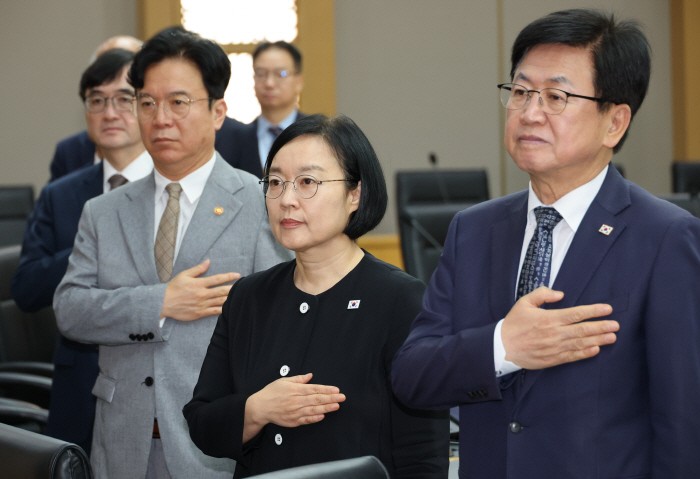 |
| Prime Minister Han Seong-suk (center) salutes the national flag during a Cabinet meeting held at the Government Complex Sejong in Sejong on the 22nd. Pictured on the right is Minister of Education Choi Kyo-jin. / Yonhap |
Entrance examinations and level tests for toddlers and young children, colloquially dubbed the "four-year-old exam" and "seven-year-old exam," will be completely banned starting in October. Hagwons (private cram schools) that violate the ban will face fines of up to 3 million won, and reporting illicit testing practices will make whistleblowers eligible for financial rewards.
The Ministry of Education announced that a partial revision to the Enforcement Decree of the Act on the Establishment and Operation of Private Teaching Institutes and Extracurricular Lessons was deliberated and approved during a Cabinet meeting on the 22nd. The revised enforcement decree serves as a follow-up measure to the amended Hagwon Act, which takes effect on the first of next month.
The "four-year-old and seven-year-old exams" refer to the practice of administering tests, interviews, or level assessments to toddlers and preschool children for admission or class placement, primarily at English-language academies. The custom has sparked intense public controversy, drawing criticism that it borders on child abuse by imposing evaluations far beyond early developmental stages, fueling premature academic competition, robbing young children of playtime and exploration, and causing excessive emotional strain.
In response, the National Assembly passed an amendment to the Hagwon Act in March, prohibiting tests and evaluations for admissions or class tracking at private institutes for young children, including so-called English kindergartens. In April, the Ministry of Education also rolled out measures tackling early-childhood private education, which banned cognitive tutoring for children under age 3 and capped cognitive lesson hours for preschoolers aged 3 and older to no more than three hours a day and 15 hours a week.
With the approval of the revised enforcement decree, private hagwons, learning centers, and individual private tutors are barred from administering tests or assessments to recruit toddlers or track them into leveled classes. The ban encompasses not only written, oral, practical, and interview-based exams, but also evaluations leveraging verification of specific competencies or past academic portfolios, as well as tests and assessments that rank children by skill level.
Diagnostic assessments to support educational activities are permitted only after a child has enrolled in a hagwon, learning center, or began private tutoring. Even in such cases, assessments must be conducted solely through observation or interviews and require prior parental consent.
The government also closed loopholes on de facto level tests disguised as diagnostic evaluations. Diagnostic outcomes can only be provided as descriptive summaries detailing an individual child's learning progress or areas requiring support, with strict bans on issuing scores, percentiles, or pass-fail ratings.
Sanctions for non-compliance have also been established. Administering tests or assessments for recruitment or leveled class placement will incur fines of 1 million won for a first violation, 2 million won for a second, and 3 million won for a third. Whistleblowers reporting violations will be eligible for cash rewards within budget allocations.
Individual tutoring for young children will also be brought under official regulatory oversight. Starting on the first of next month, young children will be formally recognized as subjects of private tutoring under the Hagwon Act, requiring private tutors and learning centers teaching early-childhood students to register with local education offices. The Ministry of Education plans to provide registration guidelines to minimize operational confusion.
The latest regulatory push seeks to curb excessive early private tutoring, such as the prep tutoring sought by parents to place toddlers into prestigious English academies—the "four-year-old exam"—or the assessments taken prior to elementary school entry, the "seven-year-old exam."
Minister of Education Choi Kyo-jin stated, "With this revision to the enforcement decree, we have blocked extreme forms of early-childhood private education such as the four-year-old and seven-year-old exams, laying the groundwork for a society where young children can grow up healthy. We will continue our efforts to ensure that our children grow up in good health and happiness."
Park Ji-sook
Most Read
-
1
Trump demands rates fall below 1% as Fed hikes for..

-
2
Celltrion seeks rheumatoid arthritis indication ex..

-
3
Chinese e-commerce giants AliExpress, Temu and She..

-
4
Trump warns countries not helping U.S. must pay re..

-
5
Turkish Airlines named main club partner of Liverp..

-
6
China expels No. 2 military official Zhang Youxia..

-
7
Houthi rebels release video claiming downing of Sa..

PEOPLE






-
Address : In-Young Bldg., 34, Uisadang-daero 1-gil, Yeongdeungpo-gu, Seoul
Copyright by ASIATODAY CO., LTD. All rights resereved