



Anti-austerity protests erupt in 60 cities across Argentina
Sep 22, 2026, 10:11 am


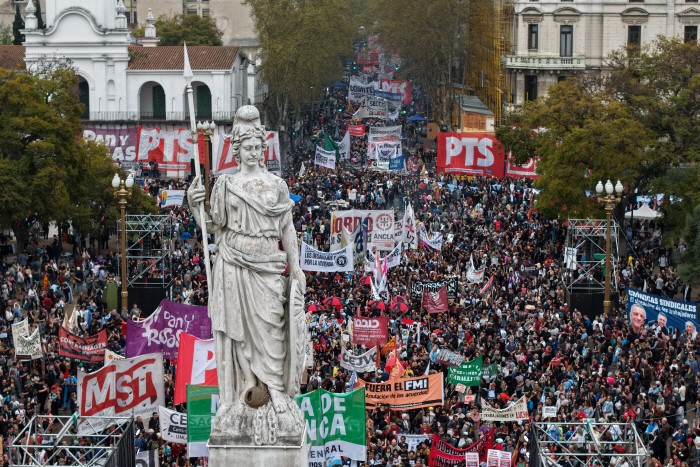 |
| A large crowd gathers outside Argentina’s presidential palace during a protest against the government’s austerity policies on Sept. 19 local time. / Reuters-Yonhap |
Opposition to the Argentine government’s sweeping austerity policies is growing across the country.
According to local media including Clarín on Sept. 20 local time, protests against President Javier Milei’s fiscal austerity measures were held the previous afternoon in 60 cities nationwide, including Buenos Aires, Córdoba, Rosario and Tucumán.
The demonstrations, dubbed the “March of Anger,” were jointly organized by left-wing political parties, labor unions and civic groups, with large numbers of ordinary citizens also taking part.
In Buenos Aires, thousands of protesters gathered in the square in front of Congress before marching to the presidential palace, where they continued their demonstration.
Participants adopted a statement calling for a nationwide general strike to halt the government’s austerity policies. The statement condemned the Milei administration’s economic policies while also sharply criticizing provincial governments for failing to oppose austerity and the country’s two major labor organizations, the General Confederation of Labor, or CGT, and the Argentine Workers’ Central Union, or CTA, for not taking stronger action against the measures.
“Bring down austerity” was repeatedly chanted from a stage set up at the rally.
Citizens weary of austerity also voiced their frustration.
“I joined the protest because I’m tired of receiving my salary and still not being able to make it through the month,” said María Veloso, 57, accusing the government of pushing people toward hunger through its austerity measures.
Rodolfo Giloso, 59, said the current policies “serve only a small minority and cannot be policies for the majority of the population,” urging the government to abandon austerity.
Since taking office in December 2023, the Milei administration has identified chronic fiscal deficits as a key cause of Argentina’s persistent inflation and pursued aggressive austerity measures, including consolidating 18 government ministries into nine and dismissing about 72,000 public employees.
Argentina posted fiscal surpluses for two consecutive years in 2024 and 2025, while inflation fell from 211% in 2023 to 117% in 2024 and 31% in 2025.
However, the economy has struggled as the prolonged austerity drive has continued.
According to Argentina’s National Institute of Statistics and Census, or INDEC, the economy contracted 0.6% in the second quarter from the previous quarter.
Private consumption fell 2.4%, while investment declined 0.8%, marking the fifth consecutive quarter of falling investment.
The nationwide unemployment rate stood at 7.9% during the same period. Unemployment reached double digits in several areas, including 11.5% in Greater Rosario and 10.5% in Greater Córdoba.
Argentina’s nationwide unemployment rate stood at 5.7% in the fourth quarter of 2023, when the Milei administration took office.
“All I hear about around me is layoffs,” said Jorge Rosas, 56. “They say more than 30,000 companies have shut down since the Milei government took office. How could there be jobs?”
Local media reported that while participants in the “March of Anger” had different personal reasons for joining — including failed job searches, mounting debt and economic insecurity caused by the downturn — they were united in opposing the government’s economic policies, reflecting growing fatigue with austerity.
Son Young-sik
Most Read
-
1
Celltrion’s Omlyclo gains ground in major European..

-
2
Trump demands rates fall below 1% as Fed hikes for..

-
3
Trump makes $1 trillion bet ahead of midterm elect..

-
4
Iran resumes ballistic missile production, assembl..

-
5
Samsung Electronics, Mistral AI to jointly develop..

-
6
Trump warns countries not helping U.S. must pay re..

-
7
Apple launches first foldable, 1 million won prici..

PEOPLE






HEADLINE NEWS
- Trump to roll out ‘unprecedented welcome’ for Xi with B-2 bombers, F-22 fighters
- S. Korea, U.S., and Japan form united front on Taiwan and economic coercion..
- Trump administration moves to impose sweeping sanctions on International Cr..
- Xi to make state visit to U.S. Sept. 23-25, dispelling rumors over his heal..

-
Address : In-Young Bldg., 34, Uisadang-daero 1-gil, Yeongdeungpo-gu, Seoul
Copyright by ASIATODAY CO., LTD. All rights resereved