



Deposit rates climb, benefiting savers but squeezing vulnerable borrowers
Sep 22, 2026, 09:52 am


 |
| This image was generated by AI. |
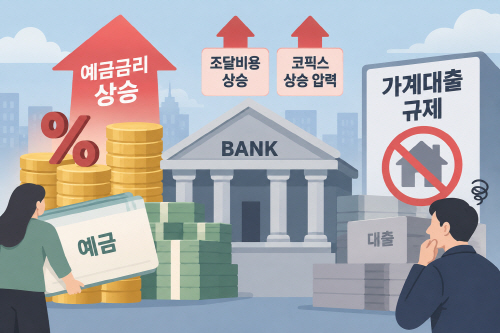
Deposit rates are rising sharply as competition among banks for customer deposits intensifies. With market rates climbing following a benchmark rate hike, banks are raising rates on major deposit products to secure funding.
While higher rates offer depositors an opportunity to earn more interest, concerns are growing that they could increase the burden on vulnerable borrowers who rely heavily on loans.
According to the financial industry on Sept. 22, KB Kookmin Bank raised the rate on its KB Star Time Deposit by 0.10 percentage point. The increase follows a 0.15 to 0.60 percentage-point hike on the same product on Sept. 14.
The rate for deposits of one year to less than two years rose from 3.40% to 3.50% per year, while the rate for six months to less than one year increased from 3.15% to 3.25%.
Other major commercial banks have also raised deposit rates this month.
Shinhan Bank increased the rate on its SOL Convenient Time Deposit by 0.20 percentage point on Sept. 9, bringing the one-year maturity rate to 3.40%.
Hana Bank and Woori Bank raised rates on their Hana Time Deposit and WON Plus Deposit on Sept. 10 by 0.10 percentage point and 0.20 percentage point, respectively, to 3.30% and 3.40%. Woori Bank raised its rate again to 3.50% on Sept. 18.
NH NongHyup Bank also increased the rate on its NH All One e-Deposit by 0.20 percentage point from Sept. 11, applying an annual rate of 3.45% for a 12-month maturity.
The rapid rise in deposit rates is attributed to the growing importance of securing stable deposits as higher market rates push up banks’ funding costs.
In a high-rate environment, the cost of issuing bonds rises and securing long-term funding becomes more burdensome, intensifying competition for relatively short-term deposits.
Growing volatility in the domestic stock market has also encouraged a reverse money move from stocks into deposits, with the term “deposit investing” gaining traction. This has created favorable conditions for banks to attract deposits more aggressively.
The combined balance of time deposits at South Korea’s five major banks — KB Kookmin, Shinhan, Hana, Woori and NH NongHyup — reached 1,005.2319 trillion won at the end of last month, surpassing 1,000 trillion won for the first time.
As of Sept. 17, the balance had climbed further to 1,010.3722 trillion won, up 5.1403 trillion won in less than three weeks.
As higher interest rates make deposits more attractive as a stable source of returns, funds have continued to flow into time deposits.
The concern is that higher deposit rates could raise banks’ funding costs and, in turn, push up lending rates, adding to the interest burden on vulnerable borrowers.
The Cost of Funds Index, or COFIX, which reflects banks’ funding costs, has also continued to rise. This month, the balance-based and new balance-based COFIX rates rose by 0.05 percentage point and 0.06 percentage point, respectively, to 3.05% and 2.71%.
Mortgage rates at major banks are also trending higher.
As of Sept. 17, floating-rate mortgage rates at the five major banks ranged from 4.29% to 6.29%, with the lower end up 0.19 percentage point from Aug. 18.
The average rate actually applied to installment-repayment mortgages by the five banks has also risen steadily, from 4.424% in May to 4.498% in June and 4.656% in July.
Although the new-deal COFIX remained unchanged from the previous month this month, upward pressure on next month’s COFIX is expected to intensify because banks broadly raised deposit rates in September.
“Banks also appear to believe that interest rates are near their peak, so they are increasing short-term funding rather than long-term funding, which is pushing up short-term rates,” said Son Jae-sung, professor of accounting at Soongsil University, adding that "This is a phenomenon that typically appears when rates are near a peak, with short-term rates overtaking long-term rates, and the burden on borrowers with floating-rate loans inevitably increases.”
Chae Jong-il
Most Read
-
1
Celltrion’s Omlyclo gains ground in major European..

-
2
Trump demands rates fall below 1% as Fed hikes for..

-
3
Trump makes $1 trillion bet ahead of midterm elect..

-
4
Iran resumes ballistic missile production, assembl..

-
5
Samsung Electronics, Mistral AI to jointly develop..

-
6
Trump warns countries not helping U.S. must pay re..

-
7
Apple launches first foldable, 1 million won prici..

PEOPLE






HEADLINE NEWS
- Trump to roll out ‘unprecedented welcome’ for Xi with B-2 bombers, F-22 fighters
- S. Korea, U.S., and Japan form united front on Taiwan and economic coercion..
- Trump administration moves to impose sweeping sanctions on International Cr..
- Xi to make state visit to U.S. Sept. 23-25, dispelling rumors over his heal..

-
Address : In-Young Bldg., 34, Uisadang-daero 1-gil, Yeongdeungpo-gu, Seoul
Copyright by ASIATODAY CO., LTD. All rights resereved