



All five military commanders involved in martial law receive prison sentences
Sep 22, 2026, 09:23 am


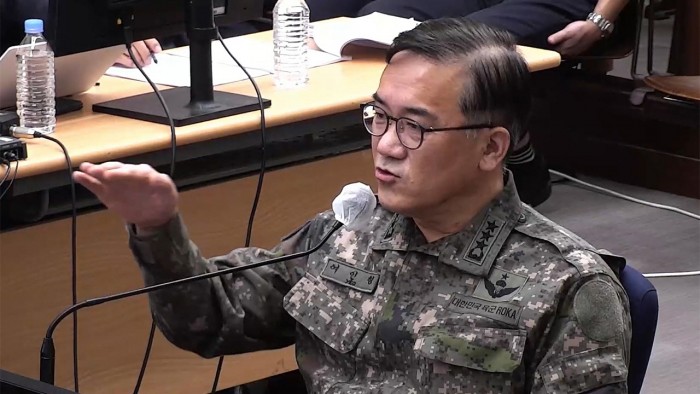 |
| The Seoul Central District Court’s Criminal Division 26, presided over by Judge Lee Hyun-kyung, sentenced former Defense Counterintelligence Commander Yeo In-hyung to 18 years in prison on Sept. 21 on charges including playing a key role in an insurrection and abuse of authority. Former Capital Defense Commander Lee Jin-woo was sentenced to 15 years, former Defense Intelligence Commander Moon Sang-ho to 12 years, former Army Chief of Staff Park An-su to 10 years, and former Special Warfare Commander Kwak Jong-keun to nine years. / Seoul Central District Court |
Five former top military commanders who were put on trial for deploying troops to sites including the National Assembly and the National Election Commission during the December 3 emergency martial law declaration have all been sentenced to prison terms in their first trial.
The 26th Criminal Division of the Seoul Central District Court (Presiding Judge Lee Hyun-kyung) on the 21st sentenced Yeo In-hyung, former commander of the Defense Counterintelligence Command, to 18 years in prison on charges including performing crucial duties in an insurrection and abuse of authority to obstruct the exercise of rights. Former Capital Defense Commander Lee Jin-woo was sentenced to 15 years in prison, former Defense Intelligence Commander Moon Sang-ho to 12 years, former Army Chief of Staff Park An-su to 10 years, and former Army Special Warfare Commander Kwak Jong-geun to 9 years. Special prosecutors had demanded 30-year prison sentences for each of them.
The court determined that rather than merely mobilizing forces in accordance with the martial law declaration, they engaged in concrete acts aimed at seizing control of the functions of the National Assembly and the National Election Commission.
Regarding former commander Yeo, the court found him guilty of organizing joint arrest teams immediately following the martial law declaration to detain politicians and ordering the securing of data related to the National Election Commission. In particular, based on notes written by former commander Yeo, the court found that he had discussed related matters and prepared execution methods with former President Yoon Suk-yeol, former Defense Minister Kim Yong-hyun, and others even before the emergency martial law declaration.
Former commander Lee was found guilty of dispatching Capital Defense Command troops to the National Assembly immediately after martial law was declared. The court determined that at a time when the National Assembly's vote on the resolution demanding the lifting of martial law was imminent, an instruction was conveyed calling for lawmakers to be dragged out, and former commander Lee relayed this order to his troops.
Former Chief of Staff Park was found guilty of issuing unconstitutional and illegal decrees in his capacity as martial law commander and restricting access to the National Assembly through police forces. The court pointed out that although former Chief of Staff Park recognized at the time that neither an actual war nor a comparable emergency had occurred, he neither prevented the illegality of the decrees nor raised objections.
Regarding former commander Moon, his prior preparations for martial law and deployment of troops to the National Election Commission were ruled guilty, while former commander Kwak was convicted of deploying Special Warfare Command troops to sites including the National Assembly and the National Election Commission. The court placed significant weight on the fact that concrete missions were assigned and ordered to restrict the functions of the National Assembly and the commission, regardless of whether all actual orders were fully carried out.
In particular, the court judged that deploying troops to the National Assembly and controlling lawmakers' access or attempting to drag them out exceeded the scope of maintaining public order or protecting facilities. Detaining election commission officials and attempting to seize servers were likewise seen as actions falling outside the boundaries of normal military operations or security duties.
Regarding the sentencing, the court explained, "This was an incident aimed at incapacitating the normal functions of the National Assembly and restricting the fundamental political participation of the public," adding, "Mobilizing the military, which requires political neutrality, for specific political purposes is also a grave matter."
It especially pointed out, "The crime of insurrection, which imperils the existence of the state, is extraordinarily grave and incomparable to any other offense," stressing, "The defendants abandoned the political neutrality of the armed forces and used the military politically for a specific faction."
The court elaborated that the individual sentences reflected differences among the five defendants in terms of how early they recognized martial law, what preparations and orders they made, and what roles they actually performed, as well as the fact that some orders were not fully executed on the ground.
Chun Hyun-bin
Most Read
-
1
Celltrion’s Omlyclo gains ground in major European..

-
2
Trump demands rates fall below 1% as Fed hikes for..

-
3
Trump makes $1 trillion bet ahead of midterm elect..

-
4
Iran resumes ballistic missile production, assembl..

-
5
Samsung Electronics, Mistral AI to jointly develop..

-
6
Trump warns countries not helping U.S. must pay re..

-
7
Apple launches first foldable, 1 million won prici..

PEOPLE





HEADLINE NEWS
- Trump to roll out ‘unprecedented welcome’ for Xi with B-2 bombers, F-22 fighters
- S. Korea, U.S., and Japan form united front on Taiwan and economic coercion..
- Trump administration moves to impose sweeping sanctions on International Cr..
- Xi to make state visit to U.S. Sept. 23-25, dispelling rumors over his heal..

-
Address : In-Young Bldg., 34, Uisadang-daero 1-gil, Yeongdeungpo-gu, Seoul
Copyright by ASIATODAY CO., LTD. All rights resereved