



Humanoids become doctors’ ‘third hand,’ passing tools and holding endoscopes
Sep 17, 2026, 03:48 pm


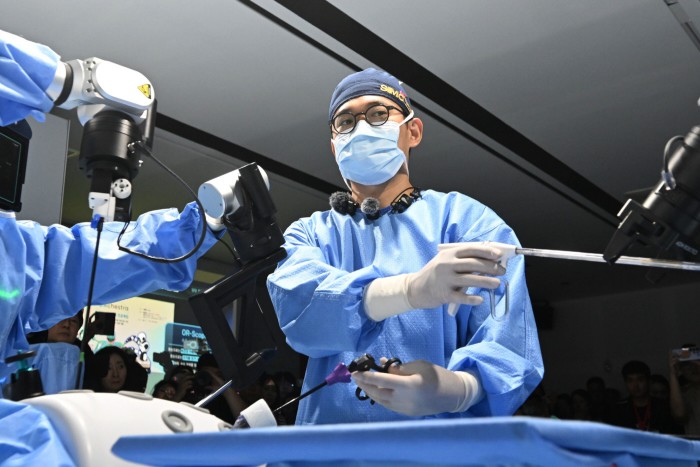 |
| Oh Nam-ki, professor of transplant surgery at Samsung Medical Center, demonstrates a surgical procedure with a humanoid robot during a demonstration of a humanoid surgical-assistance robot at the Samsung Life Insurance Irwon Station Building in Gangnam-gu, Seoul, on Sept. 16. / Song Ui-joo |
“Scissors, please.” At the surgeon’s request, a human-shaped robot scanned the area where the surgical instruments were placed. After locating and picking up the scissors, it rotated the handle so the doctor could easily grasp it and handed the tool over. Once the instrument had been used, the robot took it back and returned it to its original position.
Another robot standing nearby used one hand to move a laparoscope and keep the surgical site centered on the monitor, while using forceps in the other hand to pull tissue aside and secure space for the procedure.
Samsung Medical Center unveiled its humanoid surgical-assistance robots to the public for the first time on Sept. 16 at the Samsung Life Insurance Irwon Station Building in Gangnam-gu, Seoul. During the demonstration, two humanoid robots took on the respective roles of an operating-room nurse and an assistant surgeon, working with a human doctor to simulate a surgical procedure. The hospital said it was the first time in the world that two humanoid robots and a doctor had been demonstrated working together as a single surgical team.
Samsung Medical Center was selected last year as the lead institution for a government-funded Korean ARPA-H project titled “Development of a humanoid physical AI-based surgical-assistance robot for creating an efficient surgical environment.”
The hospital formed a consortium called “ORchestra” with Rainbow Robotics, Aidin Robotics, Ha Hae-ho, Samsung Advanced Institute for Health Sciences & Technology, Seoul National University, the National Cancer Center and Jeonbuk National University Hospital to jointly develop the humanoid surgical-assistance robot.
According to the development team, laboratory tests showed that both voice-command recognition and task success rates exceeded the first-stage target of 95%. The robots successfully picked up all five types of surgical instruments tested, while the success rate for handing instruments to doctors reached 98.7%. The system is being developed to recognize voice commands in both Korean and English.
While existing surgical robots are designed to precisely reproduce movements controlled by medical staff, the new system is focused on taking over repetitive support tasks alongside clinicians. It can pass instruments, hold an endoscope and retract tissue, while using existing operating rooms and surgical tools without requiring major changes to the environment.
The focus on surgical assistance reflects chronic staffing shortages in operating rooms. With limits on resident work hours and an exodus of experienced operating-room nurses making it increasingly difficult to secure enough personnel for emergency surgeries, the project aims to have humanoids take over repetitive support tasks and help fill staffing gaps.
The idea is that robots handle simple, repetitive duties while medical staff concentrate on delicate surgical techniques, potentially improving both the quality and efficiency of procedures.
“The situation is somewhat better at large hospitals, but in regional or smaller hospitals it is very difficult to find experienced surgical assistants,” said Jung Yong-ki, a professor of otolaryngology at Samsung Medical Center and principal investigator of the project. “We began the project with the assumption that humanoids might be able to fill that gap.”
“Considering shift work and vacations, it takes about five people to keep a single operating-room position staffed around the clock,” he added. “If robots are actually deployed in clinical settings, they could offer sufficient economic value.”
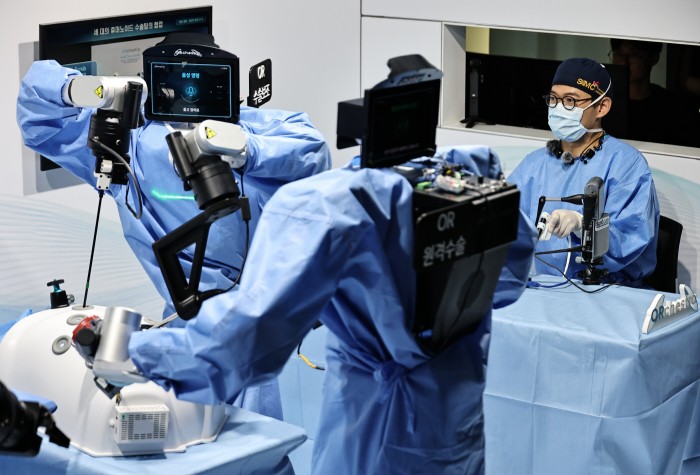 |
| A humanoid robot performs precise surgical movements through real-time dual-arm teleoperation and voice commands by Oh Nam-ki, professor of transplant surgery at Samsung Medical Center. / Song Ui-joo |
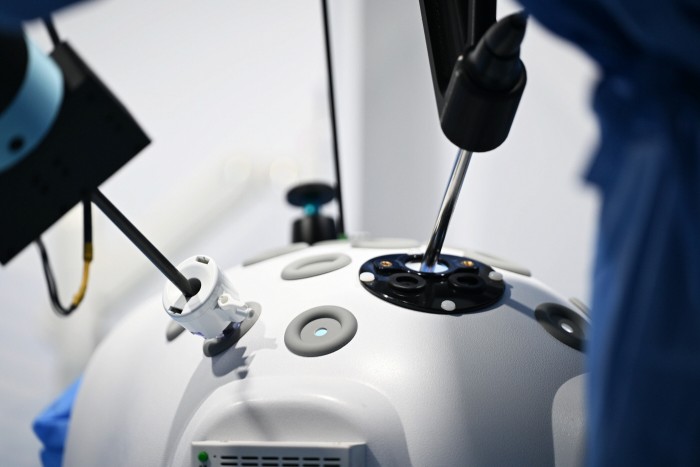 |
| A humanoid surgical-assistance robot assists with a procedure under the direction of surgeon Oh Nam-ki, professor of transplant surgery at Samsung Medical Center. / Song Ui-joo |
However, the robot unveiled this time is not a finished product ready for deployment in actual operating rooms. Rather, the demonstration served as an interim review of technologies developed through the middle of the second year of the five-year Korean ARPA-H project.
The robot used in the demonstration still moved more slowly than a human, and it took less than two seconds to begin moving after recognizing a voice command. The development team plans to improve the technology so that by the end of the project, the robot can perform support tasks at speeds comparable to those of human staff.
Technical and regulatory challenges also remain before the system can be used in real surgical environments. The AI must be able to accurately distinguish instruments from tissue even when bleeding or surgical smoke obscures the field of view, and it must also adjust the force used to retract tissue depending on its condition.
A stop-and-recovery system will also be needed to respond to malfunctions, along with legal standards clarifying liability in the event of a medical accident.
If the team passes the first-stage competitive evaluation at the end of this year, it plans to move on to follow-up research, including preclinical testing and safety and usability assessments. After securing the necessary regulatory approvals, the developers aim to begin the first clinical trial in 2029, starting with lower-risk support tasks such as holding an endoscope.
Future commercialization is expected to be led by participating companies including Rainbow Robotics and Aidin Robotics. The strategy is to adopt a versatile structure that allows one unit to be used across multiple medical departments, while improving price competitiveness through greater use of domestically produced components and standardized modules.
To reduce hospitals’ upfront adoption costs, the consortium is also considering leasing and subscription models in addition to outright sales, while leaving open the possibility of business models linked with Samsung Electronics.
“There is still no single answer as to what type of humanoid is best suited for the operating room,” Jung said. “We plan to keep refining the robot through real-world use so that it becomes optimized for operating rooms and can be deployed safely.”
Bae Da-hyun
Most Read
-
1
Celltrion’s Omlyclo gains ground in major European..

-
2
Hyundai Motor Group breaks ground on integrated st..

-
3
Trump demands rates fall below 1% as Fed hikes for..

-
4
U.S. strikes 3 Iranian oil tankers, Iran vows reta..

-
5
S. Korea seeks redemption from World Cup setback w..

-
6
Trump makes $1 trillion bet ahead of midterm elect..

-
7
Iran resumes ballistic missile production, assembl..

PEOPLE







-
Address : In-Young Bldg., 34, Uisadang-daero 1-gil, Yeongdeungpo-gu, Seoul
Copyright by ASIATODAY CO., LTD. All rights resereved