



S. Korea speeds up push to internationalize Korean won
Sep 17, 2026, 09:38 am


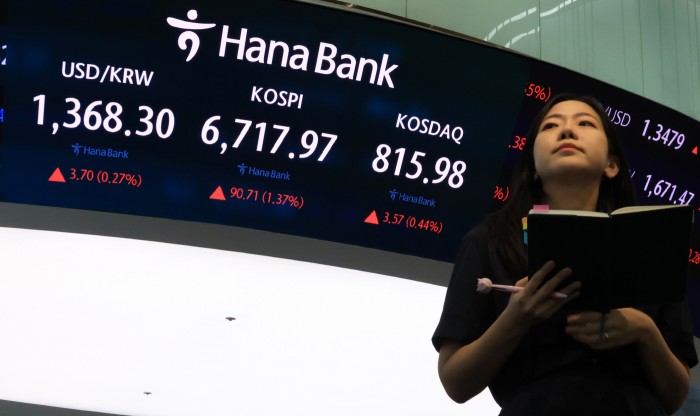 |
| Electronic display boards show the Korean won-U.S. dollar exchange rate and the benchmark KOSPI index at Hana Bank's headquarters dealing room in Jung-gu, Seoul, on the 16th. / Yonhap |
The government is accelerating its push to internationalize the Korean won by establishing an institutional framework that enables the currency to be used abroad. Under this initiative, the government aims to lay the groundwork for exchange rate stability through a system where registered foreign financial institutions can trade the won without restrictions.
According to the Ministry of Finance and Economy on the 16th, revisions to the "Guidelines on Foreign Exchange Business of Foreign Financial Institutions" and the "Foreign Exchange Transactions Regulations" were officially promulgated. The regulatory changes were prepared to build an offshore won settlement system slated for early next year as part of the "Won Internationalization Roadmap" announced in July.
Under the revisions, the government institutionalized "Registered Foreign Institutions for Korean Won Business (RFI-K)"—defined as foreign financial institutions conducting won-related foreign exchange operations for non-residents abroad—and laid down detailed procedures for registration, alteration, and termination. Consequently, foreign financial institutions registered with the ministry can open omnibus accounts at domestic foreign exchange banks and settle won transactions via the Bank of Korea's international won settlement network, making offshore won settlements possible.
In addition, eligible customers are restricted to foreign non-residents, with the operational scope configured to allow offshore non-residents to hold, procure, and manage the won, including payments, receipts, and deposits. Furthermore, RFI-K entities are mandated to verify their customers' non-resident status and submit post-transaction reports on won dealings.
A Ministry of Finance and Economy official said, "We will conduct the necessary prudential supervision for both RFI-K entities and registered foreign institutions for general foreign exchange business," adding, "We plan to closely monitor transaction details and regulatory compliance in tandem with the Bank of Korea and relevant authorities."
With the promulgation of these revisions, the legal foundation for an offshore won settlement system—a key pillar of won internationalization—has been established, setting the stage for foreign nationals to freely use the won overseas.
Exchange rate stability is cited as one of the primary benefits of internationalizing the won. This stability is particularly emphasized as the government hints at the possibility of South Korea's per capita gross national income (GNI) topping 40,000 U.S. dollars for the first time this year. On the 8th, the Bank of Korea released preliminary second-quarter national income data showing nominal GNI grew 8.8% year-on-year, raising expectations that the 40,000-dollar threshold could be crossed within the year.
During a briefing on economic growth strategies for the second half of the year in July, Yoo Byung-hee, director general of economic policy at the ministry, explained, "With the won-U.S. dollar exchange rate averaging around 1,480 won, per capita GNI for this year is projected to reach the mid-39,000-dollar range," adding, "If upside growth factors materialize or the exchange rate declines, reaching 40,000 dollars is well within reach."
Seo Byung-joo
Most Read
-
1
Celltrion’s Omlyclo gains ground in major European..

-
2
Hyundai Motor Group breaks ground on integrated st..

-
3
Trump demands rates fall below 1% as Fed hikes for..

-
4
U.S. strikes 3 Iranian oil tankers, Iran vows reta..

-
5
S. Korea seeks redemption from World Cup setback w..

-
6
Trump makes $1 trillion bet ahead of midterm elect..

-
7
Iran resumes ballistic missile production, assembl..

PEOPLE







-
Address : In-Young Bldg., 34, Uisadang-daero 1-gil, Yeongdeungpo-gu, Seoul
Copyright by ASIATODAY CO., LTD. All rights resereved