



Vietnam considers issuing dollar bonds for first time in 12 years
Sep 16, 2026, 09:58 am


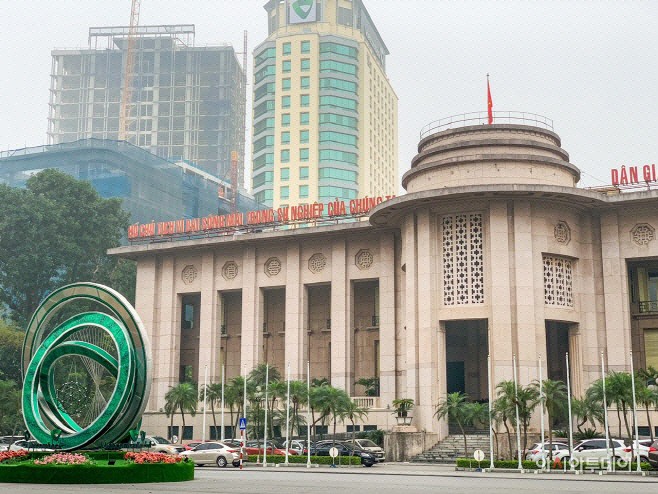 |
| State Bank of Vietnam / Hanoi Correspondent Jeong Ri-na |
Vietnam's Ministry of Finance is considering issuing U.S. dollar-denominated sovereign bonds for the first time in 12 years since 2014.
According to a report by Reuters citing four sources on the 15th (local time), the Vietnamese Ministry of Finance is discussing terms for a bond issuance with multiple foreign investment banks. One investment bank proposed 10-year notes worth 1 billion U.S. dollars (approx. 1.365 trillion won) during a meeting with the ministry, while another recommended 10-year bonds worth 500 million to 1 billion U.S. dollars (approx. 682 billion to 1.365 trillion won) with a coupon rate of around 7%. The raised capital is planned to be funneled into infrastructure development and other projects.
However, a final decision has yet to be reached. Two Vietnamese government officials noted that the government is weighing external borrowing costs amid rising global interest rates, elevated oil prices, and inflationary pressures. The volume of government bonds issued by Vietnam in its domestic market this year has surpassed 9 billion U.S. dollars (approx. 12.281 trillion won), with the average 10-year coupon rate climbing to 4.2% from 3.1% in the same period last year.
Vietnam's last overseas sovereign bond sale took place in 2014, when it issued 10-year bonds worth 1 billion U.S. dollars (approx. 1.365 trillion won) with a coupon rate of 4.8%. The country also issued sovereign debt in international markets in 2005 and 2010. While maintaining tight control over its financial system, Vietnam has historically been reluctant to pursue foreign borrowing, even as public debt remained relatively modest at around 37% of gross domestic product (GDP) based on last year's estimates.
This stance is shifting under General Secretary To Lam's leadership. The Communist Party is pursuing annual economic growth of over 10% through 2030 and is lowering its guard against external borrowing as global trade uncertainties mount for its export-reliant economy. The government's decision this year to accept development loans from Japan and Germany—after leaving billions of dollars (trillions of won) in concessionary loans untouched for years—is interpreted within the same context.
The issuance of U.S. dollar bonds is also seen as a mechanism to alleviate funding pressures on the domestic banking sector. According to the State Bank of Vietnam, commercial loan growth has outpaced deposit growth since 2021. The central bank raised the private sector's offshore borrowing ceiling this year to 6.1 billion U.S. dollars (approx. 8.323 trillion won) from 5.5 billion U.S. dollars (approx. 7.505 trillion won) in the prior year. Sources familiar with the matter indicated that the quota could see further upward revisions within the year as bank approval applications surge.
Offshore fundraising by private enterprises has likewise continued. VPBank secured a 1.44 billion U.S. dollar (approx. 1.965 trillion won) syndicated overseas loan facility from foreign financial institutions in June, while Vingroup, Vietnam's largest private conglomerate, issued 5-year bonds worth 350 million U.S. dollars (approx. 478 billion won) on the Vienna Stock Exchange in April. Vingroup is also planning to issue 3-year bonds worth 455 billion won (with an 8% coupon rate) targeting South Korean investors this year.
Jeong Ri-na
Most Read
-
1
Celltrion’s Omlyclo gains ground in major European..

-
2
Trump demands rates fall below 1% as Fed hikes for..

-
3
Trump makes $1 trillion bet ahead of midterm elect..

-
4
Iran resumes ballistic missile production, assembl..

-
5
Samsung Electronics, Mistral AI to jointly develop..

-
6
Trump warns countries not helping U.S. must pay re..

-
7
Apple launches first foldable, 1 million won prici..

PEOPLE






HEADLINE NEWS
- Trump to roll out ‘unprecedented welcome’ for Xi with B-2 bombers, F-22 fighters
- S. Korea, U.S., and Japan form united front on Taiwan and economic coercion..
- Trump administration moves to impose sweeping sanctions on International Cr..
- Xi to make state visit to U.S. Sept. 23-25, dispelling rumors over his heal..

-
Address : In-Young Bldg., 34, Uisadang-daero 1-gil, Yeongdeungpo-gu, Seoul
Copyright by ASIATODAY CO., LTD. All rights resereved