



Concerns mount over prosecutor quota cuts amid 160,000 backlogged cases
Sep 16, 2026, 09:12 am


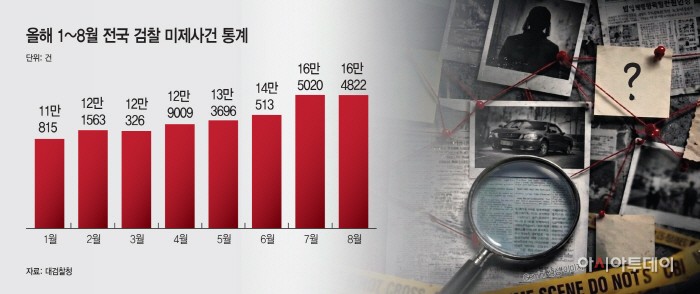 |
Backlogged cases pending across prosecutors' offices nationwide remained in the 160,000 range for the second consecutive month. After surging in the first half of the year, pending cases decreased slightly last month, temporarily halting the sharp upward trajectory. However, with the ruling bloc moving to revise organizational regulations for the upcoming Public Prosecution Service to trim the statutory quota of prosecutors just two weeks ahead of its launch, the massive caseload backlog is expected to carry over as a direct burden on the new criminal justice system.
According to the Supreme Prosecutors' Office on the 15th, unresolved cases across all prosecutors' offices nationwide stood at 164,822 as of late last month. This marks a decrease of 198 cases from 165,020 at the end of July. Compared to the surge of 24,507 pending cases between late June and late July, the rapid expansion has slowed.
By office, the Suwon District Prosecutors' Office had the highest backlog nationwide with 27,771 cases. It was followed by the Daejeon District Prosecutors' Office (15,531 cases), Incheon District Prosecutors' Office (14,730 cases), Daegu District Prosecutors' Office (14,175 cases), Uijeongbu District Prosecutors' Office (13,396 cases), Busan District Prosecutors' Office (10,652 cases), and Gwangju District Prosecutors' Office (10,591 cases). With seven offices nationwide recording over 10,000 pending cases, the backlog is not confined to specific areas but has built up across major frontline offices.
Insiders analyze that frontline prosecutors curbed the backlog's growth ahead of the transition to the Public Prosecution Service by prioritizing cases with relatively straightforward facts and legal questions. In this climate, internal concern is growing as the ruling party pushes to adjust the organizational regulations for the new service to reduce the quota of prosecutors. The ruling bloc argues that with prosecutors stripped of their investigative authority, there is no need to maintain the current ceiling of 2,292 prosecutors.
However, critics inside and outside the prosecution argue that staffing requirements should not be determined solely by the abolition of investigative powers. Prosecutors at the Public Prosecution Service must determine whether to indict cases referred by police, manage trials, review non-referral decisions, and represent the public interest. Furthermore, even if the backlog of more than 160,000 cases is transferred to investigative agencies, these cases will return to the Public Prosecution Service for indictment decisions once investigations wrap up, making heavy workloads unavoidable for frontline staff.
A senior prosecutor at a district office in the capital area stated, "Just because investigative powers are removed does not mean the prosecutor's work itself disappears. We must first evaluate the actual workload at the Public Prosecution Service—maintaining public prosecutions, requesting supplementary investigations, and reviewing warrants—before discussing proper staffing levels."
Legal circles also contend that a simplistic arithmetic approach—reducing the quota solely because investigative power has been removed—is ill-advised.
Attorney Jung Ji-woong of the Jung Law Firm (Bar Exam 1st cohort) noted, "With more than 160,000 unresolved cases piled up nationwide, hastily reducing the prosecutor quota alongside systemic reform threatens to worsen case processing delays. The proper quota should be determined after objectively analyzing actual case inflows, the caseload per prosecutor, indictment evaluations, and trial workloads following the launch of the Public Prosecution Service."
Jeong Min-hoon
Most Read
-
1
Alteogen secures European patent for Keytruda SC,..

-
2
Trump shares map on social media labeling Strait o..

-
3
Celltrion seeks rheumatoid arthritis indication ex..

-
4
Kia Sportage outperforms Mazda CX-5 in German auto..

-
5
U.S. deploys carrier, 10,000 more troops to Middle..

-
6
Trump rejects Iran's offer to open Strait of Hormu..

-
7
N. Korea conducts first swarm attack drill with dr..

PEOPLE






HEADLINE NEWS
- Pyongyang calls DMZ explosion Seoul's fabrication and grave provocation
- U.S. Department of Defense completely halts use of blacklisted Anthropic AI
- 2026 Nobel Prize in Physics awarded to Francis Halzen for neutrino research
- French students take to streets, expressing frustration over economy, educa..

-
Address : In-Young Bldg., 34, Uisadang-daero 1-gil, Yeongdeungpo-gu, Seoul
Copyright by ASIATODAY CO., LTD. All rights resereved