



S. Korea to develop indigenous vertical takeoff and landing drones by 2036
Sep 15, 2026, 01:08 pm


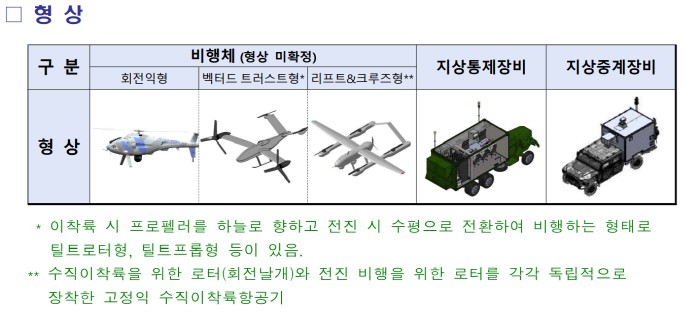 |
| A conceptual airframe potentially applicable to the vertical takeoff and landing (VTOL) reconnaissance unmanned aerial vehicle project (final design unconfirmed). / Defense Acquisition Program Administration |
The South Korean military will invest 2.16 trillion won to indigenously develop and acquire vertical takeoff and landing (VTOL) reconnaissance unmanned aerial vehicles (UAVs) by 2036.
The Defense Acquisition Program Administration (DAPA) approved the project on the 15th during the 178th Defense Acquisition Program Promotion Committee meeting, which was held in written form.
The VTOL reconnaissance UAV program aims to acquire drones through domestic research and development to overcome the takeoff and landing constraints of existing fixed-wing division-level reconnaissance UAVs and improve operational response capabilities. In this committee session, members reviewed and approved a revised basic project execution strategy that incorporated results from a renewed preliminary feasibility study, which re-examined certain required operational capabilities and reaffirmed the feasibility of indigenous development.
DAPA expects that securing an aerial surveillance and reconnaissance asset capable of vertical takeoff and landing in confined operational environments across mountainous terrain, with an operational radius expanded by more than 30% and surveillance performance enhanced fourfold compared to existing division-level UAVs, will significantly boost the military's wartime and peacetime surveillance capabilities. The project will run from next year through 2036, with a total budget of 2.16 trillion won.
While the airframe configuration has not yet been finalized, candidates include rotary-wing, vectored-thrust, and lift-and-cruise designs. Vectored-thrust configurations, such as tilt-rotor or tilt-prop aircraft, direct their propellers upward during takeoff and landing before transitioning them horizontally for forward flight. Lift-and-cruise designs refer to fixed-wing VTOL aircraft equipped with dedicated rotors for vertical takeoff and landing alongside separate rotors for forward flight.
During the meeting, the committee also deliberated and approved the aircraft type selection plan for the Maritime Operational Helicopter-II program. The Maritime Operational Helicopter-II project is designed to acquire replacements for the Navy's aging shipborne Lynx helicopters via Foreign Military Sales (FMS). Following test and evaluation results and subsequent negotiations, the committee approved selecting Lockheed Martin's MH-60R Seahawk for the program. The MH-60R measures 19.67 meters in length, 4.47 meters in width, and 5.18 meters in height, with a maximum takeoff weight of 10.2 tons.
DAPA expects the acquisition of high-performance MH-60R helicopters—which offer extended endurance compared to Lynx helicopters and are equipped with advanced low-frequency dipping sonars and sonobuoy deployment capabilities—to significantly bolster the South Korean Navy's anti-submarine and anti-surface warfare capabilities. The program spans from 2025 to 2032 with a total budget of 3.24 trillion won.
Lee Han-sol
Most Read
-
1
U.S. Treasury Secretary Bessent publicly warns ove..

-
2
Celltrion’s Omlyclo gains ground in major European..

-
3
Hyundai Motor Group breaks ground on integrated st..

-
4
Russia faces warning signs over prolonged war econ..

-
5
Anti-Western solidarity strengthens amid Trump's e..

-
6
U.S. strikes 3 Iranian oil tankers, Iran vows reta..

-
7
S. Korea seeks redemption from World Cup setback w..

PEOPLE







-
Address : In-Young Bldg., 34, Uisadang-daero 1-gil, Yeongdeungpo-gu, Seoul
Copyright by ASIATODAY CO., LTD. All rights resereved