



Koo Yun-cheol says chances of reaching $40,000 per capita income have increased
Sep 10, 2026, 09:56 am


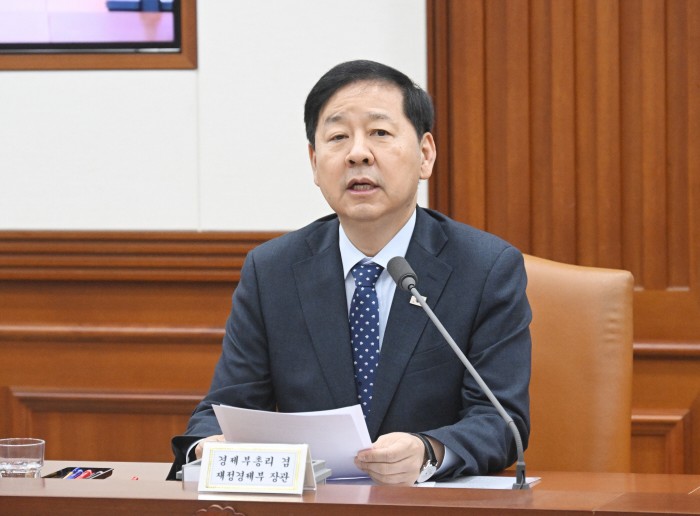 |
| Koo Yun-cheol, Deputy Prime Minister and Minister of Finance and Economy, speaks at a meeting of economy-related ministers and ministers on structural innovation at the Government Complex Seoul on Sept. 10. / Courtesy of the Ministry of Finance and Economy |
Deputy Prime Minister and Minister of Finance and Economy Koo Yun-cheol said on Sept. 10 that “the likelihood of South Korea achieving per capita gross national income of $40,000 this year has increased further.”
Koo made the remarks at a meeting of economy-related ministers and ministers on structural innovation at the Government Complex Seoul, saying, “Nominal GDP in the second quarter rose 26.4% from a year earlier, marking the highest growth rate in 47 years. The recovery of our economy is becoming increasingly evident.”
Per capita GNI is calculated by dividing the total income earned by a country’s residents at home and abroad by its population, and serves as an indicator of average living standards. Its value in US dollar terms is affected not only by nominal income in won but also by changes in the won-dollar exchange rate and population.
Koo also pointed to recent improvements in employment and household income indicators. “The number of employed people in August, announced yesterday, increased by 184,000 from a year earlier, returning to growth in the high 100,000s for the first time since the Middle East war,” he said. “The second-quarter household income and expenditure survey showed that incomes improved across all income groups, with particularly strong gains among lower-income households.”
He also noted that global credit rating agencies Moody’s and Fitch had recently given positive assessments of South Korea’s plans to improve fiscal soundness and invest in future growth under next year’s budget proposal, citing the economy’s solid growth.
“Our economy, despite difficult conditions, is moving more firmly than ever in a clear direction of recovery and growth,” Koo said. “The government will not rest on improvements in economic indicators but will design policies more carefully to accelerate growth and ensure that people can feel the benefits.”
“We will also strengthen the foundations for growth by improving the fundamentals of our economy through structural reforms,” he added.
At the meeting, the government also discussed measures to restructure the steel industry and reduce vacancies at knowledge industry centers. It plans to unveil measures to upgrade the steel industry in the fourth quarter of this year, including AI-driven innovation in manufacturing processes, expanded production of high-value-added products such as specialty steel, and a low-carbon transition centered on hydrogen-based steelmaking.
Vacant and unsold knowledge industry centers will be converted into public rental housing for young people and newlyweds. The government will also shift to a negative-list system that allows all types of businesses to move into such centers except specifically restricted sectors, with the aim of attracting emerging industries including AI and convergence businesses. It will ban the establishment of sales promotion centers before approval of sales notices and prohibit the splitting and resale of presale rights before buildings receive occupancy approval.
The government also plans to crack down on trade-based fiscal and financial crimes to establish a fair economic order. It will intensively inspect practices including the fabrication of export records aimed at securing new stock listings, policy financing or government subsidies, as well as fraudulent public procurement involving low-priced imported goods falsely presented as domestically produced.
Lee Ji-hoon
Most Read
-
1
U.S. Treasury Secretary Bessent publicly warns ove..

-
2
China overhauls National Defense Mobilization Law..

-
3
U.S. strikes Iran after a month, hits IRGC rocket..

-
4
Hyundai Motor Group breaks ground on integrated st..

-
5
Russia faces warning signs over prolonged war econ..

-
6
Anti-Western solidarity strengthens amid Trump's e..

-
7
U.S. strikes 3 Iranian oil tankers, Iran vows reta..

PEOPLE





HEADLINE NEWS

-
Address : In-Young Bldg., 34, Uisadang-daero 1-gil, Yeongdeungpo-gu, Seoul
Copyright by ASIATODAY CO., LTD. All rights resereved