



US-Iran, Saudi-Houthi clashes spread simultaneously across Middle East
Sep 10, 2026, 10:28 am


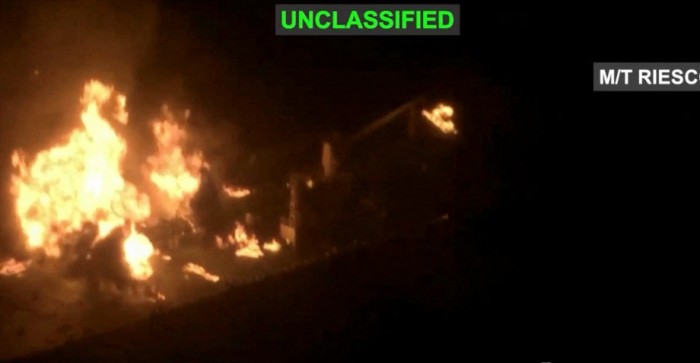 |
| An Iranian oil tanker is pictured after being struck in video footage released by U.S. Central Command (CENTCOM) on the 8th (local time). / Reuters, Yonhap |
As the United States and Iran escalate retaliatory attacks involving warships, oil tankers and US military bases around the Strait of Hormuz, fighting between Saudi Arabia and Yemen’s Houthi rebels in the Red Sea is effectively developing into a full-scale conflict.
With tensions rising simultaneously around the Strait of Hormuz and the Bab el-Mandeb Strait, two of the Middle East’s key oil shipping routes, the region is once again approaching a critical juncture.
US Central Command, or CENTCOM, said on Sept. 8 local time that its attack on an Iranian oil tanker was retaliation for two ballistic missile attacks by Iran’s Islamic Revolutionary Guard Corps, or IRGC, against US Navy vessels over the previous two days.
The US military said it had struck another Iranian tanker just three days after an attack on Sept. 5 and had destroyed five tankers so far. The military confrontation has thus developed into a maritime cycle of retaliation directly targeting US warships and Iranian oil tankers.
Washington also left open the possibility of further action. US Secretary of State Marco Rubio, who was visiting Colombia, told Reuters that “Iran continues to try to strike US Navy vessels, and every time they make such an attempt, they will lose an oil tanker.” His remarks amounted to a warning that the US could launch further strikes on Iran’s oil transport assets if Tehran continues attacking US naval vessels.
Iran quickly retaliated again. The IRGC said on Sept. 9 that it had attacked a US military base in Al-Azraq, Jordan, with ballistic missiles. According to Reuters, Jordan also confirmed through state media that 20 ballistic missiles launched from Iran had entered its territory.
In a separate statement, the IRGC claimed it had also successfully struck US Navy destroyers DDG-119 and DDG-53 with missiles. The destroyers are equipped with cruise missiles and the advanced Aegis integrated naval combat system. Iran also threatened that if US attacks on its oil tankers continue, it could target tankers off the coasts of Kuwait and Bahrain.
Tensions around the Strait of Hormuz are rising further as the US directly targets tankers that serve as a key means of transporting Iranian crude, while Iran threatens attacks on tankers elsewhere in the Gulf. As the cycle of retaliation increasingly extends to vessels directly tied to oil shipments, uncertainty surrounding the region’s energy transport network is also growing.
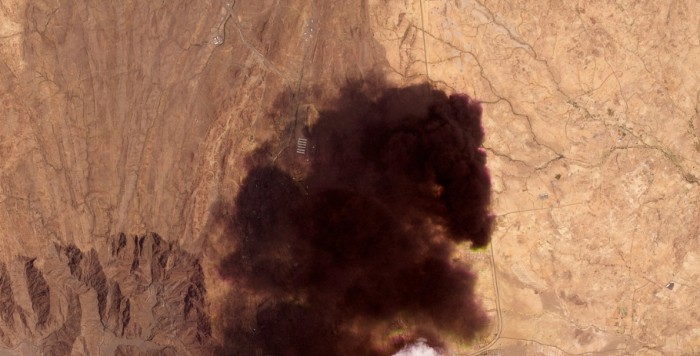 |
| A satellite image from commercial satellite operator Planet Labs shows smoke rising from a Saudi Aramco refinery following a Houthi attack. / Reuters, Yonhap |
As US-Iran retaliation intensifies around the Strait of Hormuz, another front is rapidly heating up in the Red Sea, where US-aligned oil producer Saudi Arabia and the Iran-backed Houthi rebels are trading large-scale attacks around the Bab el-Mandeb Strait, a strategic chokepoint at the entrance to the Red Sea.
On Sept. 8, the Houthis launched drone and missile attacks on four cities in southern Saudi Arabia — Khamis Mushait, Abha, Najran and Jizan. The targets included not only Saudi air bases but also refining and power facilities operated by state oil giant Saudi Aramco.
It was the largest Houthi attack on the Saudi mainland since the war between the United States and Iran began in late February. Saudi authorities said at least 73 people, including women and children, were injured.
Saudi Arabia immediately retaliated. Fighter jets from the Saudi-led coalition carried out airstrikes on Jubah, east of the Houthi-held Yemeni capital Sanaa, and on the southwestern region of Taiz. Turki al-Malki, spokesperson for the Saudi-led coalition, said the coalition would “respond decisively to deter the terrorist militia.”
Clashes between the two sides intensified in earnest after the Houthis declared an end to the ceasefire last month. Fighting between the Saudi-led coalition and the Houthis, which had remained relatively subdued for years, has expanded beyond strikes on rebel strongholds inside Yemen to large-scale attacks on military and energy facilities on Saudi territory, putting a nearly four-year ceasefire arrangement at risk of effectively collapsing.
As a result, two fronts are expanding simultaneously across the Middle East: the United States versus Iran, and Saudi Arabia versus the Houthis. With no end in sight to the US-Iran cycle of retaliation around the Strait of Hormuz and the Bab el-Mandeb Strait now also emerging as a center of military confrontation, the risk is growing that the Middle East’s two major oil and logistics shipping routes could be disrupted at the same time.
Nam Mi-kyung
Most Read
-
1
U.S. Treasury Secretary Bessent publicly warns ove..

-
2
China overhauls National Defense Mobilization Law..

-
3
U.S. strikes Iran after a month, hits IRGC rocket..

-
4
Hyundai Motor Group breaks ground on integrated st..

-
5
Russia faces warning signs over prolonged war econ..

-
6
Anti-Western solidarity strengthens amid Trump's e..

-
7
U.S. strikes 3 Iranian oil tankers, Iran vows reta..

PEOPLE






HEADLINE NEWS

-
Address : In-Young Bldg., 34, Uisadang-daero 1-gil, Yeongdeungpo-gu, Seoul
Copyright by ASIATODAY CO., LTD. All rights resereved