



Plunging approval ratings push Lee into total deadlock over personnel, policies
Sep 08, 2026, 09:08 am


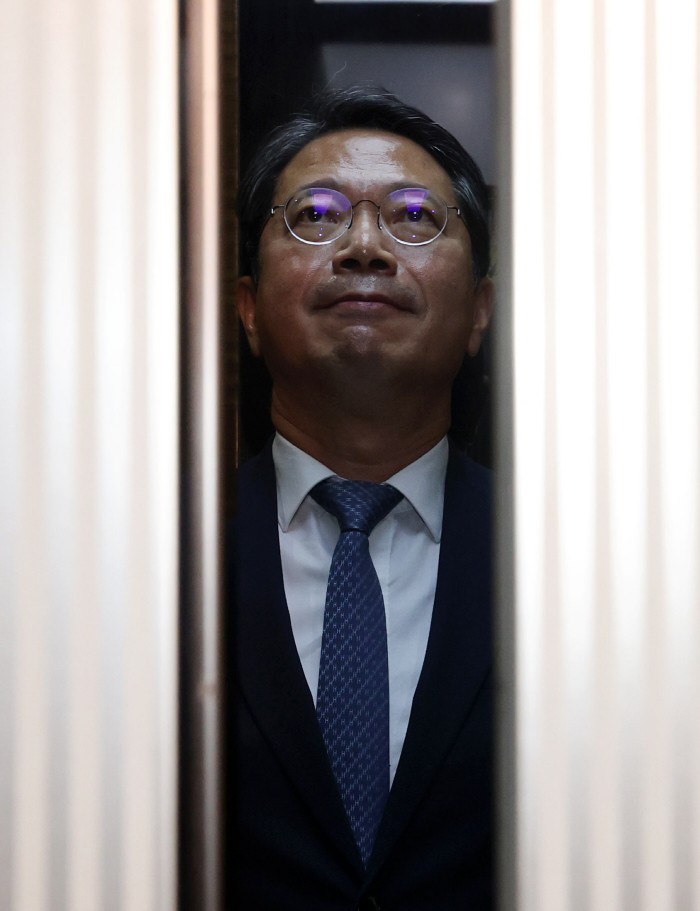 |
| Justice Minister nominee Kim Seung-won arrives at his confirmation hearing preparation office at the Jeokseon Hyundai Building in Jongno-gu, Seoul, on the 7th. / Reporter Park Sung-il rnopark99@ |
While President Lee Jae-myung carries out his state visit to France, domestic political headwinds at home are mounting. His job approval rating has fallen for eight consecutive weeks to hit an all-time low since taking office, and with overlapping controversies surrounding cabinet nominations, confusion over real estate tax policies, and the potential troop deployment to the Strait of Hormuz, his ability to manage the political fallout upon his return faces a critical test.
According to a Realmeter survey conducted from August 31 to September 4 among 2,510 voters aged 18 and older nationwide, positive evaluations of President Lee's state administration fell 1.5 percentage points from the previous week to 37.4%, the lowest point of his presidency.
Declines were particularly sharp among respondents in their 30s and residents of the capital region. Approval among those in their 30s dropped 4.9 percentage points to 29.8%, while positive ratings among men in their 20s (21.4%) and 30s (20.8%) remained in the low 20% range. Geographically, Seoul posted a 6.0 percentage point decline, with Incheon and Gyeonggi Province falling 2.3 percentage points.
Political circles point to the personnel controversies stemming from the August 30 cabinet reshuffle as the primary catalyst for the decline. Gender Equality and Family Minister nominee Yong Hye-in faces pushback over holding a concurrent cabinet position as an active proportional representative lawmaker, while Justice Minister nominee Kim Seung-won confronts allegations involving solicitation for new drug approvals and past activities in an initiative calling for dropped indictments.
The presidential office maintains that it will "wait and see how the confirmation hearings unfold," but criticism is spreading toward the presidential vetting apparatus itself. The opposition bloc is targeting both the Senior Secretary for Personnel Management, responsible for candidate recommendations, and the Senior Secretary for Civil Affairs, tasked with background verification.
Controversy over policy consistency surrounding revisions to real estate taxation poses another burden. The government reversed course on parts of its tax reform plan less than a month after its announcement, triggering backlash over its credibility.
A separate Realmeter survey released the same day revealed that negative evaluations of real estate and housing policies stood at 65.7%, the highest among four evaluated economic categories. Disapproval of overall government economic management reached 61.1%.
Disputes over the re-nomination of Supreme Court justices and the president's judicial risks also remain ongoing. These are compounded by diplomatic and security challenges surrounding potential contributions to the Strait of Hormuz. While the Trump administration presses allies to participate, Tehran has countered with warnings that any foreign involvement in military operations across the strait will bring grave consequences. Should the administration push ahead with formal deployment procedures, domestic opposition could present another major political liability.
With pressing challenges in personnel appointments, public livelihood, judicial matters, and foreign security converging at once, the message and solutions President Lee delivers immediately upon returning home are expected to mark a watershed for regaining governing momentum.
A ruling camp official noted, "The recent decline in approval ratings reflects a convergence of multiple factors, including personnel issues and public livelihood concerns," adding, "Upon his return, the president needs to articulate a much clearer direction for handling these major affairs."
Park Young-hoon
Most Read
-
1
Celltrion’s Omlyclo gains ground in major European..

-
2
Trump demands rates fall below 1% as Fed hikes for..

-
3
Hyundai Motor Group breaks ground on integrated st..

-
4
U.S. strikes 3 Iranian oil tankers, Iran vows reta..

-
5
Trump makes $1 trillion bet ahead of midterm elect..

-
6
Iran resumes ballistic missile production, assembl..

-
7
Samsung Electronics, Mistral AI to jointly develop..

PEOPLE







-
Address : In-Young Bldg., 34, Uisadang-daero 1-gil, Yeongdeungpo-gu, Seoul
Copyright by ASIATODAY CO., LTD. All rights resereved