



China struggles to revive economy, rolls out unprecedented subsidies for home purchases
Sep 07, 2026, 04:13 pm


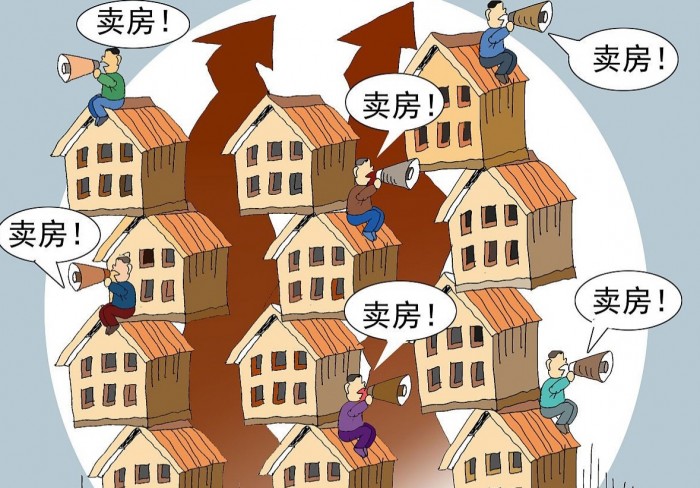 |
| An editorial cartoon from a media outlet highlighting that an active real estate market is essential for economic recovery, vividly capturing the need for trade-in subsidies when purchasing newly built homes. / The Beijing News |
Local governments across China are aggressively rolling out trade-in subsidy policies—traditionally aimed at replacing old consumer goods with new ones—for newly built home purchases in a bid to revive an economy that is clearly in distress. Notably, top-tier cities boasting relatively strong economies, such as Shanghai and Guangzhou in Guangdong Province, are turning to this stopgap measure that some provincial regions began implementing in 2023. The move clearly signals the severity of China's current economic slump.
According to Beijing sources well-versed in global industry trends on the 7th, the Chinese economy is often perceived to be in reasonably good shape due to an unprecedented boom in artificial intelligence (AI) and semiconductor industries. Looking beyond those two sectors to examine the broader industrial landscape, however, quickly reveals that the broader economy is struggling.
Statistics bear this out clearly. First, growth remains disappointing. Despite confident projections and high expectations from economic authorities, GDP growth reached only 4.7% in the first half of the year. Growth slowed even further to 4.3% in the second quarter, tumbling 0.7 percentage points from the first quarter. Furthermore, fixed-asset investment expanded by 5.7%, a figure seen as a substantial shock. The synchronized slump in both consumption and investment during the first half occurred for clear reasons.
With the August Consumer Price Index (CPI) edging up just 0.9% year-on-year, persistent deflationary pressures further suggest that the Chinese economy is confronting a crisis. Economic authorities have little choice but to recognize the urgent need for sweeping stimulus measures, a pressure felt even more acutely by local governments. In response to signals from the central government, several tier-one cities, including Shanghai and Guangzhou, began rolling out home trade-in subsidy programs in April.
Shanghai's subsidy scheme, launched on the 21st of last month, is straightforward. It provides a flat 30,000 yuan (around 6.02 million won) regardless of property size, alongside a 1% subsidy on mortgage loan totals capped at 50,000 yuan. Consequently, buyers purchasing new homes can receive benefits of up to 80,000 yuan.
Guangzhou, which rolled out its program in April to run through the end of the year, offers a 1% subsidy on mortgage loans up to a 3 million yuan ceiling. Similar measures are being adopted by other tier-one cities and regional hubs following suit, including Xi'an in Shaanxi Province, Haikou in Hainan Province, and Mianyang in Sichuan Province. By deploying homebuyer subsidies, local authorities are aggressively signaling their determination to bolster growth, fueling projections that the economic downturn will not deteriorate further.
Hong Soon-do
Most Read
-
1
Celltrion nears additional contract with major U.S..

-
2
Putin proposes trilateral U.S.-China-Russia summit..

-
3
U.S. weighs dropping MOAB, world's most powerful n..

-
4
"Aren't those foreigners on welfare?": M..

-
5
Attention centers on APEC for possible Trump-Xi-Pu..

-
6
Saudi Arabia, Iran hold first diplomatic talks to..

-
7
Saudi airport in Riyadh struck again, leaving at l..

PEOPLE







-
Address : In-Young Bldg., 34, Uisadang-daero 1-gil, Yeongdeungpo-gu, Seoul
Copyright by ASIATODAY CO., LTD. All rights resereved