



Chinese entertainment industry devastated and driven into despair by AI
Sep 07, 2026, 10:11 am


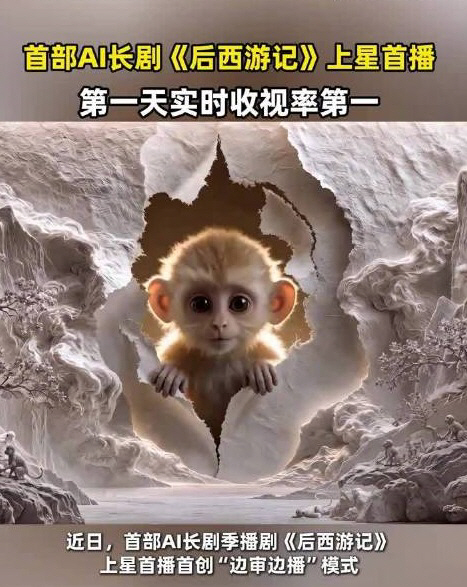 |
| The Later Journey to the West, China's first terrestrial television AI drama. It is expected to usher in an era of AI dramas on broadcast networks. Devastating the Chinese entertainment industry is bound to be only a matter of time. / Xinhua News Agency online edition. |
China's entertainment market is enormous, rivaling Hollywood, the overwhelmingly dominant global benchmark. Naturally, earnings for industry professionals, particularly actors, are equally staggering. Top-tier, S-class actors easily pull in at least 400 million yuan (roughly 80.8 billion won) annually. Leading examples include actress Yang Mi (40), who emerged as an industry powerhouse several years ago, and Liu Tao (48), renowned for her enduring career longevity.
While A-class actors earn significantly less than their S-class counterparts, they still command formidable presence and compensation. They are widely reported to bring in around 100 million yuan per year. A prime example is Liu Yifei (39), once viewed as Yang Mi's rival and widely known in Korea for her past relationship with actor Song Seung-heon. Even without a grueling work schedule, these stars routinely pull in annual sums unimaginable to everyday citizens.
B-class actors are by no means negligible either. They easily earn up to 70 million yuan a year. This bracket includes figures such as Gao Yuanyuan (47), who married into Taiwan, and Ren Jialun (37), who is even better known as a singer. For actors in this tier, playing supporting rather than lead roles is hardly a blow to pride given the financial return.Against this backdrop, sensational success stories—such as claims that an entertainer amassed fortunes exceeding 10 billion yuan after a relatively brief career—frequently populate media gossip. Likewise, whenever young people show the slightest hint of artistic talent, those around them aggressively push them to enroll in renowned training grounds like the Beijing Film Academy to break into stardom.
However, the likelihood that these golden, prosperous days will soon vanish is mounting rapidly. The reason is clear: China's artificial intelligence (AI) technology, so formidable that it raises concern even in the U.S., is virtually 100% certain to penetrate mainstream broadcasting and entertainment.
This trend is readily apparent when examining short-form dramas—one-to-two-minute episodes typically spanning around 100 installments—consumed primarily across online spaces since 2018, the vast majority of which are now produced using AI. Statistics released this year by the China Netcasting Services Association highlight this reality: out of 128,000 short-form drama titles released in the first quarter, an estimated 121,600 were produced using AI technology. At this rate, encountering a short-form drama produced without AI has become the exception.
Unsurprisingly, short-form dramas produced with AI boast remarkably high production quality. Plots, character acting, and visuals border on flawless. When viewers complain that these works lack warmth or human touch, their criticism is well founded. The real crisis, however, lies in the fact that the actors and creators who previously made a living through short-form dramas have been displaced overnight by AI, facing permanent unemployment.
Dismaying cases abound. A prime example is Liu Yuzhan (29), once a well-regarded actor in the short-form drama circuit. Having once appeared in as many as four to five productions a month, he has lost his livelihood to AI and is now reportedly working food delivery jobs to make ends meet. Even more heartbreaking are the countless cases of aspiring performers who once dreamed of entering the mainstream industry to earn hundreds of millions of yuan, only to retreat to their rural hometowns to take up farming or low-wage part-time labor. They have effectively been pushed into an unheralded retirement.
Amid this turbulence, a development that rattled mainstream entertainment stars finally unfolded on the 31st of last month. The Later Journey to the West, a 30-episode AI-produced drama running 40 minutes per episode, premiered during the prime-time 8 p.m. slot on Hunan Satellite TV. The much-anticipated yet dreaded entry of AI-generated dramas into terrestrial broadcast networks has become reality. Precedents set the pattern for everything that follows. The arrival of The Later Journey to the West makes clear that a succession of AI dramas will soon hit broadcast networks. AI-generated actors will also establish an indisputable presence in film and advertising. For directors, leveraging AI will likely become an inescapable necessity rather than an option.
Reactions within the Chinese entertainment sector toward AI dramas entering terrestrial television remain somewhat muted for now. Soon, however, cries of despair are bound to erupt across an upended industry. A sharp plunge in appearance fees for top stars, suddenly stripped of their bargaining power, appears inevitable. Their blooming spring days may be gone for good. The destructive power of AI technology is proving formidable enough to cast an entertainment market rivaling Hollywood into deep despair.
Hong Soon-do
Most Read
-
1
Celltrion nears additional contract with major U.S..

-
2
Putin proposes trilateral U.S.-China-Russia summit..

-
3
U.S. weighs dropping MOAB, world's most powerful n..

-
4
"Aren't those foreigners on welfare?": M..

-
5
Attention centers on APEC for possible Trump-Xi-Pu..

-
6
Saudi Arabia, Iran hold first diplomatic talks to..

-
7
Saudi airport in Riyadh struck again, leaving at l..

PEOPLE







-
Address : In-Young Bldg., 34, Uisadang-daero 1-gil, Yeongdeungpo-gu, Seoul
Copyright by ASIATODAY CO., LTD. All rights resereved