



Hanwha launches 22nd fireworks show, standing tall as 5th-largest conglomerate after 26 years
Sep 07, 2026, 09:58 am


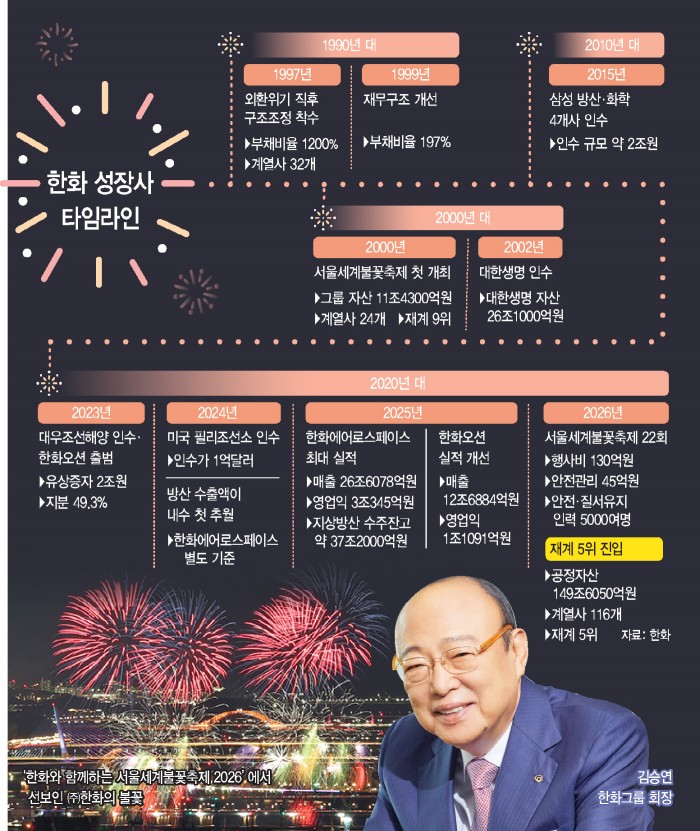 |
On the 5th, Hanwha launched its 22nd fireworks display into the night sky over Yeouido, Seoul. The year 2000, when the inaugural fireworks festival took place, coincided with Hanwha Group Chairman Kim Seung-youn completing post-Asian financial crisis restructuring and embarking on rebuilding the group. Chairman Kim subsequently pursued a string of high-profile mergers and acquisitions (M&A)—including Korea Life Insurance, Samsung's defense and chemical affiliates, and Daewoo Shipbuilding & Marine Engineering (DSME)—expanding operations across finance, defense, aerospace, and shipbuilding. Over the past 26 years, group assets surged more than 13-fold from 11.43 trillion won to 149.605 trillion won this year, propelling Hanwha into the top five of South Korea's business hierarchy for the first time since its founding.
According to business community sources on the 6th, Hanwha Group invested a total of 13 billion won into this year's Seoul International Fireworks Festival. On-site attendance reached roughly 1 million people, while online livestreams on channels such as Hanwha TV recorded 2.68 million views and a peak concurrent viewership of 260,000. Ahead of this year's festival, Chairman Kim stated, "Hanwha launches fireworks into the sky because happiness can be shared by everyone gazing upward, and we wish to deliver that joy." Launched in 2000, the festival has continued for 26 years, even after five cancellations due to events such as the 9/11 attacks, North Korean nuclear tests, swine flu, and COVID-19.
When the festival debuted in 2000, Hanwha had just concluded its restructuring following the Asian financial crisis. As the group's debt-to-equity ratio soared to 1,200% during the crisis, it sold Hanwha Energy to Hyundai Oilbank for 3 trillion won and transferred parts of Hanwha Machinery's operations to Germany's FAG. Affiliates dropped from 32 at year-end 1997 to 24 by year-end 2000, while the debt-to-equity ratio was lowered to 197% by the end of 1999. Group assets at the time stood at 11.43 trillion won.
With restructuring behind him, Chairman Kim spearheaded renewed business expansion through M&A. In 2002, the group expanded its financial footprint by acquiring Korea Life Insurance, which held assets of 26.1 trillion won—more than double the asset base of the entire Hanwha Group at the time. Korea Life Insurance was rebranded as Hanwha Life in 2012 and now serves as the flagship pillar of the group's financial affiliates.
The 2015 "big deal" with Samsung transformed Hanwha's defense operations. Hanwha invested roughly 2 trillion won to acquire Samsung Techwin, Samsung Thales, Samsung General Chemicals, and Samsung Total. Among these, the operations of Samsung Techwin and Samsung Thales evolved into Hanwha Aerospace and Hanwha Systems. In 2023, Hanwha secured a 49.3% stake in Daewoo Shipbuilding & Marine Engineering through a 2-trillion-won rights offering, launching Hanwha Ocean. Adding submarines and surface vessels to its existing land and aerospace defense portfolio broadened its footprint into naval defense.
The defense and shipbuilding affiliates integrated through M&A delivered record earnings last year. On a consolidated basis, Hanwha Aerospace recorded revenue of 26.6078 trillion won and operating profit of 3.0345 trillion won. At year-end, its land systems order backlog reached approximately 37.2 trillion won. Backed by expanding overseas orders for the K9 self-propelled howitzer and the Chunmoo multiple rocket launcher system, standalone defense exports surpassed domestic sales for the first time in 2024. Hanwha Ocean also posted revenue of 12.6884 trillion won and operating profit of 1.1091 trillion won last year.
In 2024, Hanwha made direct inroads into the U.S. shipbuilding sector by acquiring the Philly Shipyard in Philadelphia for 100 million dollars. The company builds commercial vessels locally and conducts maintenance, repair, and overhaul (MRO) operations for U.S. Navy vessels. In addition, Hanwha Aerospace serves as the system integrator for the Korea Space Launch Vehicle (Nuri), participating in rocket manufacturing and launch operations.
This year, Hanwha's fair trade assets reached 149.605 trillion won, approximately 13.1 times the 11.43 trillion won recorded in 2000 when the first fireworks festival took place. Over the same span, domestic affiliates grew from 24 to 116. In the large enterprise group rankings announced this year by the Fair Trade Commission, Hanwha climbed two spots from 7th last year, surpassing Lotte and POSCO to rank 5th behind Samsung, SK, Hyundai Motor, and LG. This marks the first time since its inception that Hanwha has entered South Korea's top five business groups.
Lee Seo-yeon
Most Read
-
1
Celltrion nears additional contract with major U.S..

-
2
Putin proposes trilateral U.S.-China-Russia summit..

-
3
U.S. weighs dropping MOAB, world's most powerful n..

-
4
"Aren't those foreigners on welfare?": M..

-
5
Attention centers on APEC for possible Trump-Xi-Pu..

-
6
Saudi Arabia, Iran hold first diplomatic talks to..

-
7
Saudi airport in Riyadh struck again, leaving at l..

PEOPLE





-
Address : In-Young Bldg., 34, Uisadang-daero 1-gil, Yeongdeungpo-gu, Seoul
Copyright by ASIATODAY CO., LTD. All rights resereved