



Constitutional Court rules failure to provide birth registration system for foreign children born in S. Korea unconstitutional
Aug 28, 2026, 09:43 am


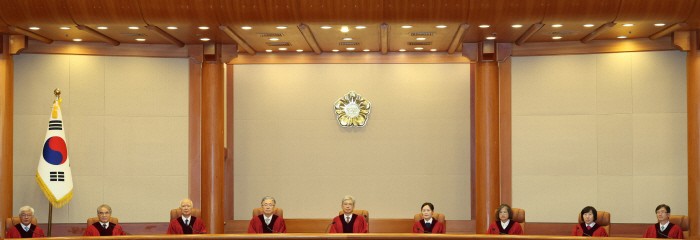 |
| Constitutional Court President Kim Sang-hwan and constitutional justices sit in their seats ahead of delivering rulings on constitutional petitions at the Constitutional Court in Jongno-gu, Seoul, on the 27th. / Yonhap News |
The Constitutional Court has ruled it unconstitutional that the state failed to establish provisions regarding birth registration for foreigners born in South Korea.
On the 27th, the Constitutional Court issued a unanimous decision confirming unconstitutionality in a constitutional petition filed by Person A, a Vietnamese national, and their child, who claimed that legislative omission failing to provide for birth registration of foreign nationals born in South Korea is unconstitutional. Legislative omission refers to instances where the National Assembly fails to enact legislation despite an obligation to do so.
Person A and their spouse, undocumented Vietnamese nationals, had a baby at a medical center in Seoul in 2019. However, the couple could not register the birth because the current Act on the Registration of Family Relations only governs the registration of births and related matters for South Korean nationals.
Consequently, Person A filed a constitutional petition in February 2022, asserting that basic rights were infringed due to statutory omissions.
The Constitutional Court stated, "The right to be registered immediately after birth is the right to register an infant's basic birth-related information for state management at the earliest possible moment so the child can be protected after birth. This is a fundamental prerequisite for realizing the general right to personal integrity derived from human dignity, worth, and the right to pursue happiness under Article 10 of the Constitution, and its guarantee should not differ based on whether a child is a citizen or a foreigner."
The court added, "Anyone must be able to have their birth officially recorded by the state exercising jurisdiction over the region where they were born and request the issuance of documents verifying it. This is a human right rather than merely a right of citizens, and the necessity of its guarantee does not depend on a child's nationality, residency status, or whether the birth was registered in their home country."
The Constitutional Court emphasized, "There is a state legislative duty to shape the specific content of that right so that birth registration under South Korean law is available regardless of nationality, residency status, or whether the birth is registered in the country of origin."
However, the court unanimously dismissed petitions challenging the Framework Act on Education, which defines targets for nine years of compulsory education (six years of elementary school and three years of middle school) as citizens, as well as the Enforcement Decree of the Elementary and Secondary Education Act, which requires verification of alien registration certificates when foreigners apply for elementary school admission.
This ruling by the Constitutional Court marks the second time since its establishment that it has upheld a constitutional petition challenging the National Assembly's genuine legislative omission.
Son Seung-hyun
Most Read
-
1
U.S. Treasury Secretary Bessent publicly warns ove..

-
2
China overhauls National Defense Mobilization Law..

-
3
U.S. strikes Iran after a month, hits IRGC rocket..

-
4
Hyundai Motor Group breaks ground on integrated st..

-
5
Russia faces warning signs over prolonged war econ..

-
6
Anti-Western solidarity strengthens amid Trump's e..

-
7
U.S. strikes 3 Iranian oil tankers, Iran vows reta..

PEOPLE






HEADLINE NEWS

-
Address : In-Young Bldg., 34, Uisadang-daero 1-gil, Yeongdeungpo-gu, Seoul
Copyright by ASIATODAY CO., LTD. All rights resereved