



S. Korean government pushes for special law on nuclear-powered submarines
Aug 28, 2026, 09:16 am


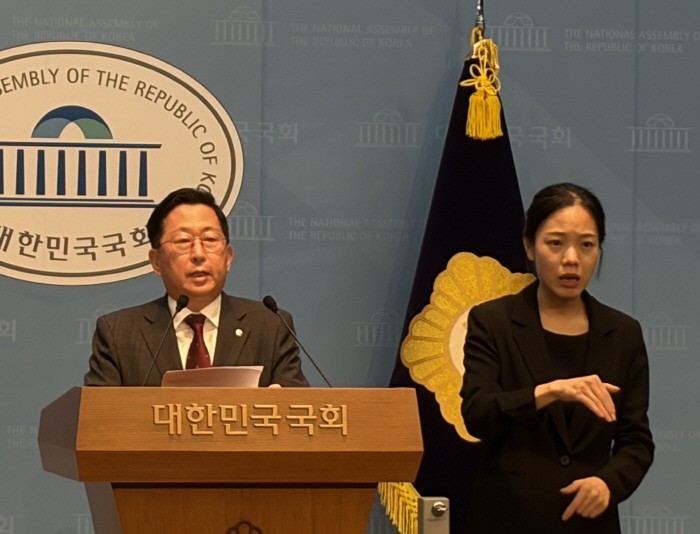 |
| People Power Party lawmaker Yoo Yong-won holds a press conference at the National Assembly's Press Center on the 27th. / Office of Lawmaker Yoo Yong-won |
Legislation is underway for a special bill designed to ensure the stable execution of the nuclear-powered submarine acquisition project.
People Power Party Lawmaker Yoo Yong-won announced at a press conference held at the National Assembly's Press Center on the 27th that he had introduced the "Special Bill on the Nuclear-Powered Submarine Project" as the primary sponsor. A total of 30 lawmakers participated as co-sponsors, including People Power Party members and independent Lawmaker Han Dong-hoon.
To drive the nuclear submarine program over the long term, the bill mandates the establishment of a strategic committee directly under the president, chaired by the president. The Chairman of the Joint Chiefs of Staff, the top authority in military operational command, will also participate as a committee member. The bill also includes provisions to guarantee policy continuity regardless of changes in administration through 10-year periodic assessments.
Moving away from internal military regulation, the bill unifies licensing and safety inspection authority under the Nuclear Safety and Security Commission, an independent regulatory body. It also explicitly stipulates in the statute the "use of low-enriched uranium with an enrichment level below 20%" and the "principle of mounting conventional weaponry," proactively meeting international nonproliferation standards and bolstering bargaining power in negotiations with the U.S.
The legislation also establishes the grounds for creating a special account to overcome the constraints of single-year budgeting. In addition, it contains provisions to fundamentally prevent construction delays and budget lapses by permitting advance procurement contracts for long-lead specialized materials, such as reactor components, as well as the carryover of expenditure appropriations.
Furthermore, the bill codifies the legal grounds to establish a dedicated, integrated public-private-military executive body tentatively named the "Nuclear Submarine Project Group," which will consistently and forcefully oversee operations ranging from planning and R&D to shipyard construction and practical working-level consultations with the U.S. In the event of a nuclear accident, the bill stipulates full state liability for compensation, establishes grounds for supporting residents near submarine bases, and mandates that crew members be legally deemed radiation workers with their exposure records preserved for 30 years.
"National security is not preserved through vague hopes, but through meticulous strategy and prepared execution," Lawmaker Yoo said. "Amid a grave security crisis marked by North Korea's advancing tactical nuclear capabilities, concerns over submarine technology transfers stemming from North Korea-Russia military alignments, and scaled-back South Korea-U.S. joint exercises, securing an independent underwater deterrence capability is an existential imperative that can no longer be delayed."
He added, "Nuclear-powered submarines are strategic assets capable of unlimited, long-term underwater operations without refueling, executing covert surveillance, reconnaissance, and strike missions against key targets in distant waters and areas adjacent to adversaries. Moving beyond discussions on its necessity, now is the time to secure tangible cooperation with the U.S. and properly take the crucial first step."
Lee Han-sol
Most Read
-
1
Celltrion nears additional contract with major U.S..

-
2
"Aren't those foreigners on welfare?": M..

-
3
U.S. weighs dropping MOAB, world's most powerful n..

-
4
Houthis launch successive attacks on Saudi airport..

-
5
Saudi Arabia, Iran hold first diplomatic talks to..

-
6
Saudi airport in Riyadh struck again, leaving at l..

-
7
Five ASEAN countries welcome Myanmar coup leader

PEOPLE





HEADLINE NEWS
- Trump's approval rating hits low of 33% as public turns back over soaring inflation
- Trump says Hyundai announced 748.6-billion-won investment in Georgia
- China tightens grip on boosting domestic demand and expanding anti-graft dr..
- Food prices jump 35% over 10 years, fueling massive protests by 800,000 acr..

-
Address : In-Young Bldg., 34, Uisadang-daero 1-gil, Yeongdeungpo-gu, Seoul
Copyright by ASIATODAY CO., LTD. All rights resereved