



North Korea intensifies criticism of Japan
Aug 25, 2026, 09:12 am


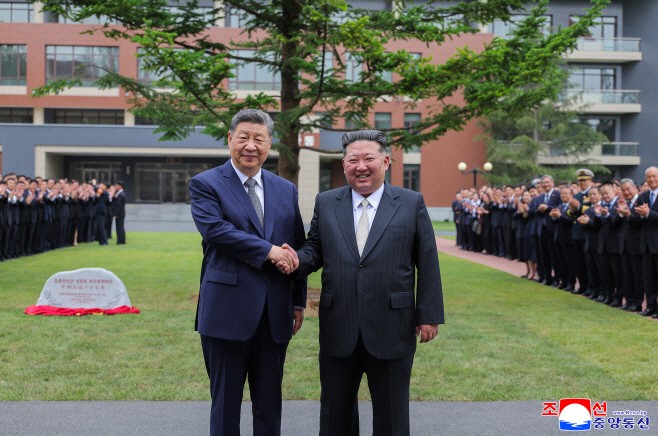 |
| Chinese President Xi Jinping visited the Central Cadres Training School of the Workers' Party of Korea, North Korea's top educational institution for training and re-educating party officials, on the 9th, the Korean Central News Agency reported on the 10th. Chairman Kim Jong-un and President Xi planted a commemorative tree marking the visit to the Central Cadres Training School, the news agency reported. / Yonhap News |
North Korea continued its criticism of Japan's military buildup, claiming that Japan's shrine visits aim to "embed a spiritual pillar supporting militaristic policies." North Korea's continuous issuance of critical stances against Japan's military buildup is interpreted as a move aimed at strengthening solidarity with China, which is in conflict with Japan.
In a commentary on the 24th, the Korean Central News Agency criticized, "Japanese Prime Minister Takaichi staged an unsightly display by bowing from afar toward the Yasukuni Shrine from a place not far from it," adding, "It is not difficult to see Takaichi's militaristic ambitions reaching an extreme." It further claimed, "The current Takaichi administration has explicitly revealed its impatient intention to realize its long-sought desire for overseas expansion by further heightening an atmosphere of reinvasion across society in line with war preparations accelerating radically under this government," calling it "a grave challenge to humanity's aspiration for world peace and security."
Recently, North Korea has released messages directed at Japan across various formats—including statements by Kim Yo-jong, director of the Party General Affairs Department, criticisms by individual commentators, and media commentaries—regarding several security issues such as Japan's Three Non-Nuclear Principles, Defense White Paper, and nuclear energy policies. Such messages directed at Japan have been issued about ten times this month alone.
Experts note that North Korea's critical tone toward Japan aligns closely with China's. Tensions between Japan and China expanded across diplomacy, the economy, and security overall after Prime Minister Takaichi mentioned the possibility of intervention during a Taiwan contingency last year.
Analysts say that in this situation, North Korea intends to share China's diplomatic stance toward Japan and pursue stronger bilateral cooperation. Furthermore, analyses suggest that it also aims to draw in China, which has been lukewarm toward a North Korea-China-Russia trilateral alignment. In fact, at the North Korea-China summit in June, Chairman Kim Jong-un reaffirmed the One China principle to President Xi Jinping, and President Xi responded by not mentioning the denuclearization of the Korean Peninsula.
Oh Kyung-seob, senior research fellow at the Korea Institute for National Unification, analyzed, "China defines contemporary Japan as the 'revival of a new form of militarism' and is responding accordingly," adding, "Under circumstances where China strongly criticizes Japan's military buildup, North Korea is strengthening diplomatic coordination by showing the same critical stance toward Japan as China."
In addition, analyses suggest that North Korea continues to bring up Japan's constitutional revisions and the possibility of nuclear armament, using them as logic to justify strengthening and modernizing its own nuclear and conventional forces. Senior Research Fellow Oh analyzed, "North Korea links Japan's military buildup with the strengthening of U.S.-South Korea-Japan cooperation, viewing it as a direct military security threat and issuing strong warnings against it."
Mok Yong-jae
Most Read
-
1
Kia Sportage outperforms Mazda CX-5 in German auto..

-
2
Houthis launch successive attacks on Saudi airport..

-
3
Saudi Arabia, Iran hold first diplomatic talks to..

-
4
Saudi airport in Riyadh struck again, leaving at l..

-
5
U.S. deploys carrier, 10,000 more troops to Middle..

-
6
Five ASEAN countries welcome Myanmar coup leader

-
7
Putin's ally visits China on the 8th ahead of APEC..

PEOPLE






HEADLINE NEWS
- New White House Press Secretary links $54 billion from Seoul to Alaska LNG in first briefing
- Industrial Bank of Korea launches local subsidiary in Vietnam
- Saudi-Houthi clashes over oil facilities escalate, hitting 24 vessels in Ho..
- Bin Salman underestimates Houthi offensive, imperiling Saudi economic refor..

-
Address : In-Young Bldg., 34, Uisadang-daero 1-gil, Yeongdeungpo-gu, Seoul
Copyright by ASIATODAY CO., LTD. All rights resereved