



K-defense secures pathway to diversify arms exports to Europe
Aug 25, 2026, 09:03 am


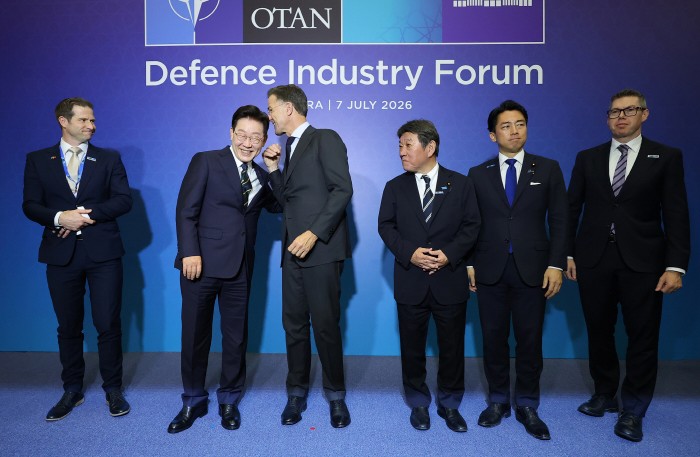 |
| President Lee Jae-myung and North Atlantic Treaty Organization (NATO) Secretary General Mark Rutte (third from left) pose for a commemorative photo with attendees after concluding the NATO Secretary General-IP4 restricted meeting held at the Ankara Convention Center in Türkiye on the 7th of last month (local time). / Yonhap |
As practical barriers hindering K-defense exports to NATO member states are lowered, efforts to tap into the European defense market are expected to gain momentum. Amid the ongoing rearmament of NATO member states, domestic defense companies will be able to meet NATO-required standards in advance starting from the bidding and joint development stages, which is also expected to help expand defense parts exports through overseas local production facilities going forward.
The Defense Acquisition Program Administration (DAPA) announced on the 24th that it has established new Guidelines on the Provision and Management of NATO Standards containing these measures. DAPA projected that improved access to NATO standards will expand the scope of K-defense exports across the entire lifecycle, extending beyond the sale of complete weapons systems to local production, follow-up logistics support, and parts exports.
NATO standards are documents that establish common performance criteria and guidelines to ensure the interoperability of military supplies. When domestic defense companies participate in weapon procurement bids of NATO member states or pursue joint R&D with NATO governments or defense firms, the counterpart may require compliance with NATO standards. In such cases, Korean companies must prove that they satisfy these standards.
Until now, official procedures for domestic companies to acquire NATO standards were not clear. There were cases where standards had to be obtained individually through government channels between South Korea and NATO, or companies had to informally request cooperation from local firms or government agencies.
With the establishment of these guidelines, a process has been built allowing DAPA to receive applications from companies and officially acquire and provide necessary NATO standards.
A DAPA official explained, "It can be viewed as the formalization of a process where DAPA receives requests and smoothly provides NATO standards needed during entry into the European market or joint R&D."
NATO standards cover a wide range, extending from hardware performance of weapons systems to software, operations, and administrative areas. They include physical criteria such as the defensive performance of guided weapons, as well as communication protocols, operational, logistical, and administrative procedures, and security guidelines for classified and non-public data.
Regarding specific export effects, the DAPA official said, "It will have the effect of smoothly verifying performance during the establishment of local factories by domestic companies, joint R&D, and the export of weapons systems to new European countries," adding, "It can also lead to the expansion of defense parts exports in addition to complete weapons systems."
Export destinations also have the potential to expand beyond NATO member states. The DAPA official stated, "There is an emerging trend where partner countries in South America and elsewhere, not just NATO members, are requesting NATO standards in proposals," adding, "As trust in our weapons systems rises, this could lead to the diversification of export destinations and weapons systems."
In addition, the guidelines categorize NATO standards into public standards, non-public standards, and classified standards based on disclosure scope and security classification, clarifying the application and provision procedures for each. The DAPA official said, "Non-public standards can now be provided in as fast as one week," adding, "Classified standards require a certain period as they must follow application procedures set by NATO, but we are continuously cooperating to shorten the process."
Lee Han-sol
Most Read
-
1
Kia Sportage outperforms Mazda CX-5 in German auto..

-
2
Houthis launch successive attacks on Saudi airport..

-
3
Saudi Arabia, Iran hold first diplomatic talks to..

-
4
Saudi airport in Riyadh struck again, leaving at l..

-
5
U.S. deploys carrier, 10,000 more troops to Middle..

-
6
Five ASEAN countries welcome Myanmar coup leader

-
7
Putin's ally visits China on the 8th ahead of APEC..

PEOPLE






HEADLINE NEWS
- New White House Press Secretary links $54 billion from Seoul to Alaska LNG in first briefing
- Industrial Bank of Korea launches local subsidiary in Vietnam
- Saudi-Houthi clashes over oil facilities escalate, hitting 24 vessels in Ho..
- Bin Salman underestimates Houthi offensive, imperiling Saudi economic refor..

-
Address : In-Young Bldg., 34, Uisadang-daero 1-gil, Yeongdeungpo-gu, Seoul
Copyright by ASIATODAY CO., LTD. All rights resereved