



Alibaba Cloud launches 3 data centers in Korea
Aug 19, 2026, 10:01 am


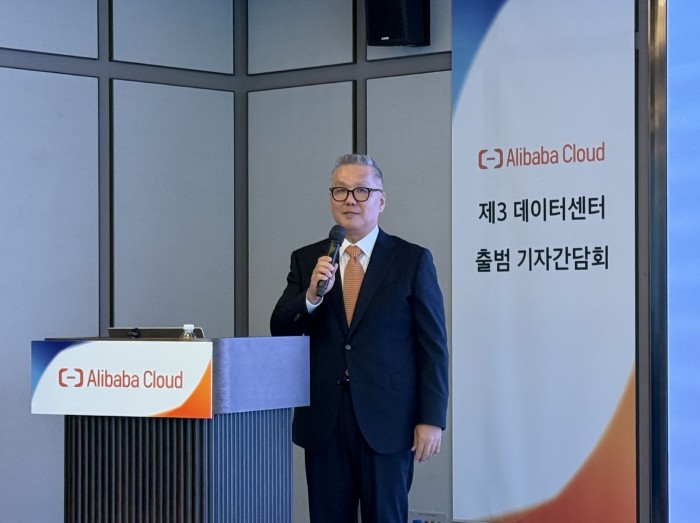 |
| Yoon Yong-jun, general manager of Alibaba Cloud Intelligence Korea, speaks at a press conference announcing the launch of the company's third data center in Korea, held at Josun Palace in Gangnam-gu, Seoul on the 18th. / Kim Min-ju, Staff Photographer |
Alibaba Cloud is strengthening its push into Korea's AI infrastructure market by launching its third data center in the country. The move reduces the risk of a single point of failure that could arise from operating with just two data centers, boosting service stability, while also reinforcing the foundation for expanding enterprise AI services as part of the company's roughly 75 trillion won investment plan.
Alibaba Cloud held a press conference on the 18th at Josun Palace in Gangnam-gu, Seoul, announcing the launch of its third data center in Korea. Following its first data center in 2022 and second in 2025, the new facility launches roughly a year later. Like the second data center, it is located in Seoul and has already begun operations.
Alibaba Cloud expects the new data center to improve service stability. Yoon Yong-jun, general manager of Alibaba Cloud Intelligence Korea, explained that the existing Korea region operated with only two data centers, meaning that if one experienced an outage, the other had to maintain customer service alone, creating a single point of failure risk. With a third data center added, he said, service can now continue at the remaining two sites even if one experiences an outage.
However, Alibaba Cloud did not disclose specifics such as the new data center's scale, power capacity, types and quantities of GPUs, or current utilization rate. Yoon said the third data center was designed at sufficient scale to account for demand from Korean customers, adding that the company has room to add more GPUs and infrastructure in consultation with headquarters if demand grows in the future.
Going forward, Alibaba Cloud plans to expand its domestic enterprise AI agent business based on the new data center. The company will gradually roll out services such as AgentRun, STAROps, and ACS Agent Sandbox in the Korean market, supporting the full process from developing and testing AI agents to deployment, operation, and security management.
This expansion of domestic infrastructure ties into Alibaba Group's broader global AI investment strategy. The company plans to invest $53 billion (about 75 trillion won) in AI infrastructure over the next three years. With the launch of this third data center in Korea, Alibaba Cloud's global infrastructure footprint has expanded to 30 regions and 104 availability zones.
Yoon said, "This data center is also an extension of Alibaba Group's large-scale AI infrastructure investment plan," adding, "We will continue expanding investment in data center construction and advanced cloud and AI-related infrastructure in Korea going forward."
As Alibaba Cloud expands its domestic business, attention is also turning to how it will address concerns over data security. Yoon stressed that day that customer data stored in the Korea region is stored and processed only within Korea, and that the infrastructure was designed to comply with domestic cybersecurity, service continuity and recovery, data governance, and other relevant regulations and standards. He explained that the company operates a multi-layered security architecture and data audit system based on global security certifications, and provides a compliance management framework tailored to regional regulations.
A particular strength, he noted, is that access rights to customer data are separated between the operator and the customer. Yoon said only the customer can access their own data, and that Alibaba Cloud, as the operator, cannot access customer data either, explaining that the system is designed to prevent the cloud provider itself from directly accessing customer data.
Finally, Yoon added that customers themselves have the authority to check and audit who accessed their data and when, ensuring traceability over external access and internal permission use by allowing customers to directly review their own data access history.
Kim Min-ju
Most Read
-
1
Alteogen secures European patent for Keytruda SC,..

-
2
Trump shares map on social media labeling Strait o..

-
3
Celltrion seeks rheumatoid arthritis indication ex..

-
4
Kia Sportage outperforms Mazda CX-5 in German auto..

-
5
Chinese e-commerce giants AliExpress, Temu and She..

-
6
China expels No. 2 military official Zhang Youxia..

-
7
Trump rejects Iran's offer to open Strait of Hormu..

PEOPLE






-
Address : In-Young Bldg., 34, Uisadang-daero 1-gil, Yeongdeungpo-gu, Seoul
Copyright by ASIATODAY CO., LTD. All rights resereved