



Rates, exchange rate boost bank stocks amid strong earnings
Aug 14, 2026, 10:16 am


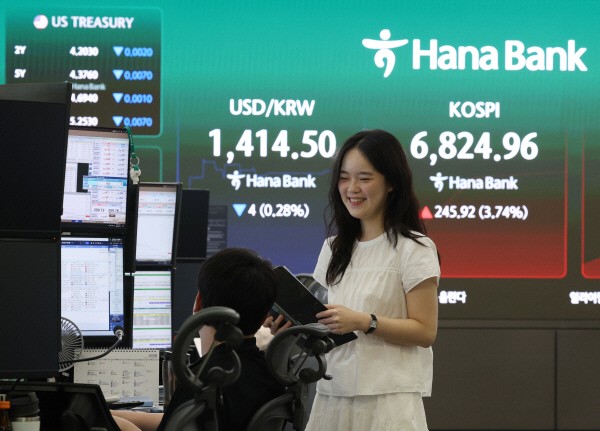 |
| Hana Bank's dealing room on the 13th. / Yonhap |
As Korea's stock market continues its rollercoaster ride, bank stocks and brokerage stocks are moving in opposite directions. While brokerage stocks have lost steam despite strong second-quarter results, weighed down by concerns over declining trading volume and investment asset volatility in the second half, bank stocks have continued climbing, buoyed by improved interest income from rising rates and expectations of stronger capital ratios as the won-dollar exchange rate falls. With record-level earnings and expectations of expanded shareholder returns adding further support, buying has continued flowing into bank stocks even amid the broader market's correction.
According to the Korea Exchange on the 13th, the KRX Bank Index has risen 25.9% this year, from 1,303.78 to 1,641.05 as of that day. Shares of major financial holding companies have also risen across the board. Hana Financial Group posted the highest return at 37.9%, followed by Shinhan Financial Group at 37.6%, KB Financial Group at 33.8%, and Woori Financial Group at 18.9%.
This stands in stark contrast to brokerage stocks. Despite posting record second-quarter earnings, brokerage share prices have retreated, as trading volume — which had driven up their earnings during the market rally — has fallen rapidly, deepening concerns over slowing profits. Average daily trading value in the domestic market fell 27.6% last month from the previous month to 99.5 trillion won. As a result, Kiwoom Securities, Mirae Asset Securities, and Samsung Securities all saw their target share prices lowered despite posting record second-quarter results. Woo Do-hyung, an analyst at Yuanta Securities, said that as the concentration in semiconductor stocks persists, a genuine rebound in brokerage shares will take time.
For bank stocks, earnings are supporting share prices. The four major financial holding companies' combined net profit for the first half of the year reached 11.3392 trillion won, surpassing 11 trillion won for a first half for the first time ever. Even with household loans held in check, lending centered on corporate loans continued to grow, keeping banks' interest income solid. Improved earnings from non-bank affiliates, such as securities and insurance units, also contributed.
The interest rate environment is also shifting in banks' favor. The Bank of Korea raised its base rate by 0.25 percentage points to 2.75% last month, from 2.50%. The market has floated the possibility of further hikes depending on the pace of economic recovery and inflation trends. As market interest rates rise, loan rates tend to follow, which can boost banks' interest income.
The falling exchange rate is also fueling the rise in bank stocks. The won-dollar exchange rate closed at 1,419.4 won in Seoul's foreign exchange market that day. With the rate having fallen back to around 1,400 won after peaking at 1,549.4 won in the second quarter, expectations have grown that financial holding companies' capital ratios will improve, since a lower exchange rate reduces the value of their foreign-currency risk-weighted assets (RWA). A smaller RWA can boost the common equity tier 1 (CET1) ratio without requiring additional capital raising — a key metric determining how much room a company has for shareholder returns. Choi Jung-wook, an analyst at Hana Securities, said that as the exchange rate falls, banks' capital ratios improve, giving them more room to expand shareholder returns such as dividends or share buybacks.
Lee Bo-ra
Most Read
-
1
Celltrion nears additional contract with major U.S..

-
2
Putin proposes trilateral U.S.-China-Russia summit..

-
3
U.S. weighs dropping MOAB, world's most powerful n..

-
4
"Aren't those foreigners on welfare?": M..

-
5
Attention centers on APEC for possible Trump-Xi-Pu..

-
6
Saudi Arabia, Iran hold first diplomatic talks to..

-
7
China tightens grip on boosting domestic demand an..

PEOPLE







-
Address : In-Young Bldg., 34, Uisadang-daero 1-gil, Yeongdeungpo-gu, Seoul
Copyright by ASIATODAY CO., LTD. All rights resereved