



Advanced self-driving cars to hit ordinary roads in Kazakhstan
Aug 14, 2026, 10:24 am


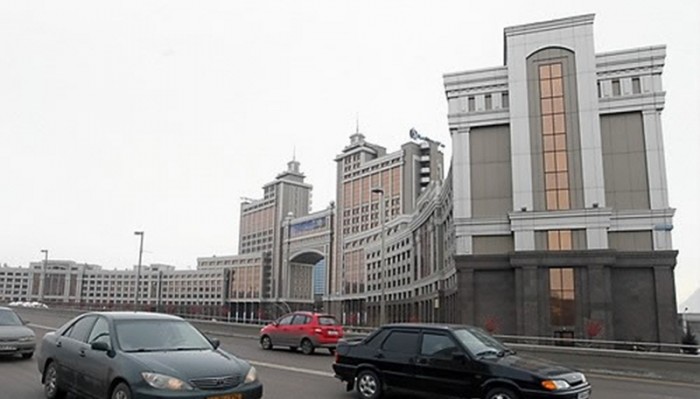 |
| Vehicles pass along a road in Astana, Kazakhstan. / EPA-Yonhap |
The Kazakh government will permit advanced self-driving vehicles capable of operating without direct driver intervention on some public roads.
According to Kazakh outlet Orda on the 12th, Kazakhstan's Ministry of AI and Digital Development, along with the Ministry of Transport and the Ministry of Internal Affairs, approved regulations for a pilot program to introduce self-driving vehicles.
Under the plan, self-driving vehicle trials will run for three years starting on the 21st in Astana, Almaty, and Kosshy in Akmola region. Testing will be permitted not only at dedicated test sites but also on ordinary roads designated by authorities.
The three-year pilot program targets Level 3 vehicles, which can drive themselves under certain conditions, and Level 4 vehicles, which don't require a driver to be present in the vehicle, with the goal of establishing laws and regulations for the commercialization of self-driving cars.
After accumulating operational data, authorities plan to establish rules covering operating conditions, liability scope, insurance, and safety standards for self-driving vehicles. They are also working to revise regulations so that self-driving technology can be used not just in ordinary passenger cars but also in taxis and non-scheduled passenger transport.
The pilot program covers internationally classified Level 3 and Level 4 self-driving vehicles. Level 3 means the vehicle can perform driving tasks on its own under certain conditions, but the driver must take over when the system requests it. Level 4 means the vehicle can drive itself without a driver present, under specific conditions such as designated areas or roads.
Safety verification will be conducted first. Vehicles must complete at least 100 hours of test driving at a testing facility, during which no accidents caused by traffic violations may occur.
Only vehicles that pass technical inspection and safety-related procedures afterward will be allowed to test on ordinary roads designated by authorities. The approach is to verify the technology in a controlled environment once a certain level of safety has been confirmed.
Insurance and accident-handling rules have also been established in preparation for accidents involving self-driving vehicles. Vehicles participating in the pilot program must be equipped with devices that record driving data and video, along with a mechanism to halt autonomous driving in emergencies and a security system to prevent external software tampering.
If an accident occurs, it must be reported to police, and a representative from the participating company must go to the scene and submit video footage from before and after the incident. Operating companies must also carry liability insurance to cover potential harm to human life or health, or damage to third-party property, with minimum coverage set at 60 million tenge (about 184 million won) per vehicle.
Most advanced driver-assistance systems currently sold in Korea are Level 2, requiring the driver to continuously monitor surrounding conditions.
Tesla's Full Self-Driving (Supervised) is also legally classified as Level 2, but as its driving assistance features have grown more advanced, some functions are seen as approaching Level 3.
What the Kazakh government has now approved is testing Level 3 and Level 4 vehicles — one step higher — on actual roads. This marks a shift beyond the research and development stage of self-driving technology into an institutional experiment aimed at gathering data in real traffic conditions.
Behind this focus on self-driving technology lies the country's broader national AI and digital transformation policy. Kazakhstan has recently been fostering the AI industry as a new growth sector, pursuing policies to incorporate digital technology not just into administration but across the real economy, including transportation and logistics.
Kazakhstan has long distances between cities and significant demand for long-haul logistics, and major cities like Astana and Almaty have persistently faced traffic congestion and mobility efficiency issues.
The taxi and logistics sectors are also seen as areas where applying self-driving technology could ease labor shortages, reduce transport costs, and improve transport efficiency.
Beyond ground vehicles, Kazakhstan has already begun demonstrating unmanned aerial mobility as well. At the "Future Games 2026" event held in Astana on the 6th, an electric vertical takeoff and landing (eVTOL) unmanned passenger aircraft carried out a demonstration flight with actual passengers aboard. The two-seater aircraft can fly at speeds of up to 130 km/h and cover distances of up to 35 km.
The government sees unmanned aircraft as useful not just for tourism but also for emergency medical services, medicine delivery, firefighting, and logistics. It is also pursuing local production of unmanned passenger aircraft systems and has drawn up plans to build six airports to support air taxi operations.
Determining who bears how much responsibility in the event of an accident — the vehicle owner, the operating company, the remote operator, the vehicle manufacturer, or the developer of the self-driving system — is expected to be an important issue in the ongoing process of regulatory development.
Kim Min-gyu
Most Read
-
1
Trump shares map on social media labeling Strait o..

-
2
Kia Sportage outperforms Mazda CX-5 in German auto..

-
3
Houthis launch successive attacks on Saudi airport..

-
4
U.S. deploys carrier, 10,000 more troops to Middle..

-
5
Trump rejects Iran's offer to open Strait of Hormu..

-
6
N. Korea conducts first swarm attack drill with dr..

-
7
U.S.-China summit falls short on substance as Trum..

PEOPLE






HEADLINE NEWS
- Seoul dismisses Ukraine's claim of 'S. Korean support for Russia' as "inaccurate and inappropriate"
- S. Korea, Japan race to develop nuclear-powered submarines
- Henri Kagan, Kenso Soai win Nobel Prize in Chemistry for uncovering how mol..
- Vance says Alaska LNG cooperation will move forward with Seoul's current or..

-
Address : In-Young Bldg., 34, Uisadang-daero 1-gil, Yeongdeungpo-gu, Seoul
Copyright by ASIATODAY CO., LTD. All rights resereved