



Food price hikes gather pace in second half
Aug 14, 2026, 10:10 am


 |
| This image was generated by AI. |
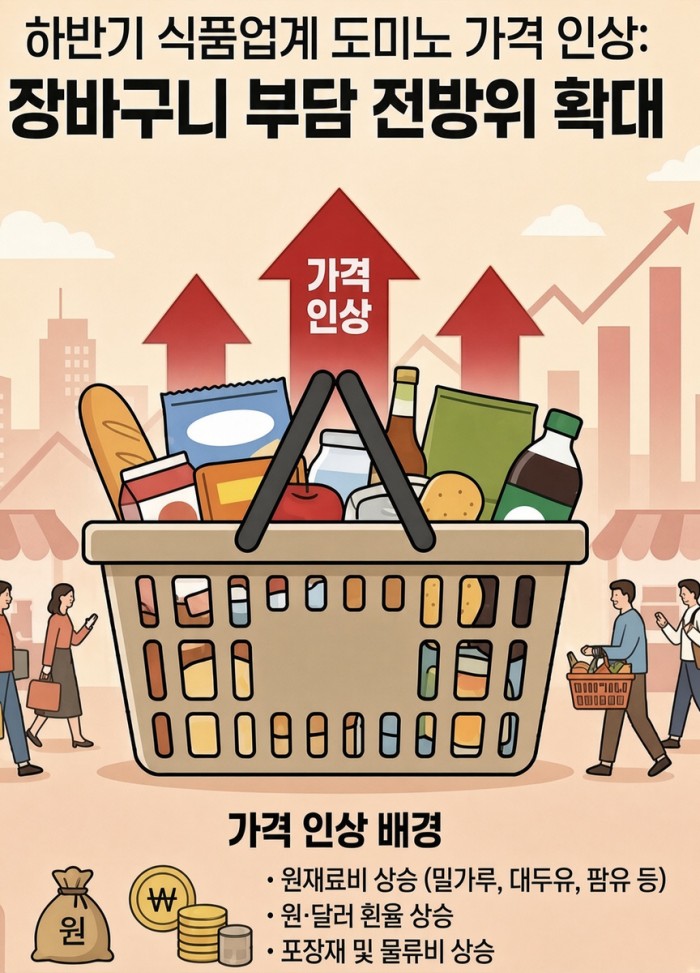
Food companies that had held off on raising prices during the first half of the year — out of consideration for the government's price stabilization policy and consumer burden — are now updating price tags one after another in the second half. Following processed foods like instant noodles, ready-to-eat rice, dumplings, and canned tuna, bread and donuts are also seeing price adjustments, deepening the strain on household budgets across the board.
Paris Baguette will raise prices on some products starting August 25, its first hike in a year and a half, since February of last year. A total of 127 items are affected — 86 types of bread and 41 types of cakes and desserts — with an average increase of 5%.
Among key items, the signature fresh bread will rise from 3,900 won to 4,100 won (up 5.1%), castella cake from 2,400 won to 2,500 won (up 4.2%), and the "My Number One" cake from 35,000 won to 36,000 won (up 2.9%).
A Paris Baguette official said, "The price adjustment was unavoidable due to rising raw material costs and various other expenses."
Other food companies have already raised prices in succession. Since the 13th, Pulmuone has raised consumer prices by an average of 6.7% across 30 items in 7 categories sold at major retail channels, including large discount stores. Basic staple foods like tofu, seasoned vegetables, and somyeon noodles were excluded from the increase, but prices rose for home snacks, frozen foods, and meal kits.
Nongshim raised factory-gate prices by an average of 5.8% across 43 brands, including cup noodles, snacks, and beverages, starting the 1st of this month. Cup noodles rose an average of 6%, snacks 5.5%, and beverages 7.7%. Products affected include Yukgaejang Bowl Noodles, Shin Ramyun Cup, Saeukkang, and Kkul Kkwabaegi.
CJ CheilJedang adjusted prices by an average of 8% across 27 items, including Hetbahn (ready-to-eat rice), dumplings, and grilled fish products, starting the 30th of last month. Hetbahn rose 12%, grilled fish 8.4%, and dumplings 4.6%. Ottogi also raised factory-gate prices by up to 17% across 29 items, including curry, glass noodles, ketchup, and pepper, starting the 16th of last month.
The bakery and dining-out industries have also seen price increases. Tous les Jours raised suggested retail prices by an average of 8.2% across 76 items, including bread and cakes, starting the 31st of last month. Dunkin' also raised prices on 39 types of donuts by an average of 6.5% starting the 2nd of this month.
Behind these price adjustments lies a prolonged buildup of cost pressure. Since food companies rely heavily on imported raw materials, the rising won-dollar exchange rate has driven up procurement costs for ingredients like flour, soybean oil, and palm oil, compounded by rising costs for packaging and logistics.
Industry sources say companies had until now been absorbing these cost increases internally through productivity improvements, cost-cutting, and adjusting profit margins, but as the cost burden has persisted, further delaying price hikes has become difficult.
Still, not every food company has moved to raise prices. Samyang Foods, Orion, Paldo, Lotte Wellfood, Crown Haitai, Dong-A Otsuka, and Woongjin Food have all said they currently have no plans to raise prices.
A food industry official said, "As long as cost pressures don't ease, it's hard to completely rule out further increases in the second half," adding, "The trend of some companies raising prices while others hold steady, depending on their individual cost structures and profitability, is likely to continue."
Lee Chang-yeon
Most Read
-
1
Celltrion nears additional contract with major U.S..

-
2
Putin proposes trilateral U.S.-China-Russia summit..

-
3
U.S. weighs dropping MOAB, world's most powerful n..

-
4
"Aren't those foreigners on welfare?": M..

-
5
Attention centers on APEC for possible Trump-Xi-Pu..

-
6
Saudi Arabia, Iran hold first diplomatic talks to..

-
7
China tightens grip on boosting domestic demand an..

PEOPLE







-
Address : In-Young Bldg., 34, Uisadang-daero 1-gil, Yeongdeungpo-gu, Seoul
Copyright by ASIATODAY CO., LTD. All rights resereved