



Discussion begins on absolute grading for CSAT, GPA — could university entrance exams return?
Aug 13, 2026, 09:51 am


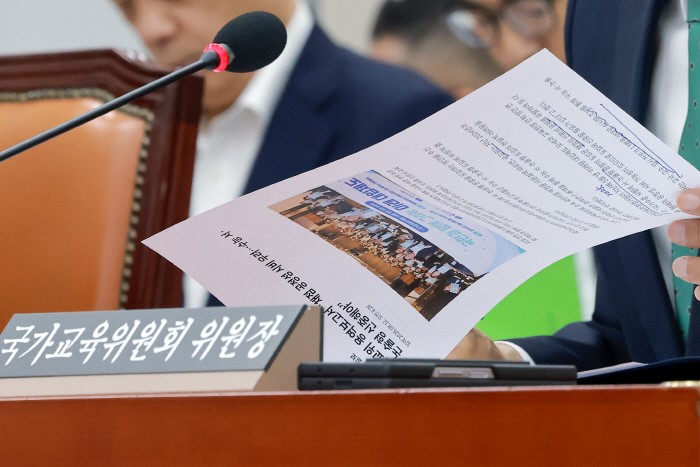 |
| Cha Jung-in, chairman of the National Education Commission, reviews a newspaper article related to the push to introduce essay-type questions on the College Scholastic Ability Test (CSAT) during a plenary session of the National Assembly's Education Committee on the 12th. / Yonhap |
As the National Education Commission begins deliberations on future college admissions reform — including shifting the College Scholastic Ability Test (CSAT) and high school GPA to absolute grading and expanding essay-type assessments — concerns are emerging that the center of gravity in admissions competition could shift toward individual university entrance exams. Critics warn that if the CSAT's ability to differentiate top students weakens, universities may strengthen their own selection tools, such as essay tests and interviews, potentially shifting private tutoring competition into a different form.
According to education circles on the 12th, the National Education Commission began public deliberation on mid- to long-term reform of the college admissions system, starting with an on-site discussion forum titled "Direction for the Future College Admissions System" held in Incheon the previous day. Key agenda items under discussion include converting the CSAT and school GPA to absolute grading, introducing and expanding essay-type assessments, and adjusting the timing of admissions processes.
Currently, both the CSAT and school GPA operate on a relative grading system, serving as the primary tools universities use to differentiate applicants. If a shift to absolute grading results in more top-tier students receiving the same grade, universities would have no choice but to seek new ways to differentiate candidates. This raises the possibility that top-ranked universities, which draw large numbers of applicants, could increasingly rely on other evaluation elements such as school records, essays, and interviews. In that scenario, the differentiation function currently served by the CSAT could shift toward individual university assessments. If university-specific evaluations expand, the burden on students could grow, since they would need to separately prepare for different essay exams and interviews at each school.
How much the CSAT's differentiation function is scaled back would also affect how much university-specific assessments expand. Park Nam-gi, a professor at Gwangju National University of Education, said that if the CSAT itself is reduced to a low-stakes pass/fail test, essentially the old-style university entrance exams would end up making a comeback, adding that universities could conduct sufficiently in-depth essay evaluations if they administer them to a smaller pool of first-round passers.
The problem is that as the tools for differentiation shift, competition and demand for private tutoring could shift along with them. Professor Park said that when the admissions system changes, schools struggle to adapt quickly, while private academies adapt faster, driving up private education spending, adding that competition doesn't disappear — it simply moves to the next stage.
Teachers' groups have also pointed out that changing the evaluation method alone is unlikely to ease admissions competition. The Korean Teachers and Education Workers Union said the fundamental problem with Korean education isn't whether grading is relative or absolute, or whether questions are multiple-choice or essay-based, arguing that the biggest driver pushing students and parents into endless competition is the hierarchical ranking of universities and a society centered on academic pedigree.
Concerns have also been raised about the pace of reform. The Korean Federation of Teachers' Associations noted that if the pace of policy implementation outstrips the readiness of schools and universities, it could trigger other side effects, including anxiety among students and parents, confusion in schools, and expanded reliance on private tutoring.
Kim Nam-hyung
Most Read
-
1
Trump demands rates fall below 1% as Fed hikes for..

-
2
Celltrion seeks rheumatoid arthritis indication ex..

-
3
Chinese e-commerce giants AliExpress, Temu and She..

-
4
Trump warns countries not helping U.S. must pay re..

-
5
Turkish Airlines named main club partner of Liverp..

-
6
China expels No. 2 military official Zhang Youxia..

-
7
Houthi rebels release video claiming downing of Sa..

PEOPLE







-
Address : In-Young Bldg., 34, Uisadang-daero 1-gil, Yeongdeungpo-gu, Seoul
Copyright by ASIATODAY CO., LTD. All rights resereved