



Child population drops by 2.27M over decade while disabled children rise by 20K
Aug 13, 2026, 09:23 am


 |
| / Korea Disability Policy Development Institute |
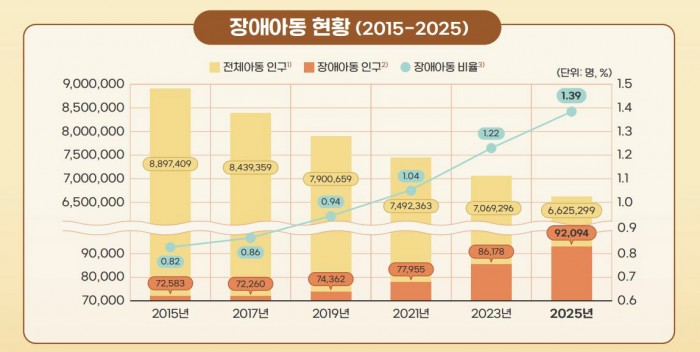
Over the past decade, South Korea's total child population shrank by more than 2.27 million, whereas the number of children with disabilities rose by nearly 20,000. Despite the decline in the school-age population, students requiring special education increased by over 20,000 in four years.
According to the "Children with Disabilities Through Statistics" report released by the Korea Disability Policy Development Institute on August 12, the total child population dropped by 2,272,110 over the past ten years, falling from 8,897,409 in 2015 to 6,625,299 last year. In contrast, children with disabilities increased by 19,511 from 72,583 to 92,094 over the same period. The proportion of children with disabilities relative to the total child population also rose by 0.57 percentage points from 0.82% to 1.39%.
As of last year, disability types among children were intellectual disability at 42.6%, autism spectrum disorder at 34.0%, and brain lesion disability at 9.2%. By severity, severe disabilities accounted for 87.9%, while mild-to-moderate disabilities accounted for 12.1%.
By age group, the proportion of infants and toddlers with disabilities relative to the total infant and toddler population rose by 0.15 percentage points from 0.30% in 2015 to 0.45% in 2025. Adolescents with disabilities increased by 20,876 from 64,461 to 85,337 during the same period, with their proportion relative to the total adolescent population rising by 0.62 percentage points from 1.05% to 1.67%.
Educational statistics reflected a similar divergence from broader demographic trends. While the total school-age population decreased from 6,607,497 in 2021 to 5,936,412 in 2025, students eligible for special education grew by 22,581 from 98,154 to 120,735 over the same timeframe. In 2025, placement types for special education students were special classes in regular schools (57.9%), special schools (25.7%), regular classes in regular schools (16.2%), and special education support centers (0.2%).
Regarding school life, 27.5% of children with disabilities reported struggling or somewhat struggling to adapt to daycare, kindergarten, or school. The single greatest difficulty experienced in school life was "understanding lesson content (keeping up with progress)" at 32.6%, followed by lack of understanding or teasing from peers (13.1%), shortage of special education teachers (11.6%), and absence of assigned support personnel for special education students (10.0%).
Lee Kyeong-hye, President of the Korea Disability Policy Development Institute, stated, "As the total child population drops while children with disabilities and special education students increase, it is crucial to establish an environment where children with disabilities receive necessary support in a timely manner as they grow. The institute will strengthen the role of regional support centers for children with disabilities to ensure early detection of developmental delays or high-risk infants and toddlers, linking them with various community organizations for continuous support."
Lee Jeong-yeon
Most Read
-
1
Trump demands rates fall below 1% as Fed hikes for..

-
2
Celltrion seeks rheumatoid arthritis indication ex..

-
3
Chinese e-commerce giants AliExpress, Temu and She..

-
4
Trump warns countries not helping U.S. must pay re..

-
5
Turkish Airlines named main club partner of Liverp..

-
6
China expels No. 2 military official Zhang Youxia..

-
7
Houthi rebels release video claiming downing of Sa..

PEOPLE






-
Address : In-Young Bldg., 34, Uisadang-daero 1-gil, Yeongdeungpo-gu, Seoul
Copyright by ASIATODAY CO., LTD. All rights resereved