



Samsung Bioepis moves early on Keytruda biosimilar, prepares for SC expansion
Aug 12, 2026, 09:56 am


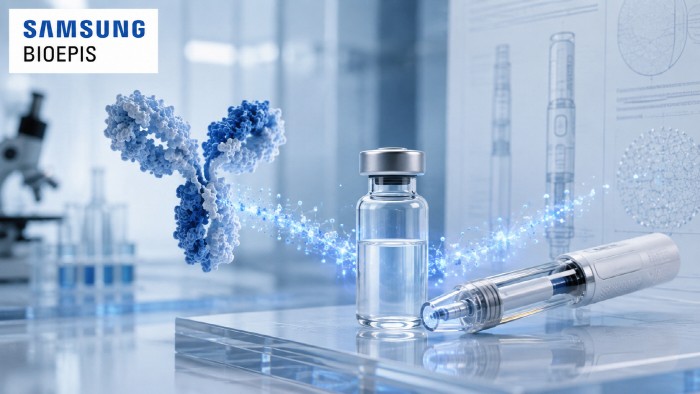 |
Image generated by AI.
Samsung Bioepis is accelerating its push into the market by filing for domestic marketing approval of "SB27," its Keytruda biosimilar candidate. Alongside challenging the patent barrier around MSD's original formulation of Keytruda through a patent trial, the company has also filed technology patents applicable to subcutaneous (SC) formulations — drawing attention to the possibility of future SC formulation expansion for its biosimilar products.
According to the industry on the 11th, Samsung Bioepis filed for marketing approval of its Keytruda biosimilar candidate SB27 with the Ministry of Food and Drug Safety on the 10th. The application covers 16 indications in total, including melanoma, non-small cell lung cancer, and head and neck cancer. The company said it demonstrated equivalence with the original drug through global Phase 1 and Phase 3 clinical trials.
Keytruda was the world's best-selling drug last year, with annual sales reaching 46 trillion won. As its patent expiration approaches, domestic and international companies have entered the race to develop biosimilars, and Samsung Bioepis is seen as having gained a head start by becoming the first Korean company to enter the marketing approval process.
Alongside this, Samsung Bioepis has also filed a series of patents related to production, purification, and formulation technology for hyaluronidase, a key enzyme used when converting high-dose antibody drugs into subcutaneous (SC) formulations. According to the World Intellectual Property Organization (WIPO), the company filed a patent for production and purification technology on the 2nd of last month, followed by a formulation technology patent on the 16th. Industry observers speculate that Samsung Bioepis may be securing this technology in preparation for potential SC formulation development following SB27's marketing approval.
An industry official said that securing proprietary SC formulation technology allows a company to reduce patent-related business risk while applying the technology across a range of products, adding that since Keytruda is the world's best-selling drug with high demand for SC formulations as well, the technology's potential applications could be significant not just domestically but globally.
Samsung Bioepis is securing core technology in preparation for the SC formulation market and reviewing which biosimilars it could apply the technology to. However, applying such technology to SB27 in the future would require clearing Keytruda's patent barriers — since even with marketing approval, the product cannot be launched immediately if patent issues remain unresolved.
To that end, Samsung Bioepis filed a passive request for a trial to confirm the scope of rights against a formulation patent held by U.S.-based MSD on the 6th. This type of trial seeks confirmation that a company's own product does not fall within the scope of another party's patent rights. The move is understood as an argument that the composition of Samsung Bioepis's formulation differs from MSD's patent. Whether this distinction is recognized in the upcoming trial is expected to be a key variable determining the timing of SB27's domestic launch.
A Samsung Bioepis official said the patent trial is aimed at preemptively confirming that its formulation does not infringe on the patent, in preparation for potential future patent litigation risk, adding that this is part of the company's R&D work on SB27.
Kang Hye-won |
Most Read
-
1
Trump shares map on social media labeling Strait o..

-
2
Trump demands rates fall below 1% as Fed hikes for..

-
3
Celltrion seeks rheumatoid arthritis indication ex..

-
4
Chinese e-commerce giants AliExpress, Temu and She..

-
5
Trump warns countries not helping U.S. must pay re..

-
6
China expels No. 2 military official Zhang Youxia..

-
7
Houthi rebels release video claiming downing of Sa..

PEOPLE






HEADLINE NEWS
- N. Korea declares nuclear status irreversible and condemns S. Korea, U.S., Japan at UN
- Japan tracks Ukraine fiber-optic drones, bolsters SDF electronic warfare
- Wave of undocumented Chinese caught in Argentina after Brazil's visa-free m..
- France's far-right National Rally forms first-ever parliamentary group in S..

-
Address : In-Young Bldg., 34, Uisadang-daero 1-gil, Yeongdeungpo-gu, Seoul
Copyright by ASIATODAY CO., LTD. All rights resereved