



700 local Korean teachers to be trained this year as Korean spreads worldwide
Aug 12, 2026, 09:30 am


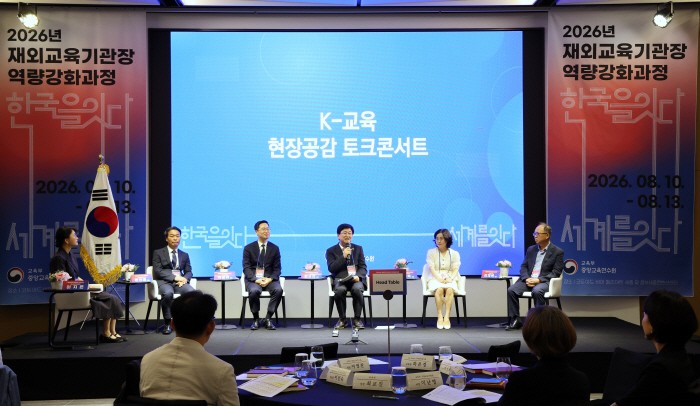 |
| Education Minister Choi Kyo-jin (third from left) speaks at a talk concert held during the "2026 Capacity-Building Training for Heads of Korean Educational Institutions Abroad," at the Courtyard by Marriott in Sejong on the 10th. / Ministry of Education |
As Korean language education expands rapidly at schools abroad, the government is stepping up efforts to train local teachers who can teach Korean overseas. Alongside dispatching Korean teachers, the Ministry of Education is broadening the foundation for securing self-sustaining local teaching staff — with about 700 local Korean-language teachers expected to be trained abroad this year.
According to the Ministry of Education on the 11th, in the early days of Korean-language education abroad, the government directly dispatched Korean teachers to countries lacking specialized instructors to support classes. But as demand for Korean continues to grow, officials have judged that dispatch alone has its limits, and are now also pursuing local teacher training in parallel. A ministry official said, "We can't keep dispatching teachers indefinitely," adding, "For Korean-language education to keep expanding, there need to be teachers on the ground who can teach it."
In Thailand, for example, local teachers already far outnumber those dispatched from Korea. Currently, about 47 Korean-language teachers dispatched to Thailand receive support from the Korean government, while more than 300 Thai teachers, trained locally, are active in the field. Local teachers are paid directly by Thai schools, while the cost of dispatched teachers is split evenly between the Korean government and the Thai schools.
The Ministry of Education is supporting teacher training and professional development programs to help build this kind of local teaching workforce. Last year, it ran 17 teacher training programs across 15 countries and dispatched 77 Korean-language teachers to 14 countries. As Korean-language education continues to expand, government-dispatched teachers alone won't be enough to meet demand, so the ministry aims to broaden the educational foundation by cultivating local teachers alongside dispatched ones.
This challenge was also a major topic at the "2026 Capacity-Building Training for Heads of Korean Educational Institutions Abroad," a four-day program the Ministry of Education is running starting on the 10th. Sixty-six heads of Korean educational institutions abroad — including principals of Korean schools and directors of Korean education centers worldwide — shared case studies and challenges around establishing Korean-language education locally, training teachers, and building sustainable pathways to study and employment abroad.
Efforts to secure local teachers are also underway in India. The Korean Education Center in India launched a Korean-language teacher training program in March, with 19 of 20 participants completing the course. They are set to begin teaching Korean at local schools from the second half of this year through the first half of next year.
Local education authorities are also increasingly hiring Korean-language teachers directly. In Paraguay, one locally trained Korean-language teacher was appointed as a regular instructor at the Ministry of Defense's language institute. In Brazil, the "Brazil-Korea Intercultural School," set to open in 2027, is pursuing a model in which the state government directly hires and pays Korean-language teachers.
The spread of Korean-language education is also being linked to study-abroad and employment pathways. Of the 47 Korean education centers currently operating, the Ministry of Education has designated 11 as international student recruitment hubs, holding study-abroad fairs with local universities and strengthening job-placement functions. The Korean Education Center in Thailand is also developing a model connecting domestic universities, local governments, and regional companies to help local talent who have learned Korean move on to study or work in Korea.
With the number of countries offering Korean-language classes set to rise from 47 to 51 this year amid growing overseas demand, the Ministry of Education plans to strengthen the sustainable foundation for Korean-language education by combining teacher dispatch with local teacher training, while also expanding links to study-abroad and employment opportunities.
Kim Nam-hyung
Most Read
-
1
Trump demands rates fall below 1% as Fed hikes for..

-
2
Celltrion seeks rheumatoid arthritis indication ex..

-
3
Chinese e-commerce giants AliExpress, Temu and She..

-
4
Trump warns countries not helping U.S. must pay re..

-
5
Turkish Airlines named main club partner of Liverp..

-
6
China expels No. 2 military official Zhang Youxia..

-
7
Houthi rebels release video claiming downing of Sa..

PEOPLE







-
Address : In-Young Bldg., 34, Uisadang-daero 1-gil, Yeongdeungpo-gu, Seoul
Copyright by ASIATODAY CO., LTD. All rights resereved