



AI adoption, preference for experienced hires drive youth jobs down
Aug 11, 2026, 09:30 am


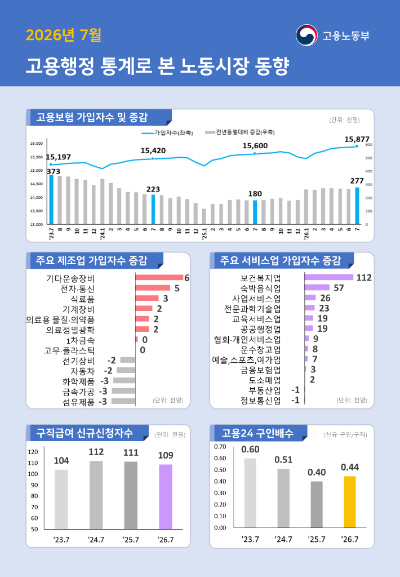 |
| Employment insurance enrollment, jobseeker benefits, and job openings/applications as of end-July 2026 / Ministry of Employment and Labor |
Amid economic slowdown, companies' preference for experienced hires, and the adoption of AI and robotics, Korea's youth employment crisis has deepened, with the number of manufacturing sector employment insurance subscribers declining for 14 consecutive months. The government attributed about 60% of the decline in youth subscribers to population decline and the remaining 40% to a genuine decrease in employment.
According to the Ministry of Employment and Labor's "July 2026 Labor Market Trends Based on Employment Administration Statistics," released on the 10th, the number of regular employment insurance subscribers stood at 15.877 million last month, up 277,000, or 1.8%, from the same month last year. The increase in subscribers has held in the high 200,000s range for seven straight months, at 270,000 in March, 271,000 in April, 270,000 in May, 266,000 in June, and 277,000 in July.
By age group, subscribers rose by 85,000 among those in their 30s, 4,000 among those in their 40s, 37,000 among those in their 50s, and 209,000 among those 60 and older. Notably, the 40s age group turned positive for the first time in 33 months, driven partly by increased labor force participation among women. In contrast, subscribers aged 29 and under fell by 57,000 from the previous year, marking 47 consecutive months of decline since September 2022.
The overall increase in subscribers was led by the services sector, which added 285,000 subscribers compared with the same month last year. Health and welfare services saw a particularly large increase of 112,000, with growth also continuing across most other sectors, including accommodation and food service, business services, and professional, scientific, and technical services.
Manufacturing sector subscribers fell by 3,000 from the same month last year, marking 14 straight months of decline. Employment increased in export-driven sectors such as semiconductors and shipbuilding, while sectors like automobiles, chemicals, and textiles saw declines, highlighting clear polarization across industries.
Textile products have continued declining since September 2021, and metal processing has fallen for 19 consecutive months. The automobile manufacturing sector turned negative starting in March and has seen its decline widen since. Chemical products also remained weak, driven mainly by basic chemicals and synthetic rubber and plastic materials.
New job openings posted through the Korea Employment Information Service's job portal rose by 13,000 from the previous year to 177,000, while new job applications fell by 11,000 to 399,000. The number of people receiving jobseeker benefits stood at 643,000, down from the previous year, with total benefit payments falling by 21.8 billion won to 1.0904 trillion won. The job openings-to-applicants ratio stood at 0.44, up from the same month last year.
Cho Won-sik, head of the Ministry of Employment and Labor's Future Employment Analysis Division, said at a briefing that the ministry estimates roughly 60% of the decline in employment insurance subscribers aged 29 and under is attributable to population decline, with the remaining 40% reflecting an actual decrease in employment. He projected that youth employment is unlikely to recover easily, given the combined effects of the economic downturn, job mismatches, hiring practices favoring experienced candidates, the adoption of AI and robotics, and layoffs of new hires and fixed-term workers.
Kim Bo-young
Most Read
-
1
Trump demands rates fall below 1% as Fed hikes for..

-
2
Celltrion seeks rheumatoid arthritis indication ex..

-
3
Chinese e-commerce giants AliExpress, Temu and She..

-
4
Trump warns countries not helping U.S. must pay re..

-
5
Turkish Airlines named main club partner of Liverp..

-
6
China expels No. 2 military official Zhang Youxia..

-
7
Houthi rebels release video claiming downing of Sa..

PEOPLE






-
Address : In-Young Bldg., 34, Uisadang-daero 1-gil, Yeongdeungpo-gu, Seoul
Copyright by ASIATODAY CO., LTD. All rights resereved