



Lee vows "blitzkrieg" pace for Honam chip cluster, mega special zone law by year-end
Aug 11, 2026, 09:02 am


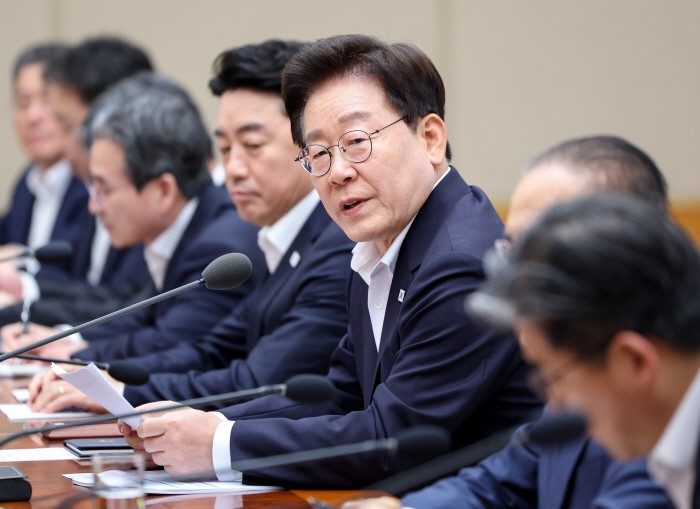 |
| President Lee Jae-myung speaks at the second joint public-private review meeting on mega-projects, held at the presidential office on the 10th. / Yonhap |
The government has decided to relocate the functions of the Gwangju military airfield — the designated site for the Honam semiconductor cluster — by 2028. It also plans to enact a "Mega Special Zone Act" this year to shorten administrative procedures for industrial complexes, and to begin supplying power to the Honam cluster from late 2028. The moves reflect an all-out push to get the cluster operational within President Lee Jae-myung's term.
Presidential Chief of Staff Kang Hoon-sik announced the results of the second joint public-private review meeting on mega-projects at the press briefing room on the 10th, saying the government plans to push for enactment of the Mega Special Zone Act this year to shorten various permitting and environmental impact assessment procedures, and to quickly establish infrastructure such as power, water, and transportation, as well as living conditions like housing and education.
At the meeting, President Lee said the situation calls not just for speed but for a "blitzkrieg," instructing officials to simultaneously pursue procedures related to relocating the Gwangju military airfield and supplying power and water.
For the site planned for an ammunition depot within the Gwangju military airfield, the government decided to proactively clear the site so that fab construction can begin as soon as possible. It also plans to quickly survey corporate demand and designate additional nearby candidate sites.
Regarding issues involving U.S. facilities at the Gwangju military airfield, a senior presidential official said the government would coordinate closely with the U.S., adding that Washington has so far responded positively.
Asked whether the Mega Special Zone Act would include provisions such as easing the 52-hour workweek limit, the official said this is not something the presidential office can unilaterally decide, and that it remains under deliberation.
The official explained that the success of the mega-projects is not seen as directly tied to the 52-hour workweek issue, and that such a change would only be possible with agreement reached through discussion between the relevant region and labor groups.
The government plans to establish a dedicated mega-project task force at the presidential office to support inter-ministerial cooperation, along with a "Mega-Project Cross-Government Support Council" under the Prime Minister's Office, and will inject 11 trillion won in government funding to support cooperation between large corporations and SMEs.
Of that, 1 trillion won will go over 10 years toward a "Grow Together Project," in which large and small companies collaborate from semiconductor technology development through pilot production and mass production. An additional 5 trillion won in cooperative trade financing will be supplied to ease funding difficulties for exporters and materials/parts/equipment (so-called "sobujang") companies. A new 5 trillion won fund will also be created for concentrated investment in promising semiconductor materials/parts/equipment companies and fabless firms.
Detailed plans for power and water supply were also presented.
Chief of Staff Kang said the Honam region will quickly build a first-phase transmission line to begin supplying power from late 2028, and will also expand regional generation capacity — including renewable energy, energy storage systems, and combined-heat-and-power LNG plants — to ensure stable supply. He added that the roughly 650,000 tons of daily water needed by 2030 will be secured and supplied without disruption using recycled wastewater and nearby dams including Dongbok, Juam, and Naju.
For the Yongin semiconductor cluster, the government plans to reliably supply the final power demand of 14.7 GW by 2041 using a combined-heat-and-power LNG plant within the industrial complex along with power from the central, east coast, and Honam regions, while also swiftly pursuing an integrated water supply project to meet companies' early completion schedules.
The Ministry of Trade, Industry and Energy announced at the meeting that it would purchase more than 1,000 robots by 2030 to help create an initial market for physical AI. President Lee reportedly called this "insufficient" and instructed officials to significantly expand the scale of government procurement.
Investments that companies announced at the Chungcheong and Yeongnam regional briefing sessions in July are also set to move into full swing starting this year. Of the roughly 392 trillion won in Chungcheong-region investment pledged by eight companies including Samsung Electronics and SK Hynix, projects worth about 246 trillion won will break ground or begin facility expansion this year. In the Yeongnam region, of the 312 trillion won in investment plans from 12 companies, projects worth about 107 trillion won are set to move forward within the year.
Chief of Staff Kang explained that at the Chungcheong regional briefing in early July, eight companies announced a combined 392 trillion won in investment plans, of which six companies — SK Hynix, Samsung Electronics, Samsung Electro-Mechanics, Samsung Display, Samsung SDI, and Naver — will begin construction or facility expansion on projects worth 246 trillion won this year.
He added that at the Yeongnam regional briefing, 12 companies announced a combined 312 trillion won in investment plans, of which eight companies — SK, Samsung Electronics, Samsung SDS, LG Innotek, LG Display, Hanwha, Hyundai Motor, and Doosan — will begin construction or expansion on projects worth 107 trillion won this year.
A senior presidential official said Samsung Electronics President Kim Yong-kwan and SK President Jung Seung-il, who oversees future growth, both attended the meeting and expressed surprise at the pace of the mega-project push, saying they were truly grateful and that their companies would also do their best.
Hong Sun-mi
Most Read
-
1
Trump demands rates fall below 1% as Fed hikes for..

-
2
Celltrion seeks rheumatoid arthritis indication ex..

-
3
Chinese e-commerce giants AliExpress, Temu and She..

-
4
Trump warns countries not helping U.S. must pay re..

-
5
Turkish Airlines named main club partner of Liverp..

-
6
China expels No. 2 military official Zhang Youxia..

-
7
Houthi rebels release video claiming downing of Sa..

PEOPLE






-
Address : In-Young Bldg., 34, Uisadang-daero 1-gil, Yeongdeungpo-gu, Seoul
Copyright by ASIATODAY CO., LTD. All rights resereved