



Extreme heat persists on Beginning of Autumn, Seoul highs expected to hit 39C
Aug 07, 2026, 10:42 am


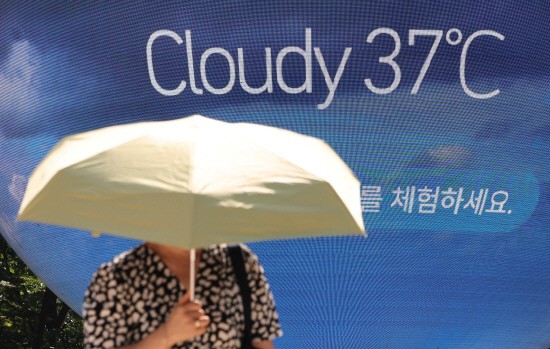 |
| The current temperature is displayed on a structure in Songpa-gu, Seoul on the 6th, as a heatwave advisory was in effect. / Yonhap |
Extreme heat is expected to continue on the 7th, which marks Beginning of Autumn (Ipchu) on the traditional lunar calendar.
The entire country will remain under the influence of the North Pacific high, bringing clear and hot weather. Seoul's daytime high is expected to reach 31-39 degrees. Incheon and Gwangju are forecast to hit 38 degrees, Daejeon and Daegu 37 degrees, Busan 35 degrees, and Ulsan 34 degrees. North Chungcheong and North Jeolla provinces are also forecast to reach highs of 37 and 39 degrees, respectively.
In the afternoon, ozone levels are expected to be "very poor" in Seoul, Incheon, and southern Gyeonggi Province, and "poor" in northern Gyeonggi, South Chungcheong, and North Jeolla.
Starting that day, strong gusts of around 55 km/h are expected in some areas of Busan and the South Gyeongsang coast. Clouds will increase over Busan and the South Gyeongsang coast from that night, and showers are expected in some inland areas of northwestern South Gyeongsang Province in the afternoon of the 8th.
Tropical nights continue alongside the heatwave. High-pressure systems currently sit firmly entrenched in both the lower and upper atmosphere over the Korean Peninsula, preventing heat that builds up during the day from dissipating easily. Amid this, a power outage in one area forced residents to evacuate overnight after losing access to air conditioning. Around 8:12 p.m. the previous day, a power outage struck an apartment complex in Euncheon-dong, Gwanak-gu, Seoul, prompting 93 residents to take shelter at a nearby community center, elementary school, and senior center. The same evening at 8 p.m., a power outage at an apartment complex in Seokhyeon-dong, Suncheon, South Jeolla Province, left 510 households without air conditioning for about 2.5 hours during restoration work.
Starting this weekend, an influx of clouds is expected to reduce solar radiation, potentially bringing rain and a temporary lull in the heat. However, the Korea Meteorological Administration noted that the North Pacific high and the Tibetan high typically peak from mid- to late August, and while temperatures may briefly ease, it cannot rule out the possibility that intense heat will return once the two high-pressure systems reestablish themselves as East Asia's atmospheric pattern readjusts. It added that while some warning levels could be downgraded slightly, with temperatures dropping by 2-3 degrees, heat at the level of a heatwave advisory is expected to continue, with temperatures around 35 degrees likely to persist for the next 10 days or so, mainly in the greater Seoul area, and conditions beyond that remain difficult to predict.
Kim Hong-chan
Most Read
-
1
Celltrion’s Omlyclo gains ground in major European..

-
2
Trump demands rates fall below 1% as Fed hikes for..

-
3
Trump makes $1 trillion bet ahead of midterm elect..

-
4
Iran resumes ballistic missile production, assembl..

-
5
Samsung Electronics, Mistral AI to jointly develop..

-
6
Trump warns countries not helping U.S. must pay re..

-
7
Seoul faces triple squeeze over troop deployment t..

PEOPLE






-
Address : In-Young Bldg., 34, Uisadang-daero 1-gil, Yeongdeungpo-gu, Seoul
Copyright by ASIATODAY CO., LTD. All rights resereved