



AI clinical support for public health centers, hospitals to fill gaps in regional care
Aug 07, 2026, 09:28 am


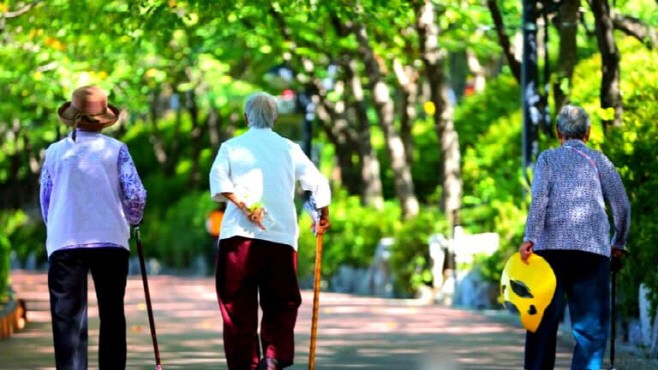 |
| Elderly people take a walk in a park. / Yonhap |
The government plans to build an AI-based clinical support system spanning public health centers to public hospitals across the country. The plan is to deploy AI to help with image reading, medical record management, and chronic disease management in regions facing medical staff shortages, while also linking emergency patient transport and public hospital care systems.
The Ministry of Health and Welfare confirmed its "AI Essential Healthcare Strategy" at the 12th National Policy Coordination Meeting, chaired by the Prime Minister, on the 6th. The strategy, built around the goal of "AI that protects lives, healthcare innovation everyone can enjoy," consists of three core strategies and 12 tasks.
The government's push into AI adoption comes in response to declining medical staff in underserved areas. Last year, 730 township-level public health branch offices, or 59.5% of the total, had no assigned public health doctor. That figure is projected to rise to 1,083 branches, or 86.9%, by 2027. Going forward, institutions primarily focused on health promotion will offer chronic disease management, prediction of acute deterioration, and disease prediction based on personal health data. The system will analyze health checkup results and lifestyle habits to predict disease risk and recommend necessary screenings. The AI system will be linked with the regional public health information system, and training on its use and error response will be provided to medical staff.
Vouchers will be provided to internal medicine, surgery, obstetrics/gynecology, and pediatric clinics in medically underserved areas to adopt a "primary care AI package." Internal medicine clinics will receive support for interpreting chronic disease tests such as diabetes and hypertension and managing health, while surgery clinics will get X-ray and ultrasound reading support. Obstetrics/gynecology clinics will receive support for fetal ultrasound interpretation, and pediatric clinics will get growth and development management support linked to infant and toddler checkups. In islands, mountainous areas, and remote regions, AI-based non-face-to-face home care consultations will also be piloted — where visiting nurses use mobile medical devices to measure patient data, which is then analyzed by AI, and if abnormalities are detected, patients are connected remotely with a doctor for consultation.
AI will also be used for emergency patient transport. In the second half of this year, an "Integrated Emergency AI Platform" — which analyzes patient condition and each hospital's treatment capacity in real time to recommend the most appropriate hospital — will be piloted in Daegu, with plans to expand it to North Gyeongsang Province in the second half of 2027.
The ministry will also replace aging computer systems at regional public medical centers with cloud-based hospital information systems, laying the data foundation for AI use. Building on this, starting in 2027, the government plans to begin developing "Korean-style medical AI" using domestic clinical data and proprietary AI technology. Safeguards will also be established to prevent AI misdiagnosis, hallucination, and personal data leaks.
Health and Welfare Minister Jeong Eun-kyeong said, "AI is a tool that fills gaps in regional, essential, and public healthcare and protects people's lives," adding, "We will implement this strategy without disruption so that everyone, everywhere in the country, can experience the benefits of AI-driven healthcare innovation."
Lee Se-mi
Most Read
-
1
Trump demands rates fall below 1% as Fed hikes for..

-
2
Celltrion seeks rheumatoid arthritis indication ex..

-
3
Chinese e-commerce giants AliExpress, Temu and She..

-
4
Trump warns countries not helping U.S. must pay re..

-
5
Turkish Airlines named main club partner of Liverp..

-
6
China expels No. 2 military official Zhang Youxia..

-
7
Houthi rebels release video claiming downing of Sa..

PEOPLE






-
Address : In-Young Bldg., 34, Uisadang-daero 1-gil, Yeongdeungpo-gu, Seoul
Copyright by ASIATODAY CO., LTD. All rights resereved