



U.S. Marines conduct first FPV drone live-fire in Korea
Aug 07, 2026, 09:06 am


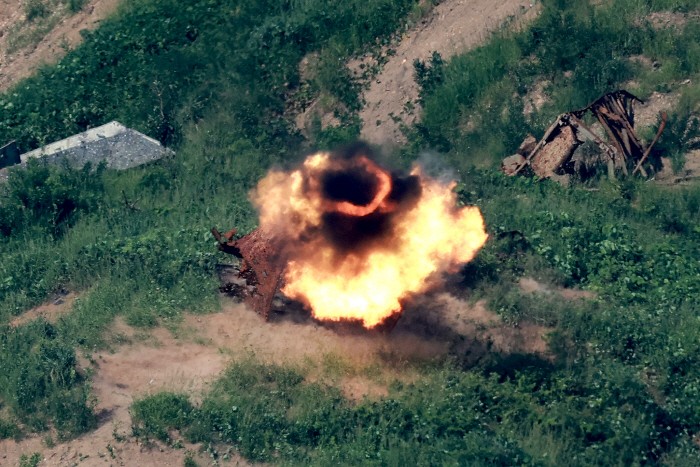 |
| U.S. Marines pilot a Neros Archer drone armed with explosives to strike a target during a first-person view (FPV) attack drone live-fire training exercise at Rodriguez Range in Pocheon, Gyeonggi Province, on the 5th. / Photo: Defense Daily |
At Rodriguez Range in Yeongpyeong-ri, Yeongjung-myeon, Pocheon, Gyeonggi Province, where the high temperature topped 37 degrees on the 5th, a low voice on the radio said "Splash," and a red flash shot up from a target 2.5 km away from the command post. About three seconds later, a loud blast shook the range.
That day, the U.S. Marine Corps opened a first-person view (FPV) attack drone live-fire exercise to domestic media as part of the Korea Marine Exercise Program (KMEP), a joint Korea-U.S. Marine Corps training exercise. This marks the first time the U.S. military has publicly disclosed FPV drone live-fire training in Korea.
Service members from the 3rd Battalion, 7th Marine Regiment — deployed under the 4th Marine Regiment, 3rd Marine Division — took part in the exercise. Eleven Neros Archer drones were used, and all six that carried out live fire successfully struck their targets.
At the observation post, the strike process could be viewed in real time through the camera mounted on the FPV drone. The footage vividly captured the drone flying rapidly across the vast Rodriguez Range toward its target. Just seconds after a barracks-shaped target came into view on screen, the feed cut to black, followed immediately by the sound of an explosion confirming a direct hit.
The Neros Archer has an effective range of about 20 km and a maximum range of around 25 km. It can fly at speeds up to 130 km/h and carry up to 3 kg of explosives. Depending on the mission, it can be fitted with anti-tank, anti-material, or anti-personnel warheads; its anti-tank warhead is reportedly capable of penetrating roughly 100mm of rolled homogeneous armor equivalent.
The drone has also received "Blue UAS" certification from the U.S. Department of Defense. Manufacturer Neros said it does not use Chinese-made components in key parts, instead building its supply chain around the U.S. and its allies — with motors reportedly sourced from Taiwan and the magnets inside the motors from Japan.
Col. Peter Ankney, deputy commander of U.S. Marine Forces Korea, said, "At the heart of all this is combined readiness," adding, "The fact that the U.S. Marine Corps can demonstrate these capabilities on the very terrain of the Korean Peninsula where we could actually be deployed in the future is itself a major opportunity." He added that the exercise is part of an ongoing process of building mutual understanding on how to operate alongside South Korean forces and establishing new standard operating procedures.
The drone is reportedly used mainly by the U.S. Army and U.S. Marine Corps units stationed in Japan, but has not yet been deployed to U.S. Forces Korea.
U.S. Marine Staff Sgt. Eric Miranda said, "Just as the Korean military shares new capabilities with us when they acquire them, we will naturally share any new capabilities we develop with the Korean military as well."
The Neros Archer drone used in this exercise has also seen combat use on the battlefield in Ukraine, with about 6,000 units reportedly delivered to date.
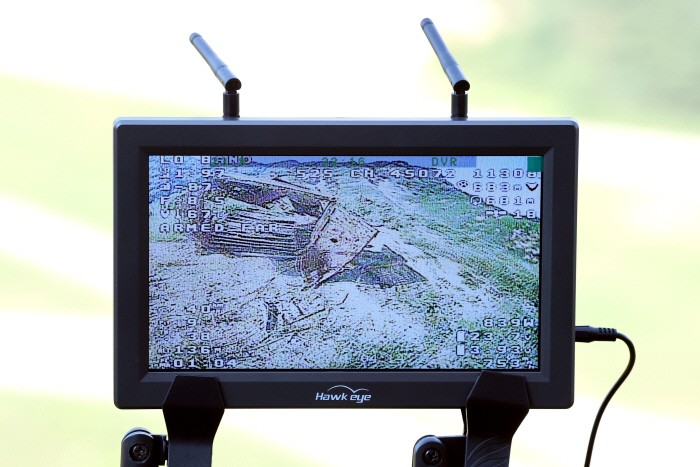 |
| U.S. Marines pilot a Neros Archer drone armed with explosives toward its target during a first-person view (FPV) attack drone live-fire training exercise at Rodriguez Range in Pocheon, Gyeonggi Province, on the 5th. The photo shows footage transmitted live from the drone. / Courtesy of Defense Daily |
Lee Han-sol
Most Read
-
1
Celltrion’s Omlyclo gains ground in major European..

-
2
Trump demands rates fall below 1% as Fed hikes for..

-
3
Trump makes $1 trillion bet ahead of midterm elect..

-
4
Iran resumes ballistic missile production, assembl..

-
5
Trump warns countries not helping U.S. must pay re..

-
6
Apple launches first foldable, 1 million won prici..

-
7
Turkish Airlines named main club partner of Liverp..

PEOPLE







-
Address : In-Young Bldg., 34, Uisadang-daero 1-gil, Yeongdeungpo-gu, Seoul
Copyright by ASIATODAY CO., LTD. All rights resereved