



AI to auto-apply for pregnancy, childbirth benefits
Aug 06, 2026, 09:51 am


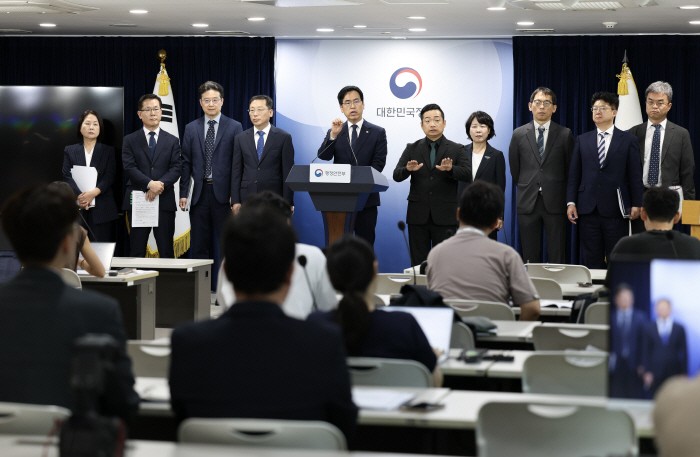 |
| Vice Minister of the Interior and Safety Kim Min-jae answers questions from reporters during a pre-briefing on the Ministry of the Interior and Safety's policy report, held at the briefing room of the Government Complex Seoul in Jongno-gu, Seoul on the 5th. / Ministry of the Interior and Safety |
The government plans to pilot a service this year where AI automatically applies for benefits — such as pregnancy and childbirth support — on people's behalf once eligibility is confirmed, without requiring a separate application. The scale of local currency vouchers will be expanded to around 31 trillion won by 2030, and the government will also pursue fiscal decentralization, adjusting the ratio of national to local tax revenue to 7:3.
The Ministry of the Interior and Safety (MOIS) announced these key initiatives for the second half of the year in a government policy briefing on the 5th.
MOIS plans to launch a pilot "Automatic Benefit Application Service" this year, going beyond simply informing citizens of benefits they're eligible for to having AI apply on their behalf. The plan under consideration is to start with pregnancy- and childbirth-related benefits, where eligibility can be confirmed through existing administrative records.
The ministry will introduce a "one-stop complex civil affairs service" to handle complicated administrative requests in one place, and will strengthen dedicated organizations and staffing at local governments. It will also expand document issuance services through the AI Government Assistant, linked with the Naver and Kakao apps. The intelligent work management platform will expand to 47 central government agencies, and the ministry plans to train 20,000 AI experts in the public sector by 2030.
The scale of local currency vouchers will expand from 24 trillion won this year to 31.2 trillion won by 2030. The ministry is also exploring converting unused credit card and other points into local currency vouchers.
The current 74.7:25.3 ratio of national to local tax revenue will be adjusted toward a target of 7:3. MOIS plans to develop detailed measures through a cross-government fiscal decentralization task force.
A "regional preference index" reflecting distance from Seoul, socioeconomic conditions, and risk of regional decline will also be used in budget planning and policy programs across government agencies.
The ministry will ease the criteria for designating special cities outside the greater Seoul area and designate "population vitality plus" regions. It also plans to promote youth work experience programs, youth villages, and the expansion of "sunshine income villages."
In disaster and safety management, the ministry will introduce a service that trains AI on 150,000 pieces of wind and flood damage data to analyze disaster vulnerability and recommend response measures. Early detection of hazardous situations using CCTV and drones will also be strengthened.
Pedestrian paths, including 148 school routes, will be improved, and high-strength bollards will be installed on a trial basis to prevent vehicle-ramming accidents. The number of water safety personnel will expand to 5,831, and free life jacket rental stations will expand to 606 locations.
Other planned measures include a one-stop claim system for local tax refunds, online proxy issuance of certificates for minor children, and mobile ID verification indicators for secondhand transactions.
Vice Minister Kim Min-jae of MOIS said, "We will actively pursue initiatives that can bring about real change in people's lives," adding, "As the central ministry overseeing state administration and disaster safety, we will do our utmost for the safety and happiness of all citizens."
Kim Nam-hyung
Most Read
-
1
Celltrion’s Omlyclo gains ground in major European..

-
2
Trump demands rates fall below 1% as Fed hikes for..

-
3
Hyundai Motor Group breaks ground on integrated st..

-
4
U.S. strikes 3 Iranian oil tankers, Iran vows reta..

-
5
Trump makes $1 trillion bet ahead of midterm elect..

-
6
Iran resumes ballistic missile production, assembl..

-
7
Samsung Electronics, Mistral AI to jointly develop..

PEOPLE






-
Address : In-Young Bldg., 34, Uisadang-daero 1-gil, Yeongdeungpo-gu, Seoul
Copyright by ASIATODAY CO., LTD. All rights resereved