



National Fire Agency builds AI-based 119 system, boosts industrial site safety
Aug 06, 2026, 09:49 am


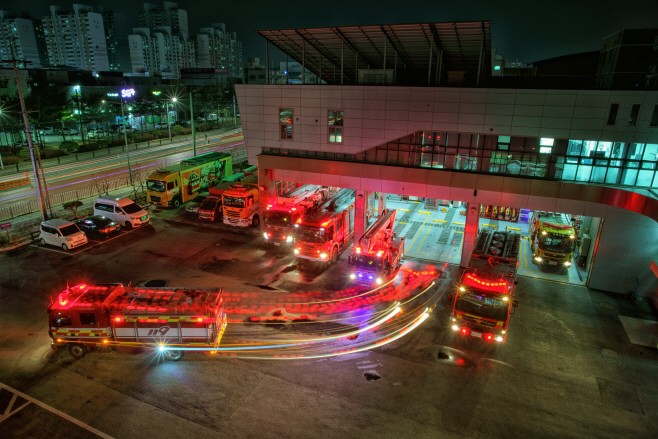 |
| A fire truck responding to a fire scene. / National Fire Agency |
The National Fire Agency, having shortened disaster response times and reduced fire and wildfire damage in the first half of this year, plans to further strengthen response capabilities at industrial sites in the second half through an AI-based next-generation 119 system, advanced equipment such as firefighting robots and drones, a restructured field command system, and improved safety and welfare for firefighters.
At the government's second policy briefing session held at the state guest house of the presidential office on the afternoon of the 5th, the National Fire Agency reviewed its key achievements from the first half of the year and outlined plans for the second half to further protect the public's lives and safety, including strengthening disaster-site command capabilities, upgrading the 119 system, introducing advanced equipment, strengthening fire safety management at industrial sites, and improving transport systems for high-risk pregnant patients and severe trauma cases.
For the first half of the year, the agency focused on shortening response times to disaster sites and reducing casualties and property damage from fires and wildfires. It also expanded safety infrastructure the public can directly feel, including the formal opening of the National Fire Service Hospital, which provides specialized health management for firefighters and essential medical care for local residents.
Focused efforts to secure the "golden time" at disaster sites in the first half raised the rate of arriving at fire scenes within seven minutes from 68.3% last year to 70.3% this year. The installation rate of fire truck priority signal systems rose from 44.9% to 47%, and the installation rate of the "119 Pass" system rose from 20% to 40%.
The integrated national firefighting helicopter dispatch system, implemented since March, has also shown results. Under the system, the average helicopter arrival time at wildfire sites fell from 15.1 minutes last spring to 10.3 minutes this year, a reduction of 4.8 minutes. Helicopter dispatches for emergency patients such as high-risk pregnant women more than doubled, from 62 cases in the first half of last year to 139 this year.
Fire prevention and safety management for vulnerable groups were also strengthened further. Fires occurring from June of last year through May of this year totaled about 37,000, down 5.97% (2,352 cases) from the previous year. Fire deaths fell from 363 to 306, a decrease of 15.7% (57 fewer deaths).
The agency inspected 37,715 fire-vulnerable facilities, including aging apartment buildings, factories, hazardous material facilities, and lodging establishments. It is also distributing standalone fire alarms free of charge to 2.85 million households of fire-vulnerable residents living in older apartments. It has expanded distribution of fire detectors for vulnerable groups and introduced the "119 Fire Evacuation Safe Call" service.
In responding to spring wildfires, the agency built a joint response system with the Korea Forest Service and local governments, reducing wildfire deaths from 32 last year to zero this year, and cutting property damage sharply from 1.1 trillion won to 4.19 billion won.
The June opening of the National Fire Service Hospital in North Chungcheong Innovation City was also cited as a key achievement for the first half. The hospital, a general hospital-level medical institution with 19 clinical departments and 302 beds, plans to expand essential services such as 24-hour emergency medicine and grow into a hub hospital for severe and emergency care.
Choi Yong-cheol, acting head of the National Fire Agency, said, "In the first half of the year, we focused all our capabilities on arriving at disaster sites faster and reducing public harm from fires and wildfires," adding, "Through fire administration that proactively analyzes and prepares for risk factors and vulnerabilities, we will ensure the public can feel tangible improvements in safety in their daily lives."
Kim Bo-young
Most Read
-
1
Celltrion’s Omlyclo gains ground in major European..

-
2
Trump demands rates fall below 1% as Fed hikes for..

-
3
Trump makes $1 trillion bet ahead of midterm elect..

-
4
Iran resumes ballistic missile production, assembl..

-
5
Samsung Electronics, Mistral AI to jointly develop..

-
6
Trump warns countries not helping U.S. must pay re..

-
7
Seoul faces triple squeeze over troop deployment t..

PEOPLE







-
Address : In-Young Bldg., 34, Uisadang-daero 1-gil, Yeongdeungpo-gu, Seoul
Copyright by ASIATODAY CO., LTD. All rights resereved